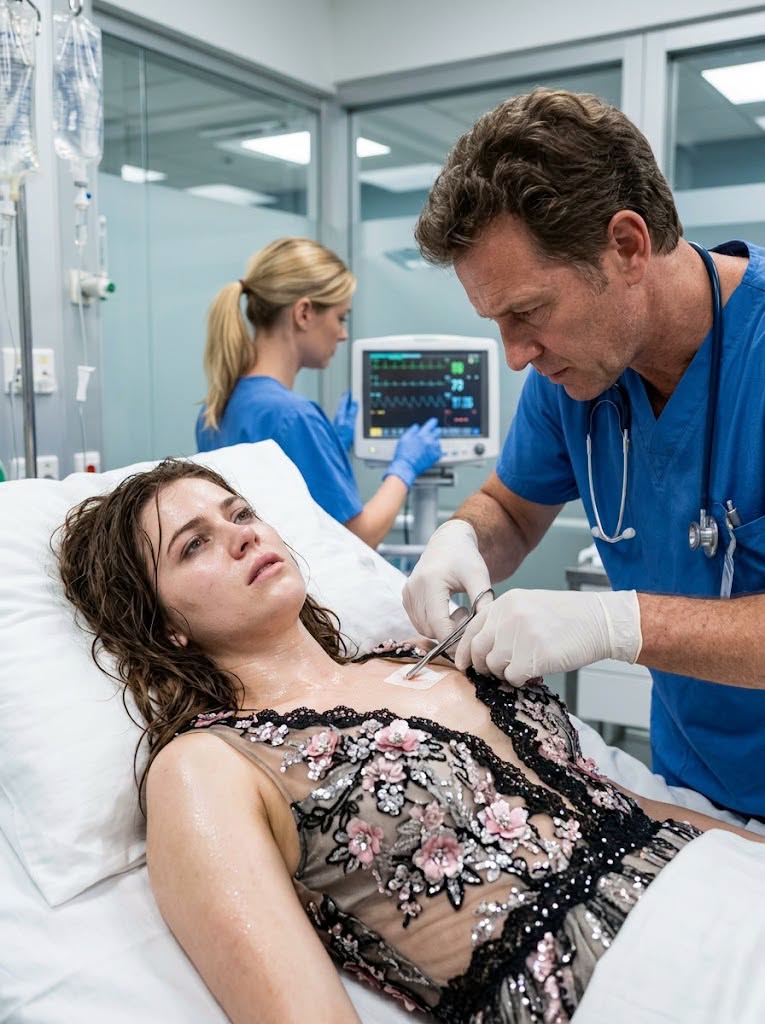
He’d also known her husband, Warren Prescott, for nearly forty years.
Charles pushed those relationships aside and concentrated on keeping her alive.
Medication.
Airway.
Monitoring.
Stabilization.
Then, while examining her, someone on the medical team noticed something beneath her clothing near her upper chest.
A small medicated patch.
That mattered.
Lillian had a documented history of severe drug allergies.
The patch was removed and preserved rather than discarded, and the substance involved was identified for the medical team.
It contained a medication Lillian should never have been exposed to.
Charles stared at it.
Then he thought about Warren.
Warren was a pharmacist.
More importantly, Warren knew his wife’s medical history.
He’d discussed her allergies with Charles before.
Charles didn’t accuse anyone.
Doctors don’t solve crimes by looking at a medical patch.
But an unexplained exposure capable of producing a life-threatening reaction couldn’t simply be ignored.
The hospital documented everything and appropriate authorities were notified.
Lillian was transferred to intensive care.
Several hours later, she was awake enough to answer questions.
Her explanation changed everything.
Warren had given her the patch.
He’d told her it was a harmless supplement intended to help with fatigue and heart palpitations.
She trusted him.
He was her husband.
He was also a pharmacist.
Why wouldn’t she?
Investigators now had a very different question to answer.
Had Warren made a terrible mistake?
Or had he known exactly what he was doing?
The answer couldn’t come from suspicion alone.
Records had to be examined.
Medication inventory.
Prescriptions.
Insurance documents.
Electronic communications.
Financial information.
Over time, the picture became increasingly troubling.
Investigators found evidence that Warren had recently obtained access to the medication involved.
They also discovered a substantial life-insurance policy on Lillian that had been taken out months earlier.
Then there was another woman.
Lillian already knew about her.
She’d suspected Warren had been involved with someone else for nearly two years.
She had stayed because after decades of marriage, walking away wasn’t as simple as outsiders liked to imagine.
“I thought we could fix it,” she told Charles.
Charles didn’t know what to say.
He had spent forty years considering Warren one of his closest friends.
Now investigators were examining whether that same man had deliberately placed his wife in mortal danger.
The case developed slowly.
There was no dramatic hospital sting where Warren was tricked into confessing beside Lillian’s bed.
Instead, detectives interviewed him.
They compared his statements with physical and digital evidence.
His explanations changed.
The records didn’t.
Eventually, prosecutors believed there was sufficient evidence to pursue serious charges related to Lillian’s poisoning and the financial motive surrounding it.
For Charles, the investigation forced another uncomfortable realization.
There had always been something strange about his friendship with Warren.
Especially where Lillian was concerned.
Charles and Lillian had been close as teenagers.
Closer than either had admitted.
Then, around graduation, they suddenly drifted apart.
Charles had been told Lillian wasn’t interested.
Lillian had heard something similar about him.
Warren eventually began dating her.
Life moved forward.
College.
Careers.
Marriage.
Decades passed.
Only after the criminal investigation began did old conversations and memories resurface.
Lillian and Charles compared what each had been told all those years earlier.
Some of it didn’t match.
They could never reconstruct every conversation from their youth with certainty.
But both came to believe Warren’s jealousy had played a role in keeping them apart.
That realization hurt.
Still, Lillian refused to let it turn thirty years of her life into something meaningless.
“I made choices too,” she told Charles. “I married him. I stayed. Those years were still my life.”
Charles respected that.
Then, before the criminal case could fully play out, Warren suffered a serious medical emergency.
Charles happened to be at the hospital when Warren was brought in.
For one brief moment, the situation became brutally simple.
Here was the man accused of trying to kill Lillian.
A man Charles felt had betrayed both of them.
And he needed medical care.
Charles helped.
Not because Warren deserved forgiveness.
Not because friendship had survived.
Because Charles was a physician.
The medical team treated Warren with the same urgency they would have given anyone else.
Despite their efforts, Warren died.
Afterward, someone asked Charles how he could have tried so hard to save him.
His answer was simple.
“I wasn’t going to let what he did decide who I became.”
Lillian understood.
She didn’t mourn Warren as though nothing had happened.
She mourned something more complicated.
The marriage she’d thought she’d had.
The person she’d believed Warren was.
And the years that could never be revisited.
Investigations into the financial and medical circumstances continued even after his death where legally appropriate.
But Lillian eventually stopped organizing her life around discovering one more terrible thing about her husband.
She sold the house they’d shared.
She found somewhere new.
And she began rebuilding.
Charles remained nearby.
Carefully.
He didn’t arrive with flowers and announce that they’d finally gotten their second chance.
Lillian had survived a life-threatening betrayal and lost a marriage of decades.
She needed recovery, not another man deciding what her future should look like.
So they drank coffee.
They walked.
They talked about high school.
Then about everything that had happened afterward.
Sometimes they didn’t talk about Warren at all.
Months passed.
Friendship slowly became something else.
More than a year after Lillian nearly died, she and Charles decided to marry.
The ceremony was small.
No grand ballroom.
No elaborate declarations about destiny correcting a thirty-year mistake.
Just two people who had known each other most of their lives choosing, finally, to build something honest together.
They settled near Lake Minnetonka.
Charles continued working limited hospital shifts.
Lillian planted a garden.
Their life became remarkably ordinary.
That was exactly what she wanted.
One evening, they sat outside watching the light disappear across the water.
Lillian asked Charles whether he ever thought about how differently everything might have happened if they’d understood the truth when they were young.
“Sometimes,” he admitted.
“And?”
Charles took her hand.
“We can’t live the life we would’ve had.”
Lillian nodded.
They’d both learned that the hard way.
There was no recovering thirty lost years.
No investigation could return them.
No late romance could erase betrayal.
But the past didn’t have to own whatever time remained.
Charles had once believed saving a life meant keeping someone’s heart beating.
Lillian taught him something more complicated.
Sometimes surviving is only the beginning.
After that, you still have to decide what kind of life you’re going to build with the time you were given back.