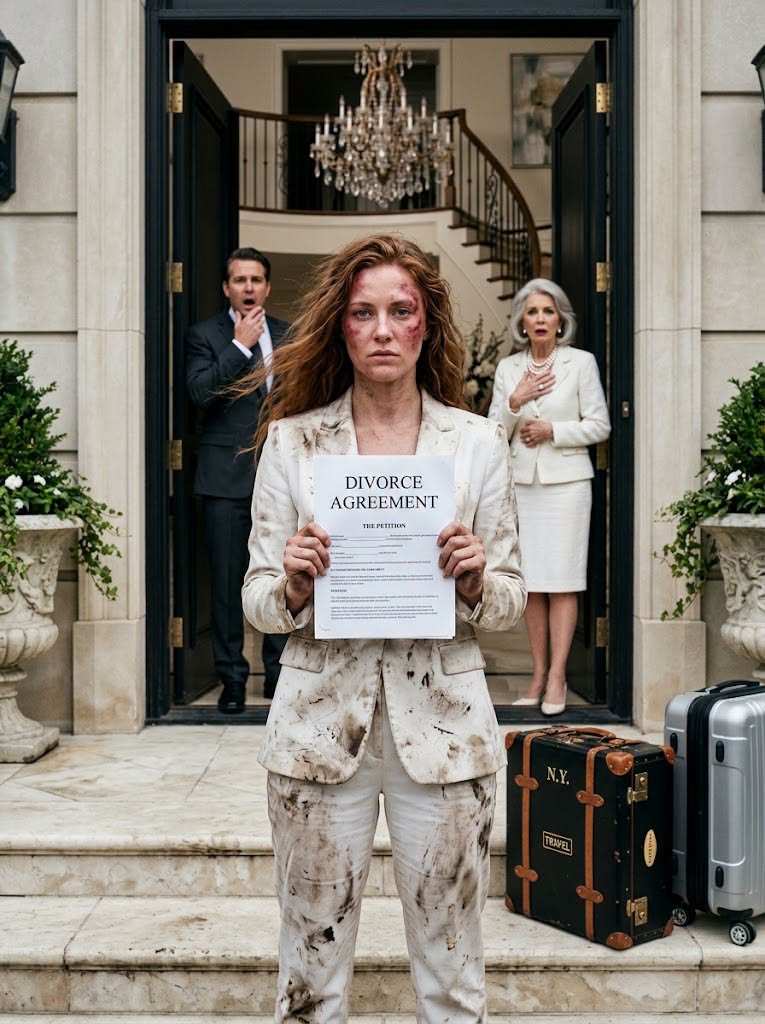
And Christopher was standing across from me with his mother, Beatrice, demanding thousands of dollars.
“I need you to authorize the transfer.”
“No.”
His expression changed.
What Christopher didn’t know was that I’d spent most of the previous night going through our finances.
Forty thousand dollars was missing from an account we’d maintained for emergencies.
Not invested.
Not transferred between our legitimate accounts.
Gone.
I’d already begun tracing where the money had gone.
But my board meeting was starting.
“We’re discussing this afterward.”
Beatrice folded her arms.
“You make more than enough money.”
“That isn’t the point.”
Christopher stepped closer.
“You’re really going to embarrass me over this?”
My video call connected.
Faces began appearing across my screen.
I reached for my tea.
Christopher struck the cup from my hand.
Hot tea splashed across my blouse.
For several seconds, nobody spoke.
Several members of the board had seen enough of the incident to know something was seriously wrong.
I muted myself, switched off the camera and disconnected.
Then I looked at my husband.
He didn’t apologize.
Instead, he said:
“Transfer the money, or get out.”
Of my house.
That’s when I stopped protecting him.
“I know about Paris.”
His face changed.
“And Rome.”
Beatrice stopped moving.
“And the Amalfi Coast.”
Christopher tried to interrupt.
I continued.
“I found the reservations.”
The missing money had been used, at least in part, to fund an elaborate European trip.
Luxury hotels.
First-class airfare.
Expensive reservations.
Christopher had apparently decided that our emergency savings were available to finance the lifestyle he wanted.
But that wasn’t the worst part.
“There are three tickets.”
Silence.
“One for you. One for your mother.”
I looked directly at Christopher.
“And one for Madison.”
Madison was a young social-media contractor who’d begun working with Christopher’s struggling consulting business about six months earlier.
I’d found more than her name on an airline reservation.
There were purchases that appeared unrelated to legitimate business expenses.
Gifts.
Meals.
Charges connected to places near her apartment.
Christopher didn’t deny it immediately.
That told me enough.
Then Beatrice did something I hadn’t expected.
She defended him.
“He deserves to enjoy himself.”
I stared at her.
“You knew?”
Her silence answered before her words did.
She knew about Madison.
Maybe not every detail.
But enough.
The two people standing in my kitchen had apparently convinced themselves that I would keep financing everything because ending my marriage would be inconvenient and embarrassing.
Christopher finally recovered.
“If you try to destroy me, I’ll tell everyone you’re unstable.”
There it was.
Not remorse.
Leverage.
He picked up his phone and called the police.
He told them his wife was behaving irrationally and that there was a domestic dispute.
That decision ultimately helped me more than him.
By the time officers arrived, I had changed clothes and contacted my attorney.
I didn’t try to turn the police into divorce lawyers.
I simply explained what had happened.
The house was mine, but Christopher had been living there as my spouse, which meant removing him wasn’t necessarily as simple as pointing to my name on a deed.
The officers separated us, documented the incident and explained our immediate options.
Given what had happened with the tea and the escalating threats, my attorney advised me about seeking appropriate protective measures and beginning the formal process of separating our living arrangements.
Christopher was furious.
He’d expected the call to establish that I was the problem.
Instead, it created a record.
And records were exactly what he didn’t need.
My attorney also told me not to touch or destroy anything connected to our finances.
We preserved statements.
Transaction histories.
Credit-card records.
Travel confirmations.
Business expenses.
Then we started separating what belonged to whom and identifying which transactions required investigation.
I notified the bank about the disputed withdrawals from our joint emergency funds.
Access was restricted while the transactions were reviewed.
I also protected accounts and credit facilities that were solely mine or connected to my own business.
Christopher suddenly discovered something he’d ignored for years.
There was a difference between being married to someone with money and actually owning that money yourself.
The European trip never happened as planned.
Madison disappeared from Christopher’s life not long afterward.
Whether she’d known where the money came from wasn’t something I could prove, and I had no interest in turning her into the center of my divorce.
Christopher was responsible for Christopher.
His business problems became harder to hide once I stopped subsidizing them.
For years, I’d quietly covered expenses.
I’d paid household costs when his company struggled.
I’d allowed our finances to create the appearance that his business was far more successful than it actually was.
When that support stopped, the image cracked.
So did our marriage.
During mediation, Christopher looked very different from the man who’d stood in my kitchen demanding vacation money.
He apologized.
He blamed stress.
His struggling company.
Pressure.
Madison.
Even his mother.
Eventually, he said:
“I made a mistake.”
“No,” I told him. “You made a series of decisions.”
Taking money.
Hiding it.
Booking the trip.
Buying gifts.
Lying.
Letting your mother know.
Threatening my reputation.
Calling the police and trying to portray me as unstable.
Those weren’t one mistake.
They were choices.
The divorce took time.
There was no magical hearing where a judge simply handed me everything because Christopher had behaved badly.
Our attorneys had to determine ownership, trace disputed funds and negotiate the division of marital property under the law.
But documentation mattered.
The home I’d purchased and the business interests I’d built were carefully addressed.
So were the missing funds and questionable expenditures.
Eventually, we reached a settlement that allowed me to protect what was legally mine and resolve Christopher’s obligations concerning money he’d improperly spent.
Beatrice never apologized.
That stopped bothering me.
I’d spent too many years believing that if I was generous enough, successful enough and accommodating enough, eventually people would recognize what I was doing for them.
Some people don’t interpret generosity as love.
They interpret it as available credit.
Months later, I was sitting at the same kitchen island.
No shouting.
No demands.
No European itineraries hidden behind passwords.
Just morning sunlight and a cup of tea.
I thought about Christopher telling me to transfer the money or leave my own home.
In the end, I didn’t do either.
I stopped funding him.
And once the money disappeared from our relationship, I finally saw exactly how much of the marriage had been built around his belief that whatever belonged to me was automatically available to him.