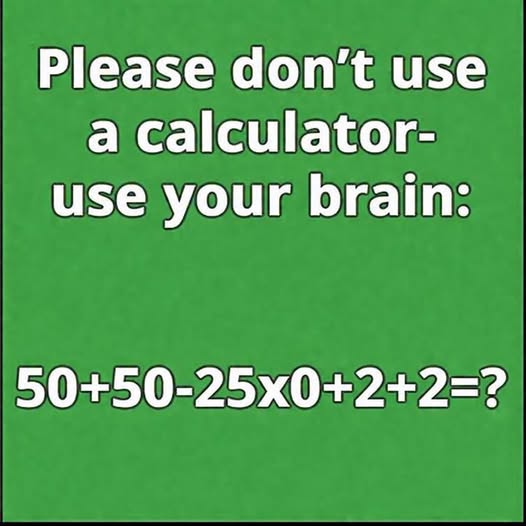
The secret to unlocking this puzzle lies in the order of operations, a fundamental set of rules often remembered by the acronyms PEMDAS or BODMAS. These principles dictate that multiplication and division must always be performed before addition and subtraction. If you were to simply calculate from left to right without regard for these rules, you would likely arrive at an incorrect conclusion. By prioritizing the multiplication component first, the path to the solution becomes remarkably clear and logical.
In this specific equation, the multiplication portion is 25 multiplied by 0. As any student of mathematics knows, any number multiplied by zero results in zero. By isolating this segment, we simplify the entire expression significantly. Once that multiplication is addressed, the remaining equation becomes 50 + 50 – 0 + 2 + 2. Now that only addition and subtraction remain, we can proceed from left to right with confidence. Adding 50 and 50 gives us 100, subtracting zero leaves us at 100, and adding the final 2 and 2 brings us to the correct total of 104.
Many people find these types of challenges intimidating because they have not practiced these specific rules in years. However, the order of operations is not merely a classroom requirement; it is a universal language that ensures consistency in everything from engineering and computer programming to daily financial management. When we treat math as a brain-training exercise rather than a chore, we improve our ability to process information systematically. The beauty of this puzzle is that it forces us to pause and evaluate the structure of the problem before rushing to a conclusion.
If you struggled with this calculation initially, do not be discouraged. It is a common experience to overlook the precedence of multiplication when faced with a string of numbers. The human brain is naturally wired to process information in a linear fashion, which often leads us to tackle problems in the order they appear. By consciously overriding this instinct and applying the correct mathematical hierarchy, you are effectively training your brain to think more critically and methodically. This is the essence of mental agility.
Beyond the simple satisfaction of solving a riddle, exercises like this reinforce the importance of precision. Whether you are balancing a checkbook, calculating a tip at a restaurant, or managing a complex project at work, the ability to break down a sequence of operations into manageable, logical steps is an invaluable skill. It prevents errors that can arise from assumptions and ensures that your final output is accurate and reliable. Mathematics is rarely about speed; it is about the structural integrity of your approach.
As you encounter more of these puzzles in the future, remember that the goal is not just to find the answer, but to understand the journey taken to reach it. Each time you solve a problem by correctly applying the order of operations, you are strengthening the neural pathways that support logical reasoning and problem-solving. This cognitive maintenance is just as important as physical exercise for long-term mental health. Keep challenging yourself with these small, daily tasks to keep your mind sharp and ready for more complex intellectual demands. It is a rewarding way to spend a few minutes of your day. By consistently engaging with these numerical patterns, you ensure that your mind remains agile, responsive, and capable of handling various logical tasks with ease and sustained focus.
In conclusion, the next time you see a mathematical expression, resist the urge to reach for a calculator immediately. Take a moment to scan the equation for multiplication or division signs, prioritize those operations, and then complete the remaining addition and subtraction. This simple, practical habit will transform how you approach numerical problems, ensuring that you maintain accuracy and clarity in your calculations. By mastering these fundamental rules, you gain a sense of control and confidence that makes every mathematical challenge a rewarding opportunity for growth.