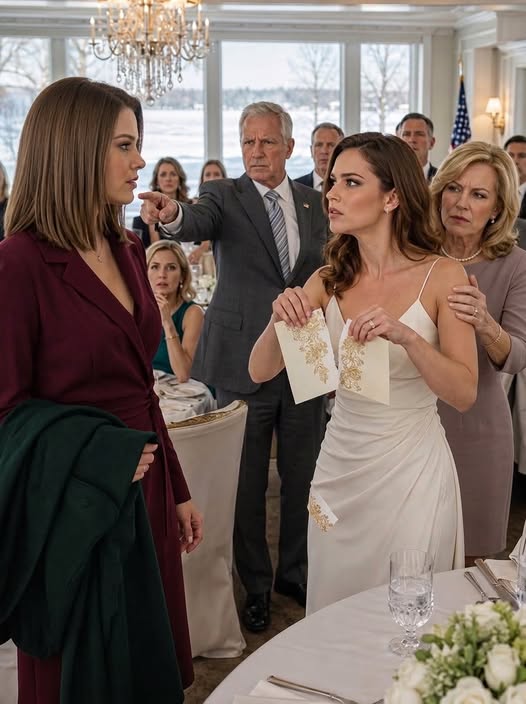
They were waiting for me to break, to apologize, or to beg for a seat at a table I had essentially purchased with my own professional capital. I looked at the torn invitation resting on the linen tablecloth, its gold foil catching the light, and realized that my family had spent their entire lives mistaking my competence for an endless, inexhaustible resource. They viewed my success as a public utility, a convenient infrastructure they could exploit without ever needing to acknowledge the person who maintained it. When Ashley declared that my presence would ruin her perfect day, the room erupted in a chorus of validation. My father’s verdict was swift, his tone dripping with the cold, performative cruelty that had defined our family dynamic for decades. He told me to leave, and for a moment, the silence was absolute as they waited for my collapse. I simply looked at the remnants of the invitation, knowing exactly what it cost to print, and felt a profound, chilling clarity wash over me. I stood up, smoothed my coat, and offered them the only thing they truly deserved: a departure that left them entirely exposed to the reality of their own incompetence. I walked out into the biting Minnesota air, the sound of my boots crunching on the snow serving as the only soundtrack to my liberation, fully aware that the fantasy they were living was about to dissolve into nothingness because I had finally decided to stop holding it together for them.
The drive back to the city was quiet, a stark contrast to the performative noise I had left behind. My phone buzzed with a message from Ashley, a demand for the gift check I had no intention of providing, which I blocked with a sense of finality that felt like a physical weight lifting from my shoulders. They were still in that room, likely toasting to their own righteousness, entirely oblivious to the fact that the ground beneath them was not made of stone, but of a precarious, contractual arrangement that I had personally secured. Six months prior, Ashley had sat in my kitchen, pointing at a magazine spread of the Weisetta Historic Estate with the casual entitlement of someone who had never had to consider the price of a dream. She wanted the venue, the lake views, and the prestige, and she assumed that because I was her sister, the logistics would simply manifest out of thin air. She never bothered to ask how a middle-management father or an unemployed mother could afford a six-figure Saturday-night rental. She never questioned why the hospitality group, with whom I was negotiating a massive corporate retreat, had suddenly granted her the prime date at a fraction of the cost. She saw only the aesthetics of a wedding, while I saw the master contract, the liability waivers, and the corporate discretionary courtesy that tethered the entire event to my firm. I had spent months reviewing invoices, managing vendors, and ensuring that every detail was perfect, all while they treated me like a secondary character in their own self-aggrandizing drama. They had spent a lifetime making me feel small, but they had forgotten that I was a senior partner in a world where power is measured in signatures and clauses, not in the hollow validation of family approval.
By the time I reached my apartment, the vindication was already settling into my bones. I slept soundly, and at six the next morning, I was back in my office, the familiar hum of the city providing a calm, professional backdrop to the final act of this orchestration. I pulled up the encrypted event file on my monitor, the language of the master contract clear and unforgiving. The document was explicit: the corporate courtesy was tied to my active participation and oversight as the primary host of record. By publicly ejecting me from the wedding, Ashley had inadvertently triggered a clause that rendered the entire arrangement null and void. I picked up the phone and dialed Marcus, the estate’s general manager, a man who understood the weight of a contract far better than my sister ever would. His voice was warm, expecting the usual final headcount, but his tone shifted the moment I informed him that I was making a permanent change to the account. I didn’t need to explain the family dynamics; I simply stated that the corporate courtesy was being revoked, effective immediately. The silence on the other end of the line was the sound of a professional reality setting in. Marcus, ever the pragmatist, understood the implications instantly. He opened the billing file, removed the line item that had subsidized their entire fantasy, and prepared to make the call that would define the rest of their morning. Across town, Ashley was likely surrounded by the trappings of a day that no longer existed, waiting for the hair and makeup team to arrive, completely unaware that the foundation of her wedding had been pulled out from under her. Marcus dialed the number listed under the bride’s contact information, his voice steady and clinical. As he began to explain the sudden loss of the venue and the immediate requirement for full, non-subsidized payment—a sum they could never hope to raise—I leaned back in my chair and watched the sunrise over the city. The performance was over, the curtain had fallen, and for the first time, the reality of their choices was finally theirs to bear alone.
The finality of the situation was absolute. I watched the cursor blink on my screen, a steady, rhythmic pulse that mirrored the calm in my chest. There would be no more invoices to approve, no more vendors to appease, and no more performative gratitude to manufacture. The corporate retreat would proceed as planned, but the estate would be entirely free of the chaotic, entitled energy that Ashley had brought to the table. I poured another cup of coffee, the dark, bitter liquid a fitting companion to the morning’s revelations. In the distance, I imagined the phone ringing in the bridal suite, the confusion turning to panic as the reality of the contract hit home. They had built their house of cards on the foundation of my professional reputation, never once considering that the same hand that built the structure could just as easily dismantle it. The silence I had cultivated in that dining room was not a sign of weakness, but a strategic pause before the inevitable collapse. I had played my part perfectly, and in doing so, I had ensured that the consequences were entirely their own. The wedding was over, not because I had been excluded, but because I had finally reclaimed the power that was rightfully mine all along. I closed the file, shut down my computer, and walked out of my office, ready to start a day that was finally, truly, my own.