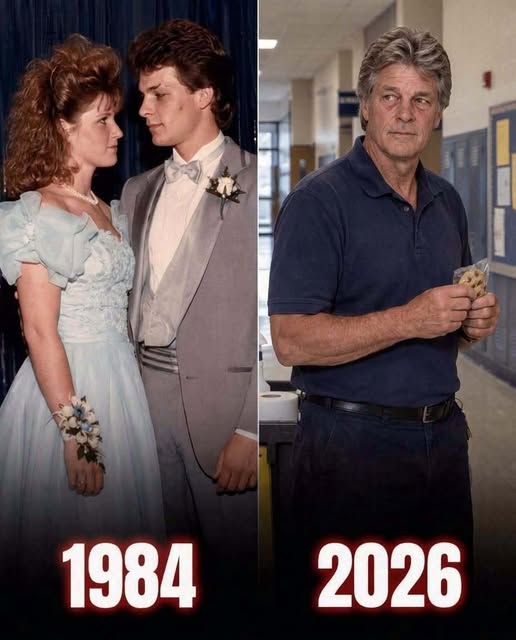
That boy was David, my high school sweetheart, a young man whose life was reported to have ended in a devastating house fire forty-two years ago. I had mourned him with the raw, jagged intensity of youth, eventually accepting the hollow silence left in his wake. Yet, here was Ellie, my eight-year-old granddaughter, insisting with unsettling clarity that this man was currently working as the custodian at her school. She spoke of his kindness, the extra desserts he slipped her, and the way he inquired about me with a familiarity that made my skin crawl. When she pointed to the faint, crescent-shaped scar above his left eyebrow—a mark I remembered tracing with my own fingers after his bicycle accident—the room seemed to tilt on its axis. The past was not a closed chapter; it was a living, breathing entity reaching out from the shadows of a school cafeteria.
Ellie reached into her backpack, her movements casual, as if she were handing over a library book rather than a piece of my shattered soul. She pulled out a small, tarnished silver locket, an object I had tucked into David’s pocket the night of our prom, a token of devotion that had been lost to the fire. My hands trembled as I took it, the metal cold against my palm. Attached to the chain was a slip of paper, the ink faded but the message searingly clear: Call this number. The truth isn’t what it seems. You shouldn’t have trusted your family.
The weight of the accusation hit me with the force of a physical blow. I retreated to the living room, my heart hammering against my ribs like a trapped bird. With Ellie watching, her eyes wide with a mixture of confusion and concern, I dialed the number. The ringing tone was rhythmic and agonizing. When a voice finally answered—a voice that had aged, deepened, and weathered decades of isolation—I felt the floor vanish beneath me. It was David. He was alive, he had been alive all this time, and the story his parents had fed me was a calculated fabrication designed to tear us apart.
He spoke in rapid, hushed tones, explaining the nightmare of his recovery. His parents, horrified by the severity of his burns and perhaps fearing the burden of a disfigured son, had orchestrated his disappearance. They had moved him across the state, cut all ties, and convinced me he was dead to ensure he would never return to the life he had built with me. He had spent years in the periphery, watching from a distance as I married and moved on, unable to bridge the chasm of the lies they had constructed. He had only taken the job at the school when he realized Ellie was my granddaughter, a desperate attempt to be near the family he had been denied.
The revelation was a jagged blade, cutting through the decades of my quiet, suburban life. I realized then that my own family had been complicit, or at least willfully ignorant, in the erasure of my first love. The betrayal was not just in the fire, but in the silence that followed. I sat on the sofa, the phone pressed to my ear, tears streaming down my face as the ghost of my youth explained the logistics of his survival. He had been a prisoner of his parents’ shame, a man living in the margins of a world that had declared him dead.
Ellie, sensing the gravity of the moment, moved closer and rested her hand on my knee. She didn’t understand the full scope of the deception, but she understood the pain. I looked at the locket, then at the photograph, and finally at the man on the other end of the line. The truth was ugly and complicated, but it was finally ours to hold. We spent the next hour talking, not as strangers, but as two people who had been robbed of a lifetime. The resolution was not a fairy tale; it was a reckoning. I knew then that I would have to confront the people I called family, to demand answers for the decades stolen by their cold, calculated interference. But for the first time in forty-two years, the ghost was gone, replaced by a man who was ready to step out of the shadows and into the light of the truth, no matter how much it burned.
The aftermath of that phone call was a whirlwind of sensory overload. My pulse raced, and the room began to spin, forcing me to lean against the wall for support. Ellie, sensing the shift in the atmosphere, instinctively reached for the landline, her small fingers dialing for help as the world blurred into a haze of shock. The ambulance arrived within minutes, the flashing lights casting long, rhythmic shadows across our living room walls. The paramedics were efficient, their voices distant and muffled, as if I were underwater. I remember the cold touch of an oxygen mask and the frantic, worried look in Ellie’s eyes.
In the hospital, the sterile white walls seemed to mock the chaos in my mind. As my heart rate stabilized, the doctors spoke of stress and blood pressure, but they could not diagnose the ache of a heart suddenly forced to reconcile the dead with the living. David arrived at the emergency room hours later, his face lined with the weariness of a man who had carried a secret for half a century. When he walked through the sliding doors, the decades melted away. The crescent scar was still there, a testament to a youth that had been stolen by lies.
We sat in the quiet of the hospital garden, the night air crisp and unforgiving. He explained how he had tracked me down, how he had watched from the shadows of my life as I built a home, a career, and a family. He had been close enough to see the milestones but too far to participate. The anger I felt toward his parents was eclipsed only by the profound sadness of what we had lost. We had been two teenagers in love, full of dreams, and we were reduced to two strangers trying to find the bridge back to one another.
The resolution was not instantaneous, nor was it simple. It required a dismantling of the narratives I had constructed to survive the loss. I had to face the reality that my own family had been part of the conspiracy, keeping the truth from me to ensure I moved on with a life they deemed appropriate. The betrayal was deep, but the presence of David—real, tangible, and scarred—was the anchor that held me steady. We decided then that we would not let the past dictate our future any longer. We would reclaim the time that had been stolen, not by erasing the years that had passed, but by acknowledging the truth that had been buried beneath them. The ghost was gone, and in his place stood a man who was ready to finally come home.