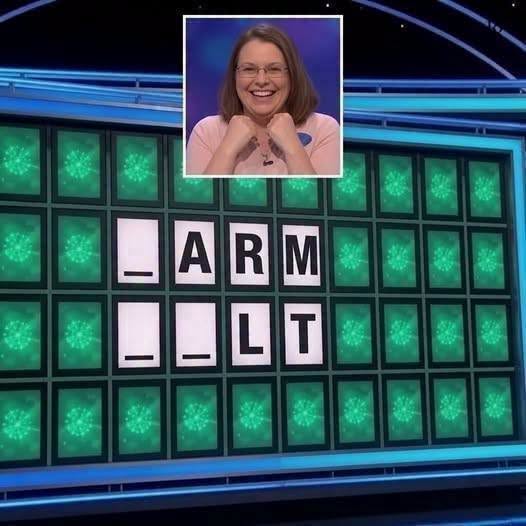
From the audience’s perspective, the contestant appeared to have very little to work with.
It seemed like the kind of puzzle that would require testing different words, studying the category and slowly piecing together possible phrases.
She didn’t need any of that—or at least it didn’t look like she did.
Within moments, she confidently gave her answer.
Even the host appeared surprised by how quickly it happened.
That speed was what made the moment stand out.
Winning a $65,000 puzzle would already be memorable. Recognizing the answer when so much of the board still appeared incomplete made it look almost effortless.
How Can Someone Solve a Puzzle That Fast?
The answer may be pattern recognition.
Experienced word-puzzle players don’t necessarily process every blank individually.
A few strategically placed letters, combined with the puzzle’s category and the structure of familiar words or phrases, can dramatically narrow the possibilities.
What looks like a collection of disconnected letters to one person may immediately resemble a familiar pattern to someone who has spent years watching or practicing these puzzles.
That’s why expertise can sometimes look like guessing.
The thinking is still happening—it has simply become extremely fast.
Staying Calm Matters Too
There was another element working in the contestant’s favor: composure.
With $65,000 at stake and a studio audience watching, recognizing a possible answer isn’t enough.
You still have to trust it.
Hesitation can consume valuable seconds, while panic can make an obvious pattern suddenly difficult to see.
This contestant appeared to do neither.
She looked at the board, recognized something and committed to it.
Seconds later, the audience was applauding.
That’s what makes moments like this so satisfying to watch.
For everyone else, the puzzle still looked unfinished.
For her, apparently, the answer was already there.