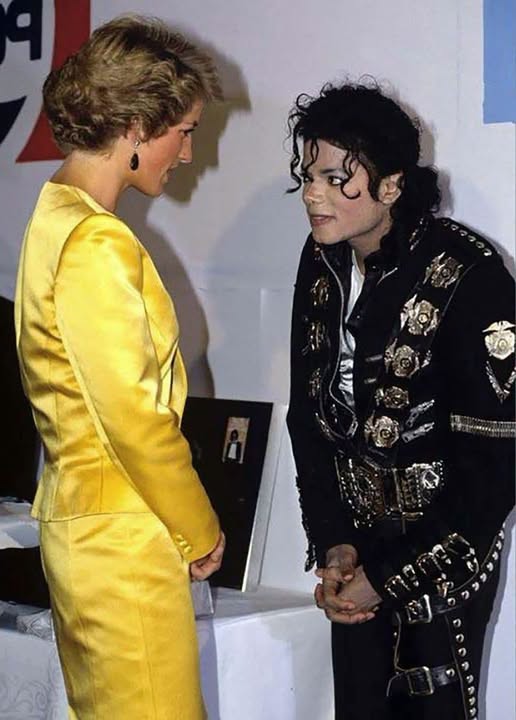
The tension of that evening was palpable, particularly regarding the setlist for Jackson’s performance. The singer, ever mindful of the Princess’s presence, had seriously considered removing his hit song “Dirty Diana” from the show, fearing the title might be perceived as a slight or an impropriety. However, in a moment that revealed her characteristic wit and genuine familiarity with his work, the Princess reportedly requested that he keep the track on the list, effectively putting his anxieties to rest.
This brief intersection at Wembley remains one of the most intriguing footnotes in the history of modern celebrity. While the public often viewed them through the lens of their respective roles—one as a member of the British royal family, the other as a titan of global pop music—their meeting was anchored by a mutual, unspoken recognition. Both individuals lived under a level of media scrutiny that few could comprehend, a constant, invasive gaze that turned their private lives into public property. In that quiet backstage space, the weight of their collective experience likely fostered a sense of familiarity that transcended the usual formalities of such an encounter. It was a moment where the barriers of protocol and the demands of performance were momentarily set aside in favor of a shared human acknowledgment. They stood as two people who understood that the public persona was merely a mask, often heavy and difficult to wear.
Beyond the spectacle of their fame, both Diana and Jackson were deeply committed to humanitarian efforts. Their public work served as a bridge, allowing them to utilize their massive platforms to shine a light on causes that often struggled to gain traction in the mainstream. Whether it was the Princess’s tireless advocacy for health initiatives, homelessness, and the vulnerable, or Jackson’s extensive support for humanitarian projects and charitable organizations, both understood the unique power they possessed to effect change. This shared dedication to helping others provided a meaningful layer to their connection, suggesting that their rapport was built on more than just the superficial trappings of celebrity. They were individuals who recognized that their fame was a tool, one that could be leveraged to alleviate the suffering of those less fortunate, even while they themselves remained the subjects of intense public fascination. Their commitment to these causes was not merely a public relations strategy; it was a reflection of their internal desire to find purpose beyond the flashbulbs.
Years after that night at Wembley, the world was forever changed by the tragic passing of Princess Diana in 1997. The international response was profound, reflecting the deep, personal connection millions felt toward her. Michael Jackson, who had experienced the same isolating nature of worldwide fame, was among those who spoke publicly about her legacy. He paid tribute to her influence and the humanitarian spirit that defined her life, acknowledging the rare, shared burden they had carried. His public reflections served as a poignant reminder of the mutual respect that had been forged in the fleeting moments they spent together. He understood, perhaps better than most, the singular weight of being a global icon whose every move was documented and critiqued. He recognized that the world had lost a voice that was uniquely capable of bridging the gap between royalty and the common person.
Despite the enduring fascination with their meeting, much of the substance of their private conversations remains undocumented. Over the years, various reports and anecdotes have circulated, often blurring the lines between verified history and speculation. It is essential to approach these narratives with a degree of caution, distinguishing between the confirmed events of that evening at Wembley and the later stories that have grown in the fertile soil of public imagination. The reality of their relationship does not require embellishment; the simple fact of their meeting is a compelling testament to the intersection of two extraordinary lives. We must respect the boundaries of what is known, acknowledging that the most profound parts of their connection likely occurred in the spaces between the headlines, where no cameras were present to capture the nuance of their exchange.
Ultimately, the story of Diana and Michael Jackson is a reflection on the nature of public life in the late twentieth century. They were two individuals who occupied the extreme edges of global recognition, navigating a world that demanded everything from them while offering little in return. Their brief encounter at Wembley serves as a quiet, humanizing chapter in their larger, more public journeys. It remains a resonant image of two icons finding a moment of normalcy amidst the chaos of their reality, a memory that continues to captivate because it speaks to the universal need for understanding, even among those who seem to have everything.
As the years have passed, the memory of that meeting has settled into the collective consciousness, stripped of the immediate, frantic energy of the concert but retaining its significance. It stands as a resolved narrative of two people who, for a brief window of time, were able to step out of the shadows of their own legends and simply acknowledge the shared, heavy mantle they both wore. Their paths diverged, leading them toward very different ends, yet the echo of that backstage meeting persists, a gentle reminder of the humanity that existed behind the headlines and the cameras. Their story is now a closed chapter, a historical footnote that serves as a testament to the fact that even the most famous people on earth are, at their core, searching for a genuine connection in an increasingly impersonal world. Their legacy remains, not just in their art or their titles, but in the quiet, human moments that defined their brief, intersecting lives.