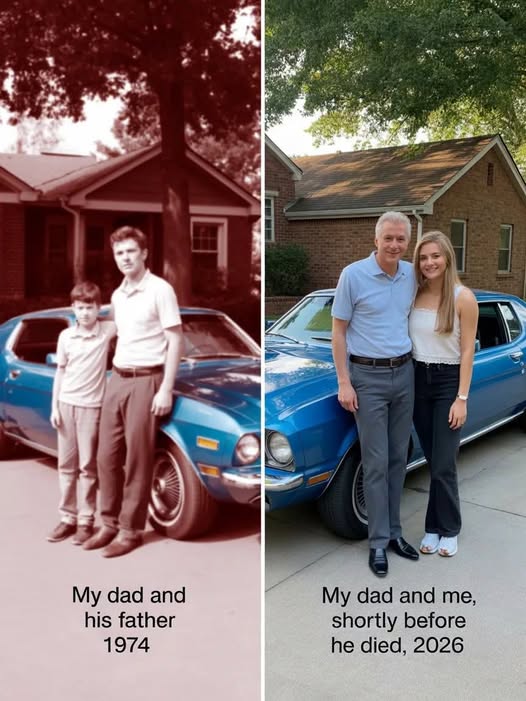
As I stood at the pulpit, delivering a eulogy I had rewritten through a haze of tears, I spoke of his patience and the midnight blue 1967 Shelby GT500 he had restored bolt by bolt over thirty years. I believed he was watching over me, but as I walked into the parking lot after the service, the reality of my stepmother’s true nature shattered my grief. A flatbed truck was already hauling away the Shelby, and Karen stood by the curb, clutching a thick envelope of cash. She had sold his pride and joy for a mere two thousand dollars, dismissing his legacy as a rusted burden she was eager to shed. My heart hammered against my ribs, a mixture of rage and profound sorrow threatening to overwhelm me as I confronted her. Before she could offer a cold justification, a young mechanic named Pete hurried toward us, his face pale with urgency. He held a sealed plastic bag he had discovered while inspecting the car’s spare tire well for rust. He insisted we see what was inside before the transport was finalized. Karen, clearly annoyed, snatched the bag from him, but as she tore it open and pulled out a letter and a stack of receipts, her knees buckled. She collapsed onto the pavement, gasping for air as the gravity of her actions collided with the truth of my father’s final, desperate attempt to save their marriage.
I knelt beside her, my hands trembling as I retrieved the papers she had dropped. The receipts detailed a fifteen-thousand-dollar payment for a luxury cruise, a surprise anniversary gift my father had hidden away, hoping to rekindle the connection they had lost. The letter, written in his familiar, spiky script, was a confession of his own shortcomings and a plea for reconciliation. He acknowledged that he had shut down after my mother’s death, yet he had never stopped trying to love Karen in his own clumsy, quiet way. He wrote that the car was the only piece of his own father he had left, but he was willing to let go of everything if it meant finding a path back to her.
The silence in the parking lot was heavy, broken only by the distant sound of traffic. Karen sat on the curb, sobbing, the mask of the grieving spouse stripped away to reveal a woman who was just as lost and regretful as I was. Aunt Lucy, who had stayed by my side throughout the ordeal, stood as a firm anchor, ensuring that the reality of the situation remained clear. Pete, the mechanic, looked on with genuine sympathy, offering to halt the sale immediately. He confirmed that no official paperwork had been filed, giving us a narrow window to reclaim the car and the history it represented.
I looked at Karen, whose mascara had run down her cheeks, making her look younger and far more vulnerable than I had ever imagined. She pushed the envelope toward me, her voice breaking as she begged me to take the money and the cruise, unable to bear the weight of her own betrayal. I refused, insisting that the sale be contested and the estate handled with the gravity it deserved. I instructed Pete to call his boss and freeze the transaction, making it clear that the car was not to move another inch. As the reality of the situation settled, I realized that we were all guilty of wanting something from my father, of taking his presence for granted until it was too late to ask for forgiveness.
In the envelope, tucked behind the letter, I found a small, candid photograph of my father and me in the garage, our faces smeared with grease and our smiles wide. On the back, he had written, “We don’t quit on things we love.” That simple sentence felt like a mandate for the difficult road ahead. We were not reconciled, and the wounds of the day would take years to heal, but for the first time, we were looking at the same truth. We left the cemetery not as enemies, but as two people bound by a shared, painful loss. The path toward healing would be long and fraught with legal hurdles, but as we walked toward the car, I felt a flicker of hope that we might finally begin the work of honoring him properly. We would not quit on each other, and we would not quit on the memory of the man who had tried, until his very last breath, to keep us together. We stood there in the quiet lot, the weight of the past finally shifting under the light of a new, painful understanding, ready to face the future without him. The legal process would be arduous, involving probate lawyers and the untangling of assets, but for the first time, Karen seemed willing to cooperate. We drove home in silence, the Shelby safely parked in its original spot, a silent witness to a man who had loved us both in ways we were only beginning to comprehend. The journey of reconciliation would not be swift, but the letter had provided a map, a fragile bridge built from the wreckage of his final, silent efforts to mend the fractures in our family. We were still grieving, yet the bitterness had been replaced by a quiet, shared determination to honor his final wish for peace.