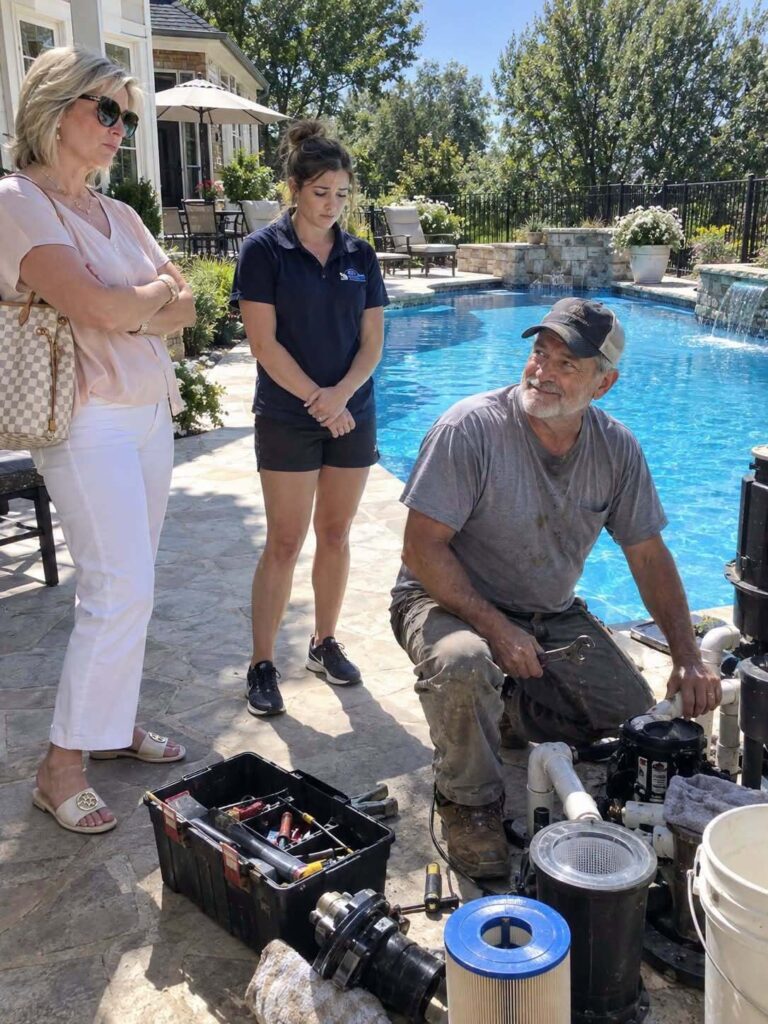
He knew what calcium buildup meant.
He knew which repairs could wait and which ones would turn expensive if you ignored them.
Dad wasn’t flashy.
He didn’t advertise much.
He didn’t drive a new truck.
He still used the same old Ford F-150 he’d owned for years, kept his tools organized in labeled compartments, and wrote everything down in a battered spiral notebook.
Customers sometimes underestimated him because of that.
My boss made that mistake.
His name was Richard Emory.
Richard owned the company where I worked and lived in a large house outside town with his wife, Melissa.
One Monday morning, he stopped beside my desk.
“Your dad still does pool work, right?”
“Yes.”
“Good work?”
I smiled.
“The best.”
Richard laughed.
“That’s a daughter’s answer.”
“No. That’s a customer’s answer.”
His backyard pool had apparently been neglected for years.
The pump barely worked.
The filtration system was failing.
The water had turned cloudy.
There were leaks somewhere underground, and two other companies had quoted Richard amounts he considered ridiculous.
So I gave him Dad’s number.
Dad went out the following afternoon.
He inspected everything.
Then he wrote up an estimate.
$7,800.
Richard signed it.
The work authorization clearly listed the repairs.
Replacement pump.
New filtration components.
Pipe repair.
Pressure testing.
Chemical treatment.
Labor.
Everything.
Dad told him it would take about nine days.
Richard agreed.
For the next week and a half, Dad worked at that house almost every day.
He removed failing equipment.
Repaired damaged plumbing.
Installed a new pump.
Rebuilt part of the filtration system.
Tracked down leaks that had been wasting water underground.
Then he balanced the chemistry and restored the pool.
By the final afternoon, the difference was unbelievable.
The water was crystal clear.
The equipment ran quietly.
Richard was thrilled.
At work the next morning, he even mentioned it.
“Your dad knows what he’s doing.”
I smiled.
“Told you.”
I assumed that was the end of it.
Then Dad called me that evening.
“Melissa doesn’t want to pay.”
I sat up.
“What?”
“She says the bill is too high.”
“But Richard signed the estimate.”
“I know.”
“What is she offering?”
“Three thousand.”
I actually laughed because I thought he was joking.
He wasn’t.
“She wants you to take three thousand dollars for a $7,800 job?”
“That appears to be the proposal.”
“What did you say?”
“No.”
Of course he had.
Then his voice changed slightly.
“She mentioned you.”
My stomach tightened.
“What about me?”
“She reminded me that Richard is your boss.”
I went quiet.
Dad continued.
“She said it would be unfortunate if a disagreement about the invoice made things uncomfortable for you at work.”
My anger came instantly.
“She threatened my job?”
“She implied things.”
“Dad, I’m calling Richard.”
“No.”
“Why?”
“Because this is my invoice.”
“But—”
“I’ll handle it.”
There was something in his voice that made me stop.
Dad had been self-employed for nearly three decades.
He had dealt with difficult clients before.
So I trusted him.
Two days later, my phone rang while I was at work.
It was Dad.
“Can you leave?”
“What happened?”
“I need you to come to Richard’s house.”
“Why?”
“Just come.”
His voice was calm.
Too calm.
“Dad?”
“I’m fine.”
That didn’t reassure me.
“What happened?”
He paused.
“There are police here.”
I was out of my chair before he finished the sentence.
When I pulled onto Richard’s street twenty minutes later, I saw two police cars parked outside the house.
My heart started pounding.
Dad’s Ford was in the driveway.
Richard stood near the front lawn arguing with one of the officers.
Melissa was beside him.
And Dad was standing near the backyard gate with an elderly woman I’d never seen before.
I parked quickly and hurried over.
“Dad?”
He turned.
“Hey.”
“Don’t ‘hey’ me. Why are there police here?”
Richard overheard.
“This whole thing has gotten completely out of hand.”
An officer looked at him.
“Sir, please let us finish.”
Melissa crossed her arms.
“This is absurd.”
I looked at Dad.
“What happened?”
He glanced toward the older woman beside him.
“This is Eleanor.”
She gave me a small nod.
Then Dad said:
“I found something under the pool.”
I stared at him.
“What?”
During the repair, Dad had noticed an unusual calcium deposit along one section of buried pipe.
At first, he thought it was simply evidence of a slow leak.
He excavated carefully.
The pipe was damaged.
But while clearing the area around it, his shovel struck something metal.
Not plumbing.
A box.
It had been buried beneath the ground near the pool for years.
Dad stopped work immediately.
He cleaned enough dirt away to determine that it was sealed.
Then, instead of opening it privately or moving it, he documented where he found it.
Photographs.
Measurements.
Location.
Time.
Exactly the kind of thing he always did.
Eventually, the box was opened with police present.
Inside were twelve antique wristwatches.
And one small clock.
Some were wrapped individually.
Others were stored in old cloth.
Richard initially assumed they belonged to whoever had owned the property before him.
Dad noticed markings on several pieces.
A name.
Tibor.
That was where Eleanor came in.
She lived three houses away.
She had been in the neighborhood for more than forty years.
When Dad mentioned the name, her entire expression changed.
“Tibor Kovacs?”
Dad nodded.
Eleanor knew him.
Decades earlier, Tibor had owned Richard’s property.
He had been a Hungarian watchmaker.
According to Eleanor, he repaired and restored watches from a workshop behind the old house before much of the property had been renovated.
She had known him personally.
More importantly, she had records.
For twenty-five years, Eleanor had kept old neighborhood documents after helping Tibor’s family sort through his affairs.
Invoices.
Photographs.
Serial-number lists.
Repair books.
She had never known what happened to part of his private collection.
Until Dad uncovered that metal box.
Richard looked furious.
“It’s my property. It was found on my land.”
One of the officers replied calmly:
“That doesn’t automatically establish ownership of the contents.”
Richard clearly didn’t like that answer.
Melissa liked it even less.
She looked at Dad.
“If you hadn’t dug around where you weren’t supposed to, none of this would be happening.”
Dad stared at her.
“I was repairing the leak your husband hired me to repair.”
She had nothing to say to that.
Over the next several hours, everything became more interesting.
Eleanor’s records matched several of the watches.
Serial numbers.
Descriptions.
One photograph even showed Tibor standing beside a workbench with two of the same pieces visible behind him.
Then police contacted Tibor’s surviving family.
His seventy-three-year-old son, Martin, lived in New Mexico.
When Martin heard what had been found, he flew in.
I met him three days later.
He stood in Richard’s backyard holding one of the recovered watches with both hands.
“My father made this one.”
Dad looked surprised.
“Made it?”
“Modified it.”
Martin smiled.
“He loved rebuilding movements. Sometimes he changed cases, hands, everything.”
The collection was later professionally evaluated.
The estimated value came in just under $90,000.
But Martin told us the money wasn’t what mattered.
His father had always believed that part of the collection had been stolen or lost during one of the property’s renovations.
Nobody knew it had been sealed underground.
Because Dad had documented the discovery exactly where it was found and immediately contacted other people instead of trying to keep anything, investigators were able to preserve the chain of evidence.
Eleanor’s records helped establish provenance.
Martin’s family records completed the rest.
Eventually, the collection was returned to Tibor’s family.
Martin offered Dad $5,000 as a finder’s fee.
Dad refused at first.
“You don’t owe me anything.”
Martin smiled.
“I know.”
Dad shook his head.
“Then keep it.”
“No.”
Martin pushed the envelope back toward him.
“My father spent his life repairing watches for other people.”
He looked down at the collection.
“You gave something of his back to us.”
Dad finally accepted.
But the watches weren’t the only matter being resolved.
While all of this was happening, Richard’s attorney reviewed the paperwork from Dad’s pool job.
The original estimate.
The work authorization.
Material receipts.
Completion documentation.
Everything.
And there was one detail Melissa apparently hadn’t remembered.
She had signed the work authorization too.
So had Richard.
The agreement couldn’t have been clearer.
$7,800.
Approved before work began.
The next afternoon, Dad received the entire amount.
Not $3,000.
Not some negotiated discount.
The full $7,800.
Richard called me into his office later that day.
For a moment, I wondered whether Dad’s invoice really was about to affect my job.
Instead, Richard closed the door.
“I owe you an apology.”
I waited.
“What Melissa said to your father was inappropriate.”
I didn’t answer.
“She should never have brought your employment into a private payment dispute.”
“No.”
“She shouldn’t have.”
Richard nodded.
“You have my word that your job here was never part of this.”
I studied him.
“You signed the invoice.”
“Yes.”
“And then let her refuse to pay it.”
His face tightened.
“That was a mistake.”
I appreciated that he admitted it.
I didn’t pretend the whole thing had disappeared.
Neither did Dad.
But the invoice was paid.
The threat against my job stopped.
And Tibor’s watches went home to his family.
On the drive back from Richard’s house one afternoon, I sat beside Dad in his old Ford.
His spiral notebook was wedged between the seats.
The dashboard rattled slightly whenever we hit rough pavement.
I looked at him.
“Can I ask you something?”
“Sure.”
“When you found that box…”
He glanced over.
“What?”
“Did you ever think about keeping the watches?”
Dad looked almost offended.
“No.”
“Not even for a second?”
“They weren’t mine.”
“But you didn’t know whose they were yet.”
“That doesn’t make them mine.”
I smiled.
“You realize some people would have opened that box, seen expensive watches, and never told anyone?”
“I know.”
“Nearly ninety thousand dollars.”
Dad shrugged.
“You don’t take what isn’t yours.”
Then he added:
“You handle it correctly.”
That was Dad.
Twenty-nine years of working in other people’s yards had taught him more than how to fix pumps.
Homeowners trusted him around open garages.
Back doors.
Expensive equipment.
Empty houses.
He believed that entering someone’s property to do a job came with responsibility.
Even when the people hiring him didn’t show him the same respect.
I looked at the envelope Martin had given him.
“So you got the invoice.”
“Yep.”
“And five thousand dollars.”
“Looks that way.”
“Not bad for a guy Melissa tried to short by $4,800.”
Dad smiled.
“Don’t start.”
I laughed.
A few miles later, the road opened ahead of us.
The sky was clear.
Dad rested one hand on the steering wheel.
Then he said:
“You know what the funny part is?”
“What?”
“I went there to fix a pool.”
I waited.
“That was the job.”
He glanced at me.
“So that’s what I did.”
He had repaired what he was hired to repair.
Documented what he found.
Returned property that wasn’t his.
And expected people to honor the agreement they had signed.
Nothing dramatic.
Nothing clever.
Just doing things correctly.
Dad looked toward the road again.
“Sometimes, if you do the work right, everything else finds its way home.”
I thought about Tibor’s watches.
About Martin holding something his father had touched decades earlier.
About Eleanor’s records sitting safely in a drawer for twenty-five years.
About an unpaid invoice that had finally been paid in full.
Then I looked at my father.
Old truck.
Worn notebook.
Organized tools.
Twenty-nine years of experience.
Some people saw those things and assumed he was someone they could cheat.
They were wrong.
Dad didn’t need to be loud to know what his work was worth.
And he didn’t need to take what belonged to someone else to make sure he received what belonged to him.