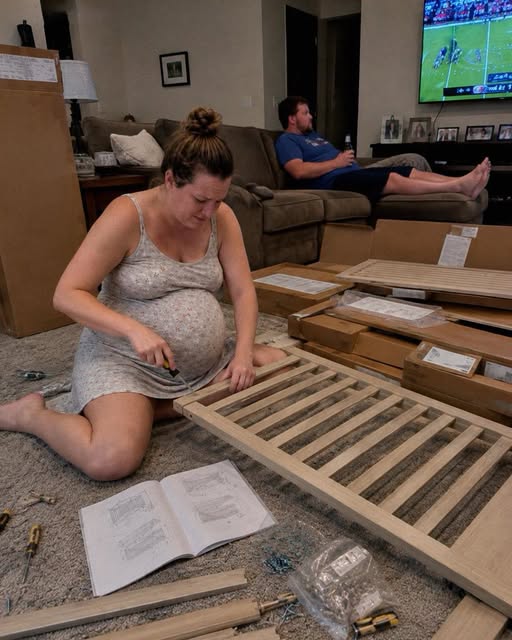
physical strain of impending motherhood in total isolation. When I finally called out for help, his dismissive comment about my being better at the little details felt like a final, crushing realization that I was truly on my own. I was struggling to keep my balance, my vision blurring from the exertion, when the front door opened and his grandfather, George, stepped into the room. He took in the scene with a quiet, devastating clarity that required no explanation. He saw the unfinished crib, the scattered screws, and the man in the next room who had abandoned his responsibilities for a television broadcast.
George moved with a deliberate, calm grace, setting aside his watch and kneeling on the floor to take over the task Ryan had refused. As he worked, he spoke of his life and his grandson, his voice steady against the roar of the television in the next room. He treated the assembly of the crib not as a chore, but as a sacred duty, a foundation for a life he clearly valued more than his grandson seemed to. He asked about the baby, and when I told him we had chosen the name Nora, he nodded with a sense of approval that felt like a lifeline. He shared stories of his own mistakes, his voice a gentle contrast to the silence of my husband, who remained blissfully unaware of the shift in the room.
When the final screw was tightened, George did not seek praise. Instead, he produced a legal document that would fundamentally alter the trajectory of our family. He had placed his estate and construction company into a trust for our unborn daughter, Nora, naming me as the sole trustee until she reached the age of twenty-five. The revelation hit Ryan with the force of a physical blow, stripping away his easy, charming veneer and leaving him exposed in his own denial and anger. Ryan’s immediate reaction was one of betrayal, as if he had been robbed of a birthright rather than given a chance to prove his maturity. He lashed out, accusing me of manipulating his grandfather, but George remained unmoved, his gaze fixed on the man he had raised but failed to reach until this moment.
The ensuing confrontation was not a shouting match, but a firm, unyielding boundary-setting session. George stood his ground, explaining that the trust was not a punishment, but a mirror reflecting the reality of Ryan’s choices. I realized then that I could no longer carry the weight of our marriage on my own. I told Ryan that if he wanted to be a part of our daughter’s life, he would have to earn his place through genuine effort, counseling, and consistent work. I watched him pace the room, his frustration mounting as he realized that his usual charm would no longer serve as a substitute for action. He eventually left the house, slamming the door behind him, leaving us in a quiet that felt like the beginning of a new chapter.
The birth of our daughter only accelerated this shift. When Ryan arrived at the hospital, hungover and unprepared, he was met with a version of me that was no longer willing to accommodate his neglect. I held our daughter and laid out the terms of our future with a calm, unwavering resolve. He was forced to confront his own inadequacy, and for the first time, he admitted that he did not know how to be the man his grandfather was. It was a painful, necessary admission that finally cracked the shell of his ego. I saw the fear in his eyes, not just of losing me, but of losing the opportunity to be a father who actually showed up.
In the weeks that followed, the change was slow but tangible. Ryan began to show up, not because he was asked, but because he was finally learning the weight of his responsibilities. He returned to work, took on the grueling late-night feedings, and allowed himself to be tired in a way that felt honest. He was not a perfect man, but he was a man in the process of becoming a father. He learned the rhythm of our daughter’s needs, and he began to understand the value of the work he had previously dismissed as beneath him. The tension in our home began to dissipate, replaced by a cautious, growing respect that we had never possessed before. We moved forward with a newfound clarity, understanding that our family was now built on a foundation of mutual accountability and genuine, hard-won love rather than the hollow, convenient promises that had defined our early years together.
I often look at the crib in the corner, a sturdy, silent testament to the day George intervened. His gift was never just the financial security of the trust; it was the permission he gave me to stop carrying a burden that was never mine to bear alone. I have reclaimed my strength, and as I watch Ryan learn to hold our daughter with genuine care, I know that we have finally moved past the hollow promises of the past. We are building a life that is grounded in accountability, and for the first time, I am not afraid of what tomorrow brings. We are learning to be a family, not through the convenience of the past, but through the hard, necessary work of showing up for each other every single day.