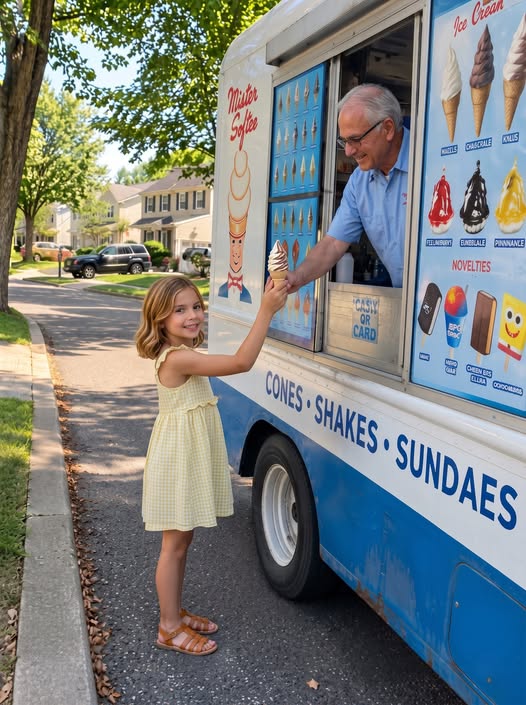
past, parked right at the curb in a rusted, white van. The jingle halted abruptly, leaving a silence that felt heavy and expectant. I squeezed Ellie’s hand, perhaps a bit too tightly, and stepped toward the vehicle. The driver’s side window slid down with a screech of metal on metal. The man inside was older than I had anticipated, his face a map of deep-set lines and sun-bleached skin, wearing a faded blue cap that obscured his eyes in shadow. He didn’t reach for the freezer handle. He didn’t offer a strawberry shortcake bar. He simply waited, his hands resting on the steering wheel, knuckles white and steady. I felt the weight of the note in my pocket, the ink still burning in my mind. I had to know if this was a coincidence or something far more calculated. The streetlights flickered to life, casting long, distorted shadows that seemed to stretch toward the van as if drawn by a magnetic force. I felt like an intruder in my own neighborhood, a woman caught between the safety of her present life and the encroaching reality of a history she had buried deep beneath years of routine and geographical distance. The man finally looked up, and the air between us grew thick with the weight of unspoken things. He didn’t look like a stranger; he looked like a bridge to a time I had almost forgotten.
“You’re a long way from home,” I said, my voice sounding thin and brittle against the backdrop of the quiet suburban street. The man turned his head slowly, and for a moment, the streetlights caught his gaze. His eyes were a familiar, piercing shade of gray that sent a jolt of recognition through my marrow. He didn’t smile, but his expression softened into something resembling a weary, profound relief. He knew exactly why I was standing there. He knew exactly what the mention of Maple Street meant to me, and he knew that I had finally come to reclaim the truth of that summer. The neighborhood felt suddenly small, a stage set for a revelation I wasn’t sure I was prepared to handle. I looked at Ellie, who was still clutching her empty hand, waiting for the treat that had become a ritual. She was the anchor keeping me from turning around and running back into the safety of my house, the reason I had to see this through to the very end.
“Maple Street hasn’t changed much,” he murmured, his voice raspy, like dry leaves skittering across pavement. “But the people who lived there certainly have. You were always the one who ran the fastest, always the one who wanted the strawberry bar before the sun even hit its peak.” I felt the air leave my lungs. I hadn’t told anyone about those races, about the way I used to sprint down the cracked sidewalk to beat the neighborhood kids to the truck. It was a memory I had tucked away, a private relic of a childhood that felt like a dream. How could he possibly know the rhythm of my youth? My breath hitched as I stepped closer, the smell of diesel and artificial vanilla washing over me. He leaned forward, the interior light of the truck illuminating his features, and I felt the years begin to peel away, revealing a face I had seen in the periphery of my childhood, a man who had been a quiet fixture in the background of my most formative years.
“Who are you?” I demanded, though my voice lacked the fire I had intended. He reached into the dashboard and pulled out a small, worn photograph, sliding it across the metal counter toward me. It was a black-and-white snapshot of a young girl with pigtails, holding a melting ice cream bar, standing in front of a house with a distinct, crooked porch railing. My house. The house on Maple Street. I looked at the man again, really looking at him this time, and the years began to peel away. The jawline, the way he tilted his head—it was Mr. Henderson, the man who had owned the corner store three blocks over from my childhood home. He had been the one to always save the best bars for me when I didn’t have enough change. The realization hit me with the force of a physical blow, grounding me in a reality that felt both impossible and entirely inevitable.
“You moved away so suddenly,” he said, his gaze drifting toward the horizon. “Your mother never told you why, did she? She thought she was protecting you, but some things have a way of following us, no matter how many miles we put between ourselves and the truth.” He explained, in a low, measured tone, that he had been a friend of my father’s, a man who had kept a watchful eye on our family during those turbulent years. He had tracked me down not to haunt me, but to deliver a final, long-overdue piece of my history. He handed me a small, sealed envelope that had been tucked behind the photograph. It contained a letter from my mother, written shortly before she passed, intended for me to read only when I was old enough to understand the weight of the secrets she had carried. The envelope was heavy, the paper yellowed with age, and as I took it, I felt the finality of the moment settling over us like a shroud.
The tension that had gripped my chest for weeks began to dissipate, replaced by a strange, hollow clarity. I looked down at Ellie, who was watching us with wide, curious eyes, oblivious to the gravity of the exchange. The man, Mr. Henderson, gave a slight nod, a silent acknowledgment of the burden he had finally passed on. He started the engine, the van shuddering to life with a low, rhythmic rumble. He didn’t offer any more ice cream, and he didn’t say goodbye. He simply pulled away, the melody of his truck fading into the distance, leaving me standing on the sidewalk with the letter in my hand and the ghosts of Maple Street finally laid to rest. The silence that followed was different—it was no longer heavy with mystery, but empty, waiting to be filled with the truth I was about to uncover.
I opened the envelope as the sun dipped below the trees, casting long, golden shadows across the lawn. My mother’s handwriting, elegant and slanted, filled the pages with the explanation I had craved for thirty years. It wasn’t a story of malice, but one of sacrifice, a desperate attempt to keep me safe from a past that threatened to consume our family. As I read, the distance between the girl on Maple Street and the woman I had become finally closed. I realized then that the strawberry bars were never just a treat; they were a tether, a reminder that even when we think we are running away, we are often just circling back to the truths that define us. I walked back to my house, Ellie skipping ahead, the evening air feeling lighter, cleaner, and full of the quiet, resolved peace of a story finally told. The mystery of the truck was gone, replaced by the simple, enduring warmth of understanding, and as I closed the front door behind us, I knew that the past was finally where it belonged—behind me.
{"post":112576,"page":2,"next":[{"id":112572,"title":"Understanding Food Safety: Managing Potential Parasite Risks in Your Daily Diet Through Proper Preparation and Handling","url":"https:\/\/new24.info\/112572"},{"id":112569,"title":"Test Your Visual Sharpness with This Challenging Santa Claus Cookie and Milk Puzzle","url":"https:\/\/new24.info\/112569"},{"id":112566,"title":"The Weight of a Name: A Father\u0027s Unexpected Reaction to His Long-Awaited Son","url":"https:\/\/new24.info\/112566"},{"id":112563,"title":"The Hidden Truth: Why Our Brains Often Fail to Notice What Is Right Before Us","url":"https:\/\/new24.info\/112563"},{"id":112560,"title":"The Science and Psychology Behind the Persistent Whiteness of Modern Toilet Paper","url":"https:\/\/new24.info\/112560"},{"id":112557,"title":"Remembering Tommy DeCarlo: The Fan Who Became the Voice of Rock Legends Boston","url":"https:\/\/new24.info\/112557"},{"id":112535,"title":"My Parents Gave My Brother Everything Until My Hidden Lien Surfaced","url":"https:\/\/new24.info\/112535"},{"id":112552,"title":"Remembering Derek Martin: A Life of Resilience, Stunt Work, and Iconic Television Performance","url":"https:\/\/new24.info\/112552"},{"id":112548,"title":"The Neighbor Who Stole My Driveway Finally Met the Past She Had Tried to Bury","url":"https:\/\/new24.info\/112548"},{"id":112545,"title":"The Silent Legacy: How One Student Found Vindication Beyond the Mockery of His Peers","url":"https:\/\/new24.info\/112545"},{"id":112542,"title":"Vivian Chen Reclaims Her Life and Assets After a Calculated Betrayal","url":"https:\/\/new24.info\/112542"},{"id":112539,"title":"A Grandfather\u0027s Firm Intervention Reshapes a Negligent Husband\u0027s Priorities Before the Arrival of a New Life","url":"https:\/\/new24.info\/112539"},{"id":112536,"title":"The Gentleman Who Sent a PayPal Invoice for Our First Date","url":"https:\/\/new24.info\/112536"},{"id":112531,"title":"The Hidden Message on a Grave: Balancing Personal Grief Against Public Expectations in Cemetery Memorialization","url":"https:\/\/new24.info\/112531"},{"id":112527,"title":"How One Freezing Balcony Incident Uncovered Our Deepest Hidden Family Secrets","url":"https:\/\/new24.info\/112527"},{"id":112524,"title":"The Enduring Legacy of the Thimble: From Ancient Utility to Treasured Keepsake","url":"https:\/\/new24.info\/112524"},{"id":112521,"title":"From Couch Surfing to Hollywood Stardom: The Resilient Path of Kevin Bacon","url":"https:\/\/new24.info\/112521"},{"id":112517,"title":"Entitled Neighbor Claims My Driveway Until Thirty Classic Cars Teach Respect","url":"https:\/\/new24.info\/112517"},{"id":112514,"title":"The Unraveling of a $200,000 Wedding Over a Profound Moral Divide","url":"https:\/\/new24.info\/112514"},{"id":112511,"title":"A Grandmother Reclaims Her Dignity After Being Charged for Her Own Family Visit","url":"https:\/\/new24.info\/112511"}]}