The reality was far more complex than the simple, cruel narrative my peers had constructed to dismiss me. I sat in the third row near the windows of Northwood High, a place where I had learned to occupy as little space as possible. My secondhand sneakers and my tendency to keep my head down were my armor against a world that rarely looked twice at the quiet kid. That week, however, the school was draped in the performative patriotism of Heroes’ Week, a time when students were encouraged to share stories of family members who had served. While others brought in medals or slideshows, I brought only a single, folded photograph of my mother, Rachel Miller, standing beside her aircraft in a remote, sun-drenched hangar. When I presented her as my hero, the mockery was instantaneous. Mr. Reynolds leaned back, arms crossed, and invited the class to join him in his patronizing amusement, effectively labeling me a liar in front of everyone I knew. The sting of being called a fraud was sharp, but it was the word “invent” that truly cut deep, as if the life my mother led was merely a fantasy I had conjured to gain social standing.
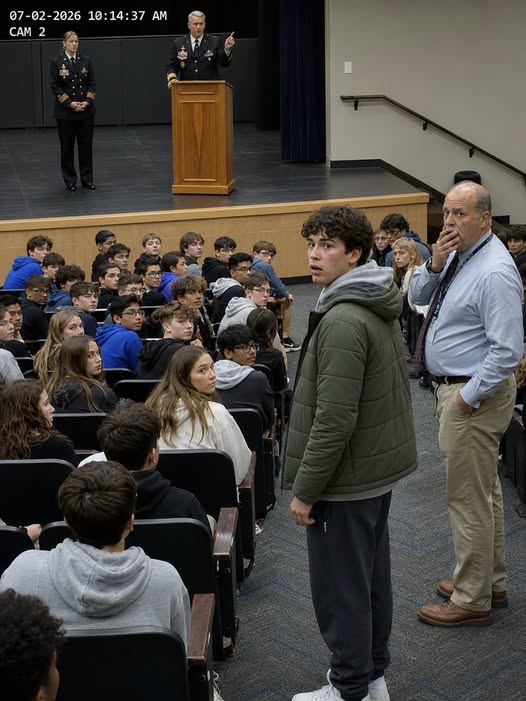
By the time the afternoon assembly arrived, the humiliation had become a physical weight. The auditorium was a sea of restless students and stern-faced faculty. Admiral William Carter, a man whose reputation preceded him, sat on the stage with the quiet, imposing gravity of a career soldier. I tried to shrink into the shadows of the freshman section, hoping to remain invisible. Then, the impossible happened. As Principal Harris introduced the guests, the Admiral glanced at the program, his eyes locking onto my name. The shift in his demeanor was instantaneous—not confusion, but a profound, chilling recognition. He stood, the room fell into a sudden, suffocating silence, and he called for me and my mother to join him on stage. As the rear doors of the auditorium creaked open, the sight of my mother in her dark Air Force uniform silenced the room more effectively than any gavel ever could.
The walk to the stage felt like traversing a mile of broken glass. My mother’s face was set in that familiar, stoic mask she wore whenever the world demanded too much of her. As we stood beside the Admiral, the air felt thin, charged with the weight of secrets that had defined my childhood. It was there, under the harsh glare of the stage lights, that I began to understand the true nature of the “Ghostwing” project. It was not merely a technological marvel of aviation; it was a shadow that had followed us through every relocation, every locked door, and every whispered conversation behind closed doors. The Admiral’s recognition was not just an honor; it was an acknowledgment of a classified reality that had turned my mother into a legend and me into a target. I realized then that my mother had not just been flying a jet; she had been navigating a labyrinth of high-stakes military secrets that had effectively stolen her autonomy and, by extension, my own.
The weeks that followed the assembly were a blur of debriefings and cold, sterile rooms. I learned that the Ghostwing project was a volatile intersection of experimental engineering and geopolitical leverage, a secret that had made my mother a pawn in a game far larger than she had ever anticipated. The laughter of my classmates seemed like a distant, childish memory compared to the reality of the danger we now faced. I was no longer just the quiet kid from Northwood; I was a key, a link in a chain of information that powerful men were desperate to control. The pressure to conform to the legacy of the project was immense, a constant, low-frequency hum of expectation that I was meant to follow in her footsteps, to embrace the same dangerous path that had cost my mother her peace of mind.
Yet, in the quiet moments between the interrogations and the strategic maneuvering, I saw the woman behind the pilot. I saw the exhaustion in her eyes and the way she looked at me—not as a successor to her military burden, but as a person she had fought to keep separate from the darkness. The turning point came in a hangar far from the prying eyes of the public, where the prototype of the Ghostwing sat like a dormant beast. A man named Voss, a figure who had once been a colleague of my mother, attempted to force my hand, to make me see the “potential” of the technology. He spoke of power and destiny, but all I saw was the wreckage of a life lived in the service of a machine. My mother stood between us, a silent guardian who had finally decided that the cost of the project was too high to pay any longer.
I chose to walk away. It was not a grand, cinematic exit, but a quiet, firm rejection of the path laid out for me. I refused to let the Ghostwing define my future or to let the darkness of my mother’s career become my own. In the aftermath, as the dust settled and the classified files were locked away for good, I found a strange, newfound clarity. The vindication I had sought in the auditorium was nothing compared to the freedom of choosing my own identity. My mother had spent her life protecting me from the sky, and finally, I was the one who could offer her a reprieve from the burden of the wings she had been forced to wear. We returned to a life that, while forever changed, was finally our own, stripped of the lies and the secrets that had once threatened to consume us both. I realized that the greatest courage was not found in the cockpit of a fighter jet, but in the ability to walk away from the things that demand you lose yourself, and in that resolve, I finally found my peace.