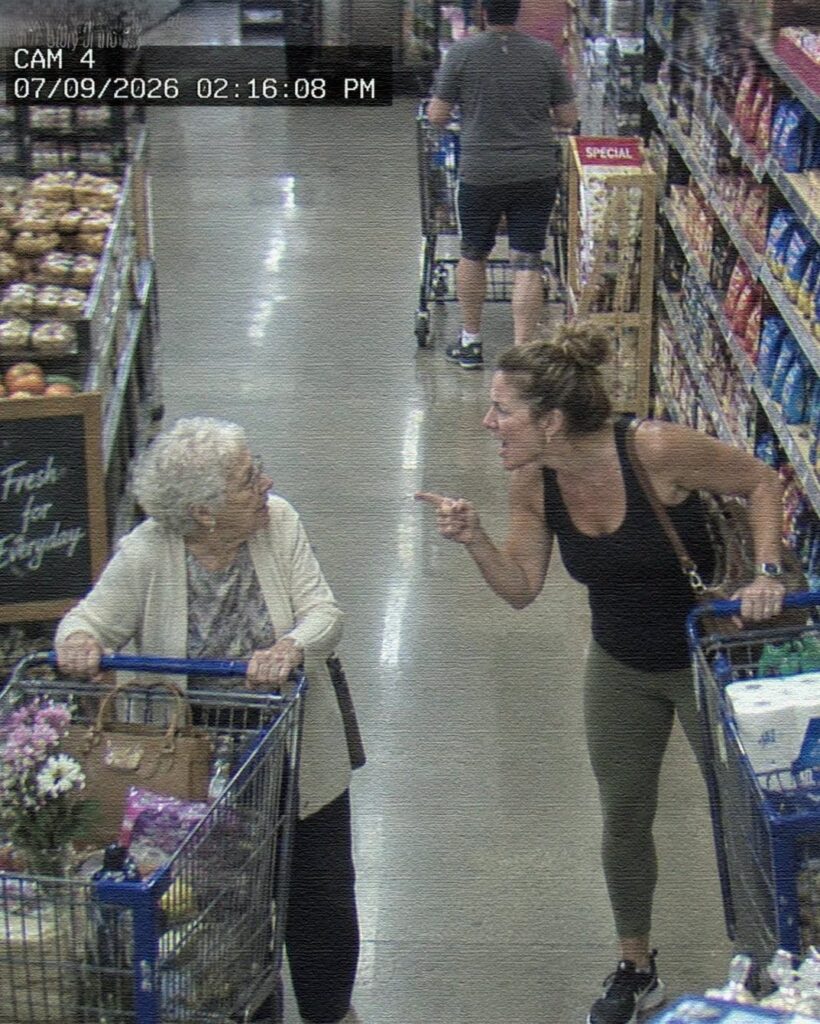
A box that would expose a family secret my mother had carried for more than fifty years.
My mother, Margaret, was eighty-three and fiercely independent.
She still insisted on doing her own grocery shopping.
She still cooked for herself.
Still folded her own laundry.
Still became offended whenever I offered to do something she believed she could manage perfectly well alone.
That Saturday, the supermarket was packed.
Mom only had six items.
Bread.
Milk.
Tea.
Apples.
Soup.
And a small chocolate cake she claimed was “for visitors,” even though we both knew she would eat half of it herself.
When it was our turn to pay, Mom opened her purse.
Then froze.
“Where did I put it?”
“What?”
“My wallet.”
She started searching.
Her hands weren’t as steady as they used to be, and the more she struggled, the more nervous she became.
Behind us, a woman with an overflowing cart sighed loudly.
“Oh, come on.”
Mom glanced over her shoulder.
“I’m sorry.”
The woman pushed her cart forward.
“If you’re too old to handle grocery shopping, maybe you should stay home.”
I turned around immediately.
“Excuse me?”
She rolled her eyes.
“I’m saying what everyone here is thinking.”
Nobody around us looked like they were thinking it.
Several people looked embarrassed for her.
Mom touched my arm.
“Amani, don’t.”
I hated that.
Even after being insulted, my mother was trying to keep me from causing a scene.
She finally found her wallet.
“There.”
Her hands shook as she pulled out her card.
The woman behind us laughed under her breath.
“Unbelievable. We’re all waiting for this.”
I opened my mouth.
But before I could say anything, the cashier looked up.
Her eyes landed on my mother.
And she froze.
Completely.
The irritation around us disappeared from my mind.
The cashier stared at Mom as though she had seen a ghost.
“Ma’am?”
Mom looked confused.
“Yes?”
“What’s your name?”
The cashier’s name tag read HELEN.
Mom blinked.
“Margaret.”
Helen didn’t move.
“Margaret what?”
My mother gave her last name.
Helen’s face drained of color.
Then she reached underneath the register.
Click.
The conveyor belt stopped.
The register locked.
She switched off the lane light.
The woman behind us groaned.
“You cannot be serious.”
Helen grabbed the phone.
“Tom?”
She listened.
“I need you at register six.”
Another pause.
“No. Right now.”
Mom looked at me.
“Amani, what is happening?”
“I have absolutely no idea.”
Helen was still staring at her.
“How old are you, Margaret?”
Mom frowned.
“Eighty-three. Why?”
Helen covered her mouth.
“Oh my God.”
“What?” I asked.
Her eyes filled with tears.
“Please. Just give me a minute.”
About two minutes later, the store manager hurried toward us.
Helen leaned close and whispered something.
His expression changed.
“The box?”
Helen nodded.
He disappeared toward the back offices.
The woman behind us had reached the end of her patience.
“This is ridiculous.”
Helen finally looked at her.
“Register four is open.”
“You said nobody leaves.”
Helen’s voice remained calm.
“I wasn’t talking to you.”
Someone nearby laughed.
The woman turned bright red, grabbed her cart, and stormed toward another checkout.
Mom barely noticed.
She was staring toward the back of the store.
The manager returned carrying an old cardboard box.
The tape around it had been replaced so many times that the corners had softened.
Helen took it with both hands.
“I’ve kept this here since my mother died.”
Mom’s expression softened.
“Oh, sweetheart. I’m sorry.”
Helen swallowed.
“Her name was Anna.”
Mom’s wallet slipped from her hand.
It hit the floor.
I bent to pick it up.
Mom didn’t move.
“What did you say?”
“Anna.”
My mother’s hand closed around the edge of the counter.
I had never heard that name before.
Helen continued.
“My mother spent most of her life wondering what happened to you.”
Mom stared at her.
Helen’s voice trembled.
“She had photographs of you.”
“What photographs?”
“One of them was older. She found it years later.”
Helen looked closely at Mom’s face.
“I knew you before I knew who you were.”
My mother made a sound I had never heard before.
Not quite a sob.
Not quite a word.
Then she whispered:
“Anna had a daughter?”
Helen nodded.
“I’m her daughter.”
I stared at my mother.
“Mom?”
She seemed to have forgotten I was standing there.
“Who is Anna?”
Mom’s lips trembled.
“A little girl I loved.”
Helen opened the box.
The first thing she removed was a photograph.
Its edges were curled.
A young woman stood outside a small white house holding the hand of a little girl with dark braids.
The young woman was my mother.
She couldn’t have been more than twenty-five.
Mom reached toward the picture.
“She was my sister’s daughter.”
Helen said nothing.
Mom continued.
“My sister died when Anna was six.”
Her voice became unsteady.
“Anna’s father worked away from home a lot then. So she came to stay with me.”
“For how long?” I asked.
“Almost six years.”
Six years.
My mother had helped raise a child for six years.
And I had never heard her name.
“At first, I thought I was helping because my sister wasn’t there anymore.”
Mom touched the girl’s face in the photograph.
“But somewhere along the way, Anna became mine too.”
I stared at her.
“Why didn’t you ever tell me?”
Mom didn’t answer.
Helen did.
“My mother talked about you.”
Margaret closed her eyes.
“Please.”
“I think you need to hear this.”
Helen reached into the box again.
This time, she removed another photograph.
I recognized it immediately.
My mother was holding a newborn wrapped in a yellow blanket.
“That’s me.”
Helen looked at me.
“I know.”
Something about the way she said it made my stomach tighten.
She turned the photograph over.
On the back were two different kinds of handwriting.
The first belonged to Mom.
Amani. Six days old.
Underneath, in faded blue ink, someone had written:
The baby Margaret needed more than me.
Mom’s knees buckled.
I caught her.
“No.”
Helen immediately came around the counter.
Mom stared at the words.
“No, no, no.”
“Mom?”
“That isn’t what happened.”
She pressed the photograph against her chest.
“That isn’t what I meant.”
The manager brought over a chair.
Mom sat down.
The store continued around us.
Carts rattled.
Registers beeped.
People walked past.
But register six had become its own little world.
Helen crouched beside her.
Mom looked at me.
“When I was pregnant with you, things were difficult.”
She took a shaky breath.
“I was sick constantly.”
I knew that part.
“Your father was working two jobs. We were behind on bills. The refrigerator broke.”
She looked at Helen.
“And Anna needed new shoes.”
Helen was crying now.
“Anna’s father, Robert, offered to take her for the summer.”
“You said no?” I asked.
“Immediately.”
Mom looked down.
“Until one night.”
She had been exhausted.
Sick.
Scared.
After Anna went to bed, Mom sat at the kitchen table and cried.
“I told your father I didn’t know how I was going to manage once the baby arrived.”
She squeezed my hand.
“And I said…”
Her voice cracked.
“I don’t know how I’m going to manage both of them.”
Helen inhaled sharply.
“Mom heard you.”
Margaret looked up.
“What?”
Helen nodded.
“She told me.”
My mother went completely still.
“The next morning,” she whispered, “Anna said she wanted to live with her father.”
Helen nodded.
“I argued with her.”
“I know.”
“She insisted.”
“I know.”
“I thought she missed him.”
Helen wiped her face.
“She thought she was helping you.”
Mom broke.
Not gently.
Not quietly.
She covered her face and sobbed.
“She left because of me?”
“No.”
Helen took both of her hands.
“She left because she loved you.”
I wrapped my arms around my mother.
For a moment, she didn’t feel eighty-three.
She felt like a frightened young woman losing a child all over again.
“I tried to get her back,” Mom cried.
“I know.”
“I called.”
“She wouldn’t speak to you.”
“Robert said she needed space.”
Helen nodded.
“He told me not to come,” Mom said. “He said I was making it harder for her to adjust.”
Helen closed her eyes.
“Mom thought you’d come anyway.”
Mom stared at her.
“She didn’t want to talk to me.”
“She was twelve.”
Helen’s voice softened.
“She thought if you really wanted her, you would refuse to let her leave.”
Mom’s face collapsed.
“I thought respecting her choice was loving her.”
“She thought fighting her choice was.”
Neither woman spoke.
And suddenly I understood.
They had spent more than fifty years interpreting the same silence in opposite ways.
Anna thought Margaret had let her go.
Margaret thought Anna wanted to be left alone.
Then Helen picked up the photograph of me.
“After Amani was born, you sent this.”
“With a letter.”
Helen looked at her.
“What?”
“A four-page letter.”
Helen’s face changed.
“There was no letter.”
Mom stared.
“Yes, there was.”
“What did it say?”
Mom’s voice became urgent.
“I told Anna her room was still hers.”
Helen covered her mouth.
“I told her I wanted her home.”
Mom looked at me.
“I told her she had a baby sister.”
Helen shook her head.
“My mother never saw that.”
“What do you mean?”
“Robert had moved.”
Helen explained that the envelope had been forwarded.
When it finally reached Anna, it had been damaged.
“The envelope was torn open and placed inside a postal bag.”
Mom stared at her.
“What was inside?”
“Only the photograph.”
No letter.
No explanation.
No invitation home.
Just a photograph of Margaret smiling while holding a newborn.
To twelve-year-old Anna, it looked like proof.
Margaret had the daughter she really wanted.
Mom covered her mouth.
“Oh God.”
“I sent another card.”
Helen reached into the box.
“I know.”
She pulled out an envelope.
Mom recognized the handwriting immediately.
Her own.
Across the front, somebody had written three words in blue ink.
RETURN TO SENDER.
Helen touched the writing.
“That’s my mother’s handwriting.”
Mom looked devastated.
“She sent it back.”
“Yes.”
“Then why did she think I didn’t try?”
Helen swallowed.
“She sent it back because she wanted to see if you’d send another one.”
Mom stared at her.
“What?”
“She checked the mailbox every day afterward.”
Mom closed her eyes.
“Then Christmas came.”
Helen nodded.
“She thought you’d write.”
“I didn’t.”
“I know.”
“I thought she was telling me to leave her alone.”
“And she thought you had given up.”
The cruelty of it was almost impossible to comprehend.
Each believed they were respecting what the other wanted.
Each experienced the other’s silence as rejection.
Years passed.
Robert moved again.
My parents moved.
Anna married.
Her surname changed.
Life became more complicated.
And eventually, misunderstanding hardened into fear.
“Why didn’t she look for me when she got older?” Mom asked.
There was no anger in her voice.
Only heartbreak.
Helen looked at her.
“Probably for the same reason you didn’t look for her.”
Mom said nothing.
“She was scared.”
“Of what?”
“That she’d find you.”
Helen paused.
“And learn she’d been right.”
Mom whispered:
“That I didn’t want her.”
“Yes.”
Mom looked away.
“I was scared of the opposite.”
“That she really didn’t want you.”
Mom nodded.
“For decades.”
Helen reached into the bottom of the box.
There was a small bundle tied with string.
Inside were addresses.
Photographs.
Notes.
Newspaper clippings.
Returned letters.
Anna had looked for Margaret.
Not constantly.
But throughout her life.
An old address one year.
A possible married name another.
A photograph she had found somewhere.
A letter sent to a house Margaret had already left.
“She did look,” Helen said.
Mom touched one of the papers.
“So did I.”
Then Helen removed a folded letter.
“Mom wrote this after she got sick.”
Mom couldn’t take it.
Her hands were shaking too badly.
“Read it.”
Helen opened the letter.
She only read a few lines.
Anna wrote that she no longer blamed Margaret.
That becoming a mother herself had changed the way she saw the past.
That adults could love children desperately and still make mistakes that changed entire lives.
Then Helen stopped.
“There’s something else.”
Mom looked up.
Helen glanced at me.
“My mother never forgot Amani.”
I blinked.
“What?”
“She called you her little sister.”
My throat tightened.
I had lived my entire life without knowing a woman somewhere had thought of me that way.
For Anna at twelve, I had been the baby she believed replaced her.
But as an adult, something had changed.
I had become the sister she wished she had met.
Mom reached for Helen’s hand.
“Did she hate me?”
“No.”
“Was she angry?”
“For a long time.”
Mom nodded.
Then Helen squeezed her fingers.
“But she never stopped loving you.”
Mom began crying again.
“Before she died,” Helen continued, “she told me something.”
“What?”
“She said if I ever found you, I shouldn’t ask why you didn’t come for her.”
Mom waited.
“She wanted me to ask if you thought she didn’t want you.”
Margaret broke down.
“I did.”
Helen nodded through tears.
“She thought so.”
“I would’ve gone anywhere for her.”
“I know.”
“She needed to know that.”
Helen’s voice cracked.
“She died hoping it was true.”
There are sentences that comfort you.
And sentences that hurt because comfort arrived too late.
That one did both.
Nothing could return those lost decades.
Anna could never hear what Margaret had written in the missing four-page letter.
Margaret could never go back and hold a twelve-year-old girl who was checking the mailbox every afternoon.
There would be no reunion between them.
No chance to laugh about the misunderstanding.
No chance to say:
You were wanted.
You were loved.
I thought you wanted me to stay away.
But after more than fifty years, my mother finally knew something she had spent most of her life doubting.
Anna had loved her too.
For a while, none of us spoke.
Then Mom wiped her face.
Looked at the six items sitting untouched on the conveyor belt.
And said:
“I think I’d like to buy my groceries now.”
Helen laughed through her tears.
“Okay.”
She returned behind the counter.
Unlocked the register.
Turned the belt back on.
One by one, she scanned Mom’s groceries.
Bread.
Milk.
Tea.
Apples.
Soup.
Chocolate cake.
When it was time to pay, Mom took out her card.
Her hands were trembling again.
She tried to insert it into the reader.
Missed.
She tried a second time.
Missed again.
For half a second, I saw embarrassment cross her face.
I knew exactly what she was remembering.
The woman behind us.
The sigh.
The cruel remark.
If you’re too old to handle shopping, maybe stay home.
“I’m sorry,” Mom whispered automatically.
Helen reached toward the card reader.
But she didn’t take the card from her hand.
Instead, she held the machine steady.
“Try again.”
Mom did.
This time, the card slid into place.
Helen looked directly at her.
“Take your time.”
Mom gave a weak smile.
“I’ve already made you wait long enough.”
Helen’s eyes filled again.
“You don’t have to apologize for making me wait.”
She reached across the counter and placed her hand over Mom’s.
Margaret laughed.
Then cried.
Then somehow did both at once.
When we finally left the store, Helen walked outside with us.
Under the awning, she turned the newborn photograph over again.
The baby Margaret needed more than me.
Mom touched the faded words.
“She was wrong.”
“I know,” Helen said.
“I wish I could tell her.”
Helen looked at my mother for a long moment.
Then said:
“You just did.”
Mom reached up and touched Helen’s cheek.
Neither woman moved for several seconds.
That morning, a stranger had looked at my mother’s trembling hands and decided she was wasting everyone’s time.
She had no idea Margaret had already spent more than fifty years waiting.
Waiting for a child who thought she had been replaced.
Waiting for an explanation that had vanished with a damaged letter.
Waiting for proof that silence had never meant a lack of love.
Before we left, Mom handed me the photograph.
“Keep this safe.”
I looked at the newborn version of myself in her arms.
Then at Anna’s faded words on the back.
“I will.”
Mom took Helen’s hand.
And as they walked together toward the parking lot, my mother’s fingers were still trembling.
But this time, nobody sighed.
Nobody complained.
And nobody told her to hurry.
{"post":112490,"page":2,"next":[{"id":112487,"title":"My Son\u0027s Fianc\u00e9e Asked Me Not to Wear Blue to Their Wedding \u2013 Then I Saw What Her Mother Was Wearing","url":"https:\/\/new24.info\/112487"},{"id":112485,"title":"For Eight Years He Left The House At The Same Hour, And I Never Once Asked Where The Road Went.","url":"https:\/\/new24.info\/112485"},{"id":112471,"title":"Kobe Bryant\u0027s Daughter Natalia Attends the US Open Blue Carpet in a Chic Look That Has Fans Comparing Her to Her Father and an Unexpected Celebrity \u2014 Photos","url":"https:\/\/new24.info\/112471"},{"id":112468,"title":"Which animal do you see first? Rabbit?\/ Fish??","url":"https:\/\/new24.info\/112468"},{"id":112466,"title":"A Sixth Grader\u2019s Quiet Persistence Transformed a Simple Gift Into a Lasting Lesson of True Heart","url":"https:\/\/new24.info\/112466"},{"id":112462,"title":"He Walked Away After the Pregnancy Test\u2014Then the Truth Changed Everything","url":"https:\/\/new24.info\/112462"},{"id":112459,"title":"My 8-Year-Old Granddaughter Pointed at the Boy in My Old Prom Photo and Said, \u0027Grandma, He Gives Me Extra Dessert at School\u0027 \u2013 He\u0027d Been Gone for 42 Years, and She Handed Me Something That Made Me Go Pale","url":"https:\/\/new24.info\/112459"},{"id":112456,"title":"My Wife Left Me with Our 6 Daughters for Her Rich Boss \u2013 15 Years Later, She Showed up at Our Oldest Daughter\u0027s Wedding, but What Our Daughter Did Next Left Everyone Speechless","url":"https:\/\/new24.info\/112456"},{"id":112448,"title":"Dad revealed heartbreaking last words before son, 10, was decapitated on \u2018world\u2019s tallest waterslide\u2019","url":"https:\/\/new24.info\/112448"},{"id":112449,"title":"Shakira Stops Miami Performance Unexpectedly After Incident in the Crowd","url":"https:\/\/new24.info\/112449"},{"id":112441,"title":"The Tiny House Bug That May Be Hinting at a Bigger Issue","url":"https:\/\/new24.info\/112441"},{"id":112434,"title":"Beloved Indigenous actor and filmmaker dies following tragic rodeo incident","url":"https:\/\/new24.info\/112434"},{"id":112433,"title":"Can You Spot the Hidden Figure in This Eagle Illusion?","url":"https:\/\/new24.info\/112433"},{"id":112429,"title":"Husband Demands Divorce Before Brain Surgery Without Knowing Wife Controls Entire Fortune","url":"https:\/\/new24.info\/112429"},{"id":112425,"title":"Bride Abandons Her Wedding After Shocking Early Morning Demands For Gold","url":"https:\/\/new24.info\/112425"},{"id":112421,"title":"The ultimate visual brain-scan test: left-brained, right-brained ?","url":"https:\/\/new24.info\/112421"},{"id":112418,"title":"After My In-Laws Moved Out, I Found Something Unexpected Under the Guest Bed","url":"https:\/\/new24.info\/112418"},{"id":112416,"title":"Remembering Georgina Lightning: A Trailblazing Indigenous Filmmaker and Advocate","url":"https:\/\/new24.info\/112416"},{"id":112413,"title":"A Medical Failure and a Heartbreaking Accusation Lead to a Miraculous Truth","url":"https:\/\/new24.info\/112413"},{"id":112410,"title":"The Quiet Reclamation of a Life Once Stolen by Those I Raised","url":"https:\/\/new24.info\/112410"}]}