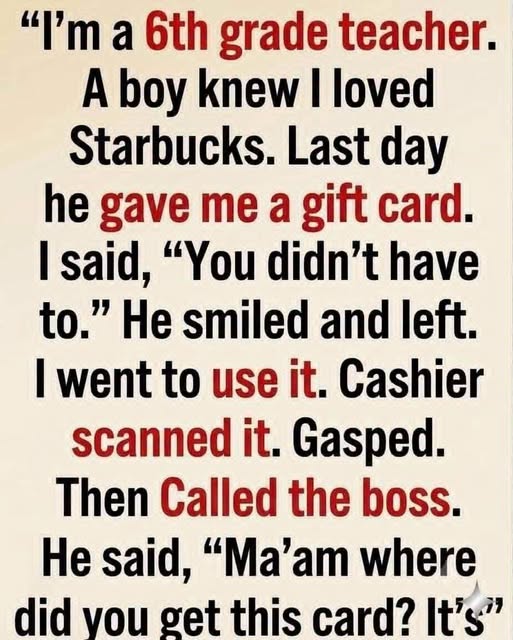
The teacher accepted the gift with a warm smile, assuming it was a standard token of appreciation—a common gesture in the final hours of the academic year. Inside, a simple Starbucks card rested against the paper. It seemed like a polite, unremarkable end to a long year, yet the boy’s lingering gaze suggested something deeper. He didn’t rush away; he stood there for a heartbeat longer than necessary, as if checking to see if the weight of the envelope was felt, before finally turning to join his friends in the hallway. The teacher tucked the card into a drawer, intending to use it during the quiet, reflective days of summer break, never suspecting that the plastic rectangle held a history far more profound than a quick caffeine fix. The classroom felt suddenly empty, the silence magnifying the small, kind gesture that had just occurred.
A few days later, the teacher found themselves standing at the counter of the local coffee shop, the afternoon sun streaming through the glass. As they presented the card to the barista, the manager, who had been observing the transaction from the side, leaned in with a curious expression. He asked, with a gentle tone, if the card had been a gift from a young student. When the teacher nodded, the manager’s face softened into a look of genuine admiration that caught the teacher off guard. He gestured toward the counter, inviting the teacher to step aside for a moment, and began to recount a story that would forever change how the teacher viewed the act of giving. It was a story of a child’s quiet, unwavering commitment to a goal that transcended the simple act of purchasing a beverage.
For weeks, the manager explained, this same sixth-grade boy had been a regular fixture at the shop, though he rarely ordered anything for himself. Instead, he would approach the register with a handful of coins—pennies, nickels, and dimes—meticulously counted out from a small pouch. He would ask the staff to load the change onto the same gift card, one small increment at a time. The employees had grown accustomed to his presence, watching as he navigated the process with a seriousness that belied his age. He wasn’t just buying coffee; he was building a gift with the currency of his own persistence. The staff members had often wondered about the boy’s motivation, watching him carefully count his meager savings, but they never interfered, respecting the gravity of his mission.
The manager recalled how the boy had confided in them early on, explaining that he was saving every spare cent he could find to honor his favorite teacher before school ended. He had turned the mundane act of saving change into a ritual of devotion. Every time he stood at that counter, he wasn’t just handing over metal; he was investing his own time, his own restraint, and his own quiet labor into a project that no one else could see. The staff had watched him return again and again, his pockets lighter but his resolve clearly growing stronger with every visit. It was a rare display of foresight for a child of his age, a testament to a character that prioritized the happiness of others over his own immediate desires.
As the manager spoke, the teacher felt the air in the coffee shop shift. The card in their hand, which had felt like a simple plastic object just moments ago, suddenly felt heavy with the weight of the boy’s dedication. The teacher pictured the student, perhaps skipping a small treat for himself or scouring his home for stray coins, all to ensure that this specific gift would be ready by the last day of school. The realization hit with the force of a revelation: this was not a gift of money, but a gift of time, sacrifice, and deep, unspoken gratitude. The teacher realized that the boy had been planning this for weeks, carefully curating a token of appreciation that reflected his own personal investment in the classroom experience.
The teacher left the shop, the coffee forgotten, and returned home to place the card in a prominent spot on their desk. It remained there, even after the balance was spent, serving as a permanent anchor for the teacher’s perspective. It became a daily reminder that the most significant contributions in life are rarely the ones that carry the highest price tag. Instead, they are the ones forged in the quiet, steady fires of intention and effort. The boy had taught a lesson that no textbook could ever convey, proving that true generosity is measured not by the size of the offering, but by the depth of the heart that prepares it. Every time the teacher looked at the card, they were reminded of the student’s patience and the profound impact of his small, consistent actions.
In the months that followed, the teacher often found themselves looking at that card and feeling a renewed sense of purpose. The student’s act of kindness had transcended the classroom, leaving a mark that would not fade with the seasons. It was a testament to the idea that even the smallest, most overlooked actions—when fueled by genuine care and unwavering patience—can create a legacy of warmth. The gift was no longer about coffee; it was a beautiful, enduring symbol of a young soul who understood that the best way to show someone they matter is to give them a piece of your own time, one coin at a time, until the gift is finally, perfectly complete. The teacher finally understood that the true value of the gift lay in the journey of its creation, a journey that had been walked with love and purpose, resulting in a bond that would remain long after the school year had ended.