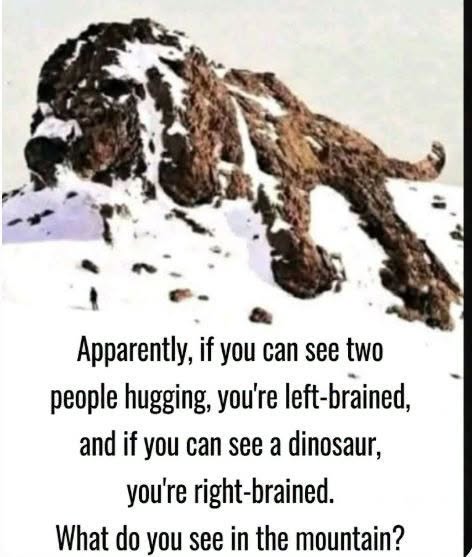
These suggested interpretations act as a psychological barrier, forcing your brain to search for patterns that fit these specific, preconceived categories. Because your focus is narrowed to finding human figures or reptilian features, your visual system effectively filters out the actual subject matter. The image is not a psychological test of brain dominance; it is a masterclass in camouflage. The snowy terrain provides a high-contrast background that obscures the natural contours of the animal, making the dog’s form blend seamlessly into the drifts and ridges of the landscape. By focusing on the suggested narratives, you are essentially ignoring the most obvious physical evidence present in the photograph.
To break through this illusion, you must consciously suspend the search for the suggested figures and instead scan the image for organic, non-human textures. If you look closely at the left side of the composition, the chaotic shadows and highlights begin to resolve into recognizable anatomy. You will find a distinct, dark snout, a soft eye, and floppy ears that are partially dusted with snow. These features are the key to unlocking the entire scene, but they are easily overlooked when the mind is preoccupied with the false choices provided by the caption. The brain is naturally inclined to favor the most complex or dramatic narrative, which is why the idea of a dinosaur or a romantic couple is far more compelling than the reality of a resting pet.
The supposed mountain ridge, which might have looked like the back of a dinosaur or the silhouette of a person, is actually the curve of a large dog’s body. Once you identify the head, the rest of the animal becomes impossible to unsee. You can trace the front paws as they stretch comfortably over the frozen mound, and follow the long, relaxed line of the body as it extends toward the right side of the frame. The scale of the animal is distorted by the snowy environment, which is why it may appear significantly larger or more mysterious than a typical domestic pet. The way the snow settles on the fur creates a unique texture that mimics the surrounding terrain, effectively masking the animal’s true form from a casual observer.
This phenomenon illustrates a fundamental principle of human perception: we are pattern-seeking creatures who prefer to categorize visual information quickly rather than analyze it objectively. By providing two distinct, unrelated options—lovers or a dinosaur—the illusion exploits our tendency to accept a binary choice. We want to be right, so we force the ambiguous shapes into the boxes we have been given. The brain effectively ignores the “noise” that does not fit the narrative, even when that noise contains the actual answer. This cognitive bias is a survival mechanism, but in the context of visual puzzles, it often leads us away from the truth.
Once the dog is identified, your brain undergoes a shift known as perceptual reorganization. The features that were previously confusing—the strange lumps, the dark patches, and the odd angles—suddenly coalesce into a coherent, familiar image. This is not a change in the image itself, but a change in your cognitive map. The dog’s face, paws, and posture become obvious because your brain has finally established a successful template for interpreting the visual input. The mystery vanishes the moment you stop looking for what you were told to see and start observing what is actually there. This shift is permanent; once you have seen the dog, your brain will likely prioritize that image every time you look at the picture in the future.
To avoid falling for similar visual traps in the future, practice a more analytical approach to ambiguous imagery. Start by ignoring the captions, headlines, or suggested outcomes that accompany such puzzles. Instead, break the image down into smaller, geometric components. Look for textures, light sources, and shadows that do not align with the suggested narrative. By consciously deconstructing the image rather than searching for a complete, pre-defined shape, you can bypass the cognitive bias that leads to these common misinterpretations. The next time you are presented with a “brain test,” remember that the most effective way to solve it is to trust your own observation over the provided labels. True visual clarity comes from patience, not from following the path of least resistance set by others.