We poured the foundation in 1988.
Three years later, the house was finished.
Richard was a civil engineer, but the details were personal—the white oak floors, walnut cabinets, and dozens of small imperfections that made the house ours.
He died seven years ago after thirty-eight years of marriage.
Afterward, I kept almost everything as he’d left it.
My favorite piece wasn’t valuable at all.
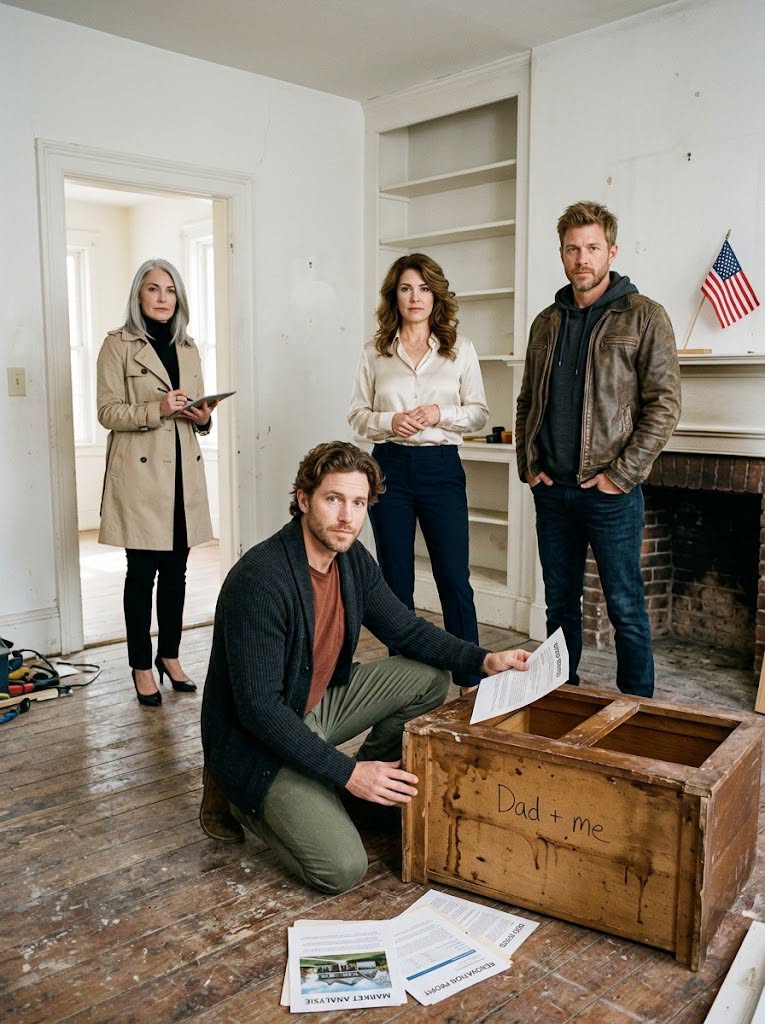
It was a crooked pine bookshelf Richard had built with our son, Derek, when Derek was nine.
On the back, two shaky words had been burned into the wood:
Dad and me.
Years later, Derek became a successful corporate attorney in Des Moines and became engaged to Morgan Ellis, who worked in commercial real estate marketing.
From the beginning, Morgan seemed unusually interested in my house.
It had recently been appraised at just under $700,000.
She talked about its value, renovation potential, and resale possibilities.
Then her contractor brother, Gavin, visited and spent more time examining the foundation and cabinetry than talking to me.
Still, I wanted to welcome Morgan into the family.
I spent approximately $72,000 covering Derek’s wedding.
And privately, I planned something much larger.
My estate attorney, Patricia Hames, prepared documents that would allow me to transfer the house to Derek as a wedding gift.
Richard had built it.
I thought he’d want our son to have it.
The deed wasn’t signed yet.
That detail became very important.
At the rehearsal dinner, held at the expensive winery venue I’d paid for, I discovered my seat positioned near the restrooms.
I ignored it.
Then Morgan approached me privately in the hallway.
She had something she wanted to say before the wedding.
“The best gift you could give us,” she told me calmly, “is to disappear from our lives.”
According to Morgan, Derek didn’t need me anymore.
I didn’t yell.
I didn’t tell Derek.
I simply reached inside my blazer and touched the unsigned deed.
Then I drove home.
I went into Richard’s old workshop, placed the document on his workbench and wrote one word across the signature line.
DENIED.
The following morning, while everyone else prepared for the wedding, I called Patricia.
The transfer was canceled.
Instead, I arranged for the house to be placed into a protective estate structure so nobody could treat it as an expected wedding asset.
Then I called movers.
By Wednesday afternoon, three trucks had removed thirty-four years of my belongings.
I moved into a comfortable furnished apartment near the river.
I took Richard’s engineering jacket.
His old pencil.
Our photographs.
Everything that mattered.
I left one thing behind.
The crooked bookshelf.
That belonged to Derek.
Beside it, I placed an envelope.
Inside were three documents.
The first was a market analysis Morgan had commissioned months before the wedding, calculating potential resale figures for my property.
The second was the unsigned deed she’d never known existed.
Across it was my answer.
DENIED.
The third was a letter to my son.
I told Derek exactly what Morgan had said to me.
I also reminded him that his father had loved him more than any house could ever represent.
When Derek and Morgan eventually entered the property, they found almost nothing.
Just empty rooms.
The oak floors Richard had laid.
And that crooked bookshelf.
Derek sat on the floor and read everything.
Then he called me.
He admitted he’d spoken about the house as though inheriting it someday was practically guaranteed.
That had apparently helped create Morgan’s expectations.
But he hadn’t known she’d already been calculating what could be done with the property.
I told him about the rehearsal dinner.
Every word.
Derek apologized.
Then he asked what I thought he should do about his marriage.
For perhaps the first time in my life, I refused to give my son an answer.
I had spent three decades watching families interfere with one another’s marriages.
I wasn’t going to become another case from my own courtroom.
Derek and Morgan began counseling.
What happens between them is their decision.
Mine had already been made.
The house Richard built would not become somebody else’s anticipated profit.
Recently, Derek came to my apartment for dinner.
We talked about his father.
We laughed about Richard’s terrible singing and the years it took him to finish projects because nothing was ever quite good enough.
Before Derek left, he carefully carried the crooked bookshelf downstairs and loaded it into his car.
I watched from the window.
For years, I’d thought preserving Richard’s legacy meant keeping his house exactly as he’d left it.
I understand it differently now.
A legacy isn’t the market value of white oak floors or walnut cabinets.
It isn’t an appraisal approaching $700,000.
Sometimes it’s a crooked bookshelf made by a father and his nine-year-old son.
Morgan wanted me to disappear so she and Derek could begin their new life.
In one sense, I gave her exactly what she requested.
I stepped away.
I stopped interfering.
And I let my adult son decide what kind of marriage he wanted.
But I didn’t disappear from my own life to make theirs more profitable.
After thirty-one years of watching people fight over property, retirement finally gave me one last lesson:
You can love your children deeply without handing them everything you own.