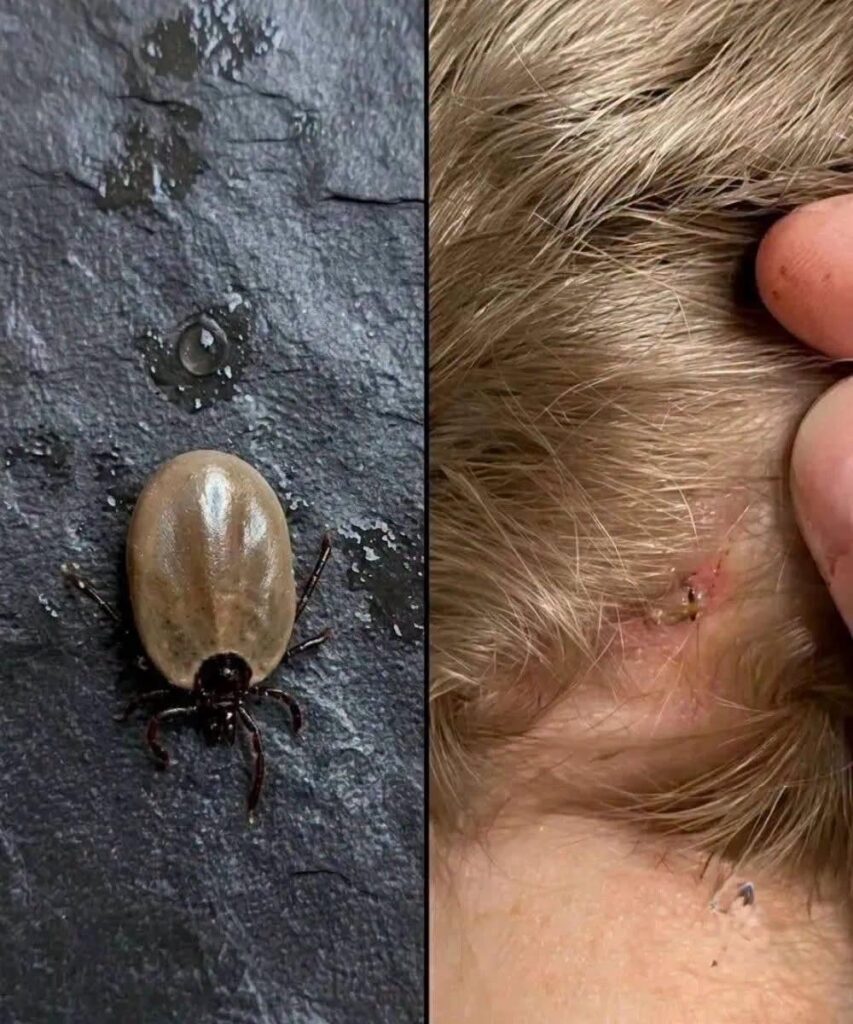
The first step is removing the tick safely.
Use a pair of fine-tipped tweezers and grasp the tick as close to the skin as possible. Try to catch it near the head or mouthparts rather than squeezing its body.
Once you have a firm grip, pull straight upward using slow, steady pressure.
Avoid twisting, jerking, crushing, or squeezing the tick. These actions can make removal more difficult and may leave parts of the tick embedded in the skin.
After the tick has been removed, wash the bite area and your hands thoroughly with soap and water. An antiseptic can also be used to clean the area.
Some parents choose to place the removed tick in a sealed container or plastic bag and record the date of the bite. This may be useful if symptoms later develop and a healthcare professional wants more information about the possible tick species or exposure.
Removing the tick is only the first part.
For the following days and weeks, pay attention to how your child feels.
Watch for symptoms such as fever, unusual tiredness, headache, muscle or joint aches, swollen lymph nodes, or an unexplained rash.
Also pay attention to changes in your child’s normal behavior, especially in younger children who may not be able to clearly describe how they feel.
Some illnesses associated with ticks do not cause symptoms immediately. Signs may appear days or even weeks after the bite, and the earliest symptoms can sometimes resemble an ordinary viral illness.
That is why remembering when the tick was found can be helpful.
The appearance of the bite itself is also worth monitoring.
A small area of redness or irritation immediately after removing a tick can occur and does not necessarily mean that an infection has developed.
However, a rash that grows, spreads, or develops an unusual pattern should be evaluated by a healthcare professional.
Parents should also seek medical advice if the tick appears to have been attached for a prolonged period, was significantly engorged, could not be completely removed, or if there is uncertainty about what type of tick it was.
Risk can vary considerably depending on where the bite occurred, the species of tick, how long it was attached, and which tick-borne diseases are present in that particular region.
A healthcare provider can use those details along with the child’s symptoms to decide whether further evaluation or treatment is necessary.
Prevention is equally important.
After children spend time hiking, camping, playing in wooded areas, walking through tall grass, or spending time around brush and vegetation, check their skin carefully.
Ticks often hide in warm or less visible areas, including behind the ears, along the hairline, under the arms, around the waist, behind the knees, between the legs, and around the scalp.
Protective clothing can also reduce exposure.
Long pants, closed shoes, and appropriate insect repellents can be particularly useful when children are spending time in places where ticks are common.
Clothing, backpacks, and outdoor gear should also be checked after returning indoors because ticks can sometimes be carried inside before attaching to the skin.
Finding a tick on your child is understandably stressful, but panic is rarely helpful.
Remove the tick carefully, clean the area, remember when the bite occurred, and monitor your child for anything unusual.
Most tick bites do not result in serious illness.
Knowing what to watch for—and seeking medical care when concerning symptoms appear—is the best way to protect your child while avoiding unnecessary fear.
{"post":112303,"page":2,"next":[{"id":112299,"title":"Devoted Mother Uncovers Husband Betraying Their Family Inside An Empty Apartment","url":"https:\/\/new24.info\/112299"},{"id":112295,"title":"Behind the Prairie: Uncovering the Production Realities and Enduring Quirks of a Television Classic","url":"https:\/\/new24.info\/112295"},{"id":112292,"title":"Behind the Prairie: Uncovering the Production Quirks and Human Realities of a Television Classic","url":"https:\/\/new24.info\/112292"},{"id":112290,"title":"The Valentine\u0027s Day Dinner Test That Almost Cost Us Everything","url":"https:\/\/new24.info\/112290"},{"id":112286,"title":"A Single Snapshot Unravels a Marriage When a Hidden Detail Shifts the Entire Narrative","url":"https:\/\/new24.info\/112286"},{"id":112283,"title":"A Vasectomy Failure and the Shattered Trust That Nearly Destroyed a Decade of Love","url":"https:\/\/new24.info\/112283"},{"id":112280,"title":"Henry Winkler Reflects on the Collaborative Spirit and Rare Tensions Behind the Scenes of Happy Days","url":"https:\/\/new24.info\/112280"},{"id":112276,"title":"My Husband Had an Affair with My Sister While I Cared for His Ill Mother \u2013 After the Funeral, We Divorced and They Got Engaged, but Days Later, He Yelled, \u0027You Knew from the Beginning That My Mother Would Do This!\u0027","url":"https:\/\/new24.info\/112276"},{"id":112274,"title":"Understanding the Hidden Function of Your Vehicle\u0027s Front Bumper Panel","url":"https:\/\/new24.info\/112274"},{"id":112271,"title":"The Carrum Beach Photograph: Analyzing the Viral Mystery Behind a Family Snapshot","url":"https:\/\/new24.info\/112271"},{"id":112268,"title":"Decoding the Baby Avatar Challenge: Can You Spot the Hidden Detail in This Viral Personality Test?","url":"https:\/\/new24.info\/112268"},{"id":112265,"title":"The Silent Sentinels: Decoding the Concrete Markers Hidden Within Our Forests and Old Roadbeds","url":"https:\/\/new24.info\/112265"},{"id":112262,"title":"Essential Safety Guidelines for Managing a Copperhead Snake Encounter and Potential Bite Injuries","url":"https:\/\/new24.info\/112262"},{"id":112259,"title":"The Strategic Silence: Analyzing the Viral Impact of the Taylor Swift and Travis Kelce Joint Livestream","url":"https:\/\/new24.info\/112259"},{"id":112255,"title":"Autistic boy goes to school with a hidden recorder in his backpack and two teachers get fired","url":"https:\/\/new24.info\/112255"},{"id":112250,"title":"Tennessee Governor Faces Rare Decision in Death Row Case","url":"https:\/\/new24.info\/112250"},{"id":112246,"title":"How to Spot a Sweet Watermelon Before You Buy","url":"https:\/\/new24.info\/112246"},{"id":112242,"title":"My Husband Returned to Vietnam Two Days After Our Wedding and Never Came Back \u2013 56 Years Later, Flowers Arrived with a Note That Began, \u0027Darling, You Won\u0027t Believe Why I Had to Disappear\u0027","url":"https:\/\/new24.info\/112242"},{"id":112240,"title":"The Cognitive Science Behind Why We Love Solving Visual Puzzles Like the Funny Fisherman","url":"https:\/\/new24.info\/112240"},{"id":112238,"title":"Why Our Brains Crave the Challenge of Visual Spot-the-Difference Puzzles","url":"https:\/\/new24.info\/112238"}]}