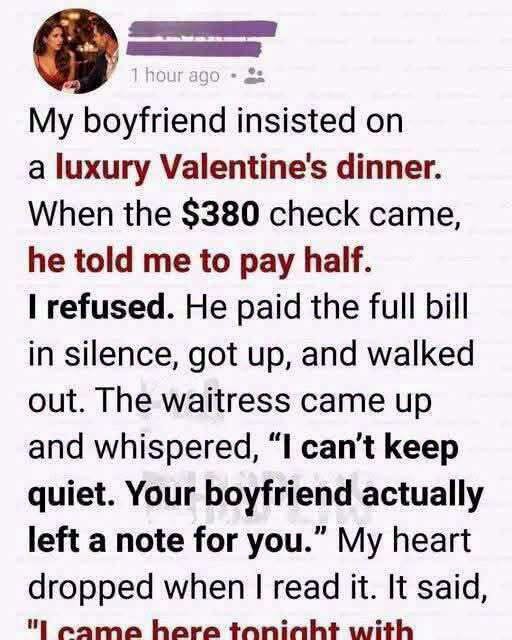
asked for half the payment. I felt a sharp sting of confusion, followed by a wave of indignation. We had discussed our finances before, but this demand felt like a sudden, jarring departure from the evening he had curated himself. I refused, my voice steady despite the thrumming in my chest. He paid the bill in silence, his expression unreadable, before standing up and walking out of the restaurant, leaving me alone with the remnants of our dinner.
I sat there for a long moment, the ambient noise of the restaurant fading into a dull roar. The waitress returned, her expression softened by a flicker of sympathy, and handed me a folded piece of paper he had left behind. My hands trembled as I unfolded the note. The handwriting was his, but the words felt like they belonged to a stranger. He explained that he had brought an engagement ring with him, intending to propose, but had decided to turn the evening into a test of how we would handle a financial disagreement. The realization hit me with the force of a physical blow. He had been watching me, measuring my reactions, and waiting for me to fail a test I never knew I was taking. The note continued, shifting from a confession of his intent to an admission of his own profound error. He acknowledged that testing me in such a manipulative way was inherently immature and unfair. He wrote that he had realized, in the moment of our conflict, that marriage should never be built upon games or psychological traps. He asked me to meet him outside, away from the prying eyes of the staff and the lingering tension of the table.
I found him standing near the valet stand, the cold night air doing little to dissipate the heat of my frustration. We walked to a quiet corner of the parking lot, and for the next two hours, we stripped away the pretenses that had defined our relationship. We talked about money, not as a weapon, but as a language we both needed to learn to speak. We discussed the expectations we carried from our respective upbringings and the fear that had driven him to create such a misguided experiment. It was a raw, difficult conversation, one that forced us to confront the cracks in our foundation that we had previously ignored. The conversation was not easy. There were moments when I wanted to walk away, to leave the hurt and the confusion behind, but the honesty we were finally sharing acted as an anchor. He apologized without reservation, admitting that his insecurity had clouded his judgment. I, in turn, expressed the betrayal I felt at being treated as a subject in his personal study rather than a partner. We did not solve every issue that night, but we established a new baseline for how we would handle conflict: with transparency rather than subterfuge.
In the weeks that followed, the memory of that dinner remained a touchstone for our growth. We started having regular, scheduled check-ins about our budget and our long-term goals. We learned to voice our anxieties before they manifested as tests or arguments. The shadow of that three-hundred-and-eighty-dollar bill eventually receded, replaced by a genuine sense of partnership. We were no longer playing roles; we were building a life. The experience, while painful, had been the catalyst we needed to stop assuming we knew what the other was thinking and start actually asking. We learned that the silence between us was often filled with assumptions that had no basis in reality, and we committed to filling that space with words instead. This process required patience, as we had to dismantle the defensive walls we had both built over the years. We found that by being vulnerable, we were actually stronger than we had been when we were merely performing for one another. The financial discussions, once fraught with tension, became routine and productive, allowing us to plan our future with a shared understanding of our values and our limitations. We began to appreciate the mundane aspects of our relationship, finding joy in the simple act of being honest about our daily lives.
Three months later, the atmosphere was entirely different. We were at home, in the quiet comfort of our living room, surrounded by the ordinary artifacts of our shared life. He did not choose a fancy restaurant or a public spectacle. He sat across from me, took my hands in his, and told me that he had spent the last ninety days learning what it actually meant to be a partner. He spoke about the lessons he had learned from our conversation in the parking lot and how much he valued the trust we had rebuilt. He pulled a small box from his pocket, but this time, there was no hidden agenda, no secret metric for success, and no looming test. He simply asked me to marry him, his eyes clear and his intent pure. I looked at him—really looked at him—and saw the man I had fought for and the man who had fought to change his own patterns. I said yes, not because of a grand gesture, but because of the quiet, consistent work we had done to understand each other. We had survived the test, and in doing so, we had found something far more valuable than a perfect, staged romance: we had found the truth of our commitment to one another.
{"post":112290,"page":2,"next":[{"id":112286,"title":"A Single Snapshot Unravels a Marriage When a Hidden Detail Shifts the Entire Narrative","url":"https:\/\/new24.info\/112286"},{"id":112283,"title":"A Vasectomy Failure and the Shattered Trust That Nearly Destroyed a Decade of Love","url":"https:\/\/new24.info\/112283"},{"id":112280,"title":"Henry Winkler Reflects on the Collaborative Spirit and Rare Tensions Behind the Scenes of Happy Days","url":"https:\/\/new24.info\/112280"},{"id":112276,"title":"My Husband Had an Affair with My Sister While I Cared for His Ill Mother \u2013 After the Funeral, We Divorced and They Got Engaged, but Days Later, He Yelled, \u0027You Knew from the Beginning That My Mother Would Do This!\u0027","url":"https:\/\/new24.info\/112276"},{"id":112274,"title":"Understanding the Hidden Function of Your Vehicle\u0027s Front Bumper Panel","url":"https:\/\/new24.info\/112274"},{"id":112271,"title":"The Carrum Beach Photograph: Analyzing the Viral Mystery Behind a Family Snapshot","url":"https:\/\/new24.info\/112271"},{"id":112268,"title":"Decoding the Baby Avatar Challenge: Can You Spot the Hidden Detail in This Viral Personality Test?","url":"https:\/\/new24.info\/112268"},{"id":112265,"title":"The Silent Sentinels: Decoding the Concrete Markers Hidden Within Our Forests and Old Roadbeds","url":"https:\/\/new24.info\/112265"},{"id":112262,"title":"Essential Safety Guidelines for Managing a Copperhead Snake Encounter and Potential Bite Injuries","url":"https:\/\/new24.info\/112262"},{"id":112259,"title":"The Strategic Silence: Analyzing the Viral Impact of the Taylor Swift and Travis Kelce Joint Livestream","url":"https:\/\/new24.info\/112259"},{"id":112255,"title":"Autistic boy goes to school with a hidden recorder in his backpack and two teachers get fired","url":"https:\/\/new24.info\/112255"},{"id":112250,"title":"Tennessee Governor Faces Rare Decision in Death Row Case","url":"https:\/\/new24.info\/112250"},{"id":112246,"title":"How to Spot a Sweet Watermelon Before You Buy","url":"https:\/\/new24.info\/112246"},{"id":112242,"title":"My Husband Returned to Vietnam Two Days After Our Wedding and Never Came Back \u2013 56 Years Later, Flowers Arrived with a Note That Began, \u0027Darling, You Won\u0027t Believe Why I Had to Disappear\u0027","url":"https:\/\/new24.info\/112242"},{"id":112240,"title":"The Cognitive Science Behind Why We Love Solving Visual Puzzles Like the Funny Fisherman","url":"https:\/\/new24.info\/112240"},{"id":112238,"title":"Why Our Brains Crave the Challenge of Visual Spot-the-Difference Puzzles","url":"https:\/\/new24.info\/112238"},{"id":112235,"title":"Mastering the Art of the Perfect Home-Cooked Steak: A Guide to Technique and Flavor","url":"https:\/\/new24.info\/112235"},{"id":112232,"title":"The Stranger in My Foyer: How a Simple Act of Kindness Revealed My Long-Lost Mother","url":"https:\/\/new24.info\/112232"},{"id":112225,"title":"Shakira Departs Miami Nightclub Stage Following Uncomfortable Interaction With Audience Member During Promotional Appearance","url":"https:\/\/new24.info\/112225"},{"id":112227,"title":"Shakira Departs Miami Stage Following Uncomfortable Interaction During Promotional Appearance at LIV Nightclub","url":"https:\/\/new24.info\/112227"}]}