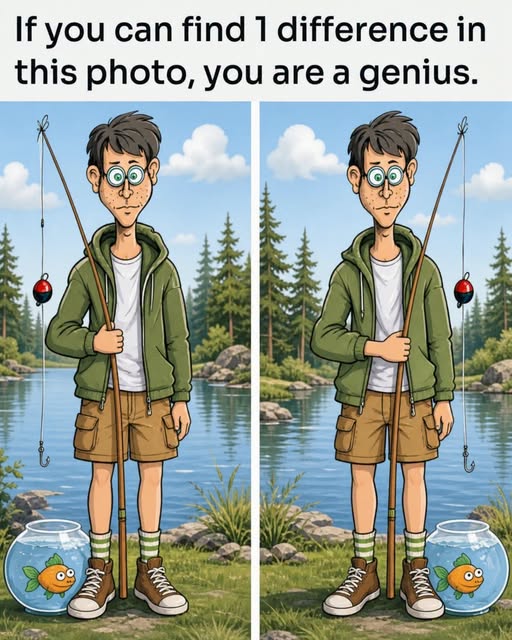
conflict between what your eyes perceive and what your cognitive faculties insist must be true. This phenomenon is the hallmark of the Funny Fisherman challenge, a puzzle that thrives on the brain’s tendency to prioritize patterns over individual components. As you meticulously scan the fisherman’s glasses, the texture of his hair, the curve of his fishing rod, and the tiny fish held within the bowl, you become convinced that you have accounted for every possible variable. Yet, the missing line or the slightly shifted stripe remains elusive, quietly laughing at your initial confidence and demanding a more rigorous level of visual scrutiny.
The psychological appeal of this activity lies in the sophisticated way our neural pathways process information. When we engage in a spot-the-difference task, we are essentially forcing our brains to abandon the habit of rapid, heuristic-based scanning. Instead, we must adopt a deliberate, analytical mode of observation. This shift is not merely an exercise in patience; it is a form of cognitive training that enhances our ability to isolate specific details within complex environments. By resisting the urge to settle for a surface-level impression, we actively strengthen the connections responsible for sustained attention and visual acuity.
Many people experience a distinct sense of frustration when the solution remains hidden, but this emotional response is actually a vital component of the learning process. The discomfort of not knowing acts as a catalyst, pushing the mind to refine its search parameters and look beyond the obvious. When the breakthrough finally arrives—that electric jolt of recognition when the discrepancy suddenly snaps into focus—the brain releases a surge of dopamine. This chemical reward is what makes the experience so deeply satisfying, reinforcing the value of persistence and rewarding the effort required to overcome mental inertia.
Beyond the immediate gratification of solving the puzzle, these challenges serve as a necessary mental reset. In a world characterized by constant noise and rapid-fire information, we are often conditioned to skim rather than observe. Engaging with a static image that requires deep, focused attention provides a rare opportunity to slow down. It allows us to practice the art of mindfulness, where the only objective is to observe the world with clarity and precision. By dedicating time to these small visual mysteries, we cultivate a habit of noticing the subtle nuances that might otherwise pass us by in our daily lives.
It is important to recognize that the value of these puzzles is not tied to the speed of your performance. Whether you identify the difference in ten seconds or ten minutes, the cognitive benefits remain largely the same. The process of searching, comparing, and analyzing is where the true work occurs. Speed is often a distraction; the real prize is the act of training your perception to be more discerning. When you allow yourself to linger on the details, you are essentially recalibrating your focus, making it easier to maintain concentration in other, more demanding areas of your life.
To get the most out of these visual challenges, try to approach them with a sense of curiosity rather than competition. If you find yourself struggling, take a brief step back, blink, and return to the image with a fresh perspective. Often, the solution reveals itself when you stop forcing the search and allow your eyes to wander naturally across the composition. By treating these puzzles as a form of mental play, you ensure that your brain remains agile and receptive to new information, effectively turning a simple game into a powerful tool for cognitive maintenance and long-term mental health. Integrating these short, focused sessions into your daily routine can serve as a highly effective, low-stakes cognitive workout that keeps your mind sharp and ready for more complex tasks, proving that even a simple fisherman can teach us about our own mental resilience.