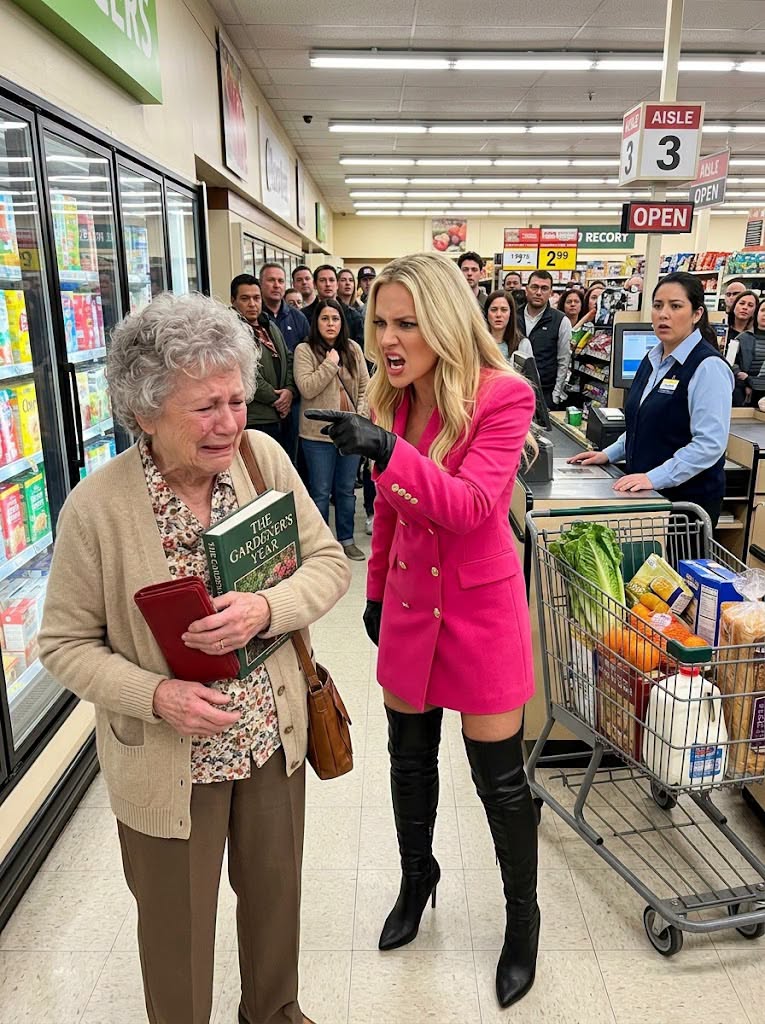
I had one item.
A box of chamomile tea.
The cashier announced the total.
$980.
Stephanie looked at me and told me to pay.
According to her, it was the least I could do considering I lived in their house.
My monthly pension was barely $1,200.
I needed it for medication and basic expenses.
But what hurt wasn’t simply the money.
Four years earlier, after my husband Donald died, Stephanie had persuaded me to sell the family home where we’d spent most of our married life.
I gave her and Clinton $250,000 from the sale.
They promised to build me a comfortable private suite on the ground floor of their house.
Instead, I ended up sleeping in a damp corner of their basement surrounded by storage boxes.
Gradually, I became their unpaid housekeeper.
I cooked.
I cleaned.
I walked their dog.
I ironed Clinton’s work shirts.
Then they started using my pension to cover electricity, internet, streaming services, and other household bills.
Standing at that supermarket register, I finally saw the arrangement clearly.
They weren’t supporting me.
I was supporting them.
So I closed my red leather wallet.
“No.”
Stephanie stared at me.
Then she began arguing loudly enough for people around us to hear.
I didn’t argue back.
I walked through the sliding doors, crossed the parking lot, and boarded a city bus.
I went to my longtime friend Clara.
The following morning, Clara came with me to the bank and utility offices.
I canceled every automatic payment and household service that was still connected to my accounts.
Then Stephanie and Clinton discovered what their lifestyle actually cost.
They arrived at Clara’s home in their luxury vehicle, furious, demanding that I restore everything.
I spoke to them through the front gate.
That’s when the truth about my $250,000 finally came out.
Very little had been spent creating a place for me to live.
The rest had gone toward designer furniture, vacations, vehicle payments, and old personal debts.
There was no investment protecting my future.
No savings account waiting for me.
Almost everything Donald and I had spent decades building was gone.
And now Stephanie and Clinton had become dependent on my pension too.
I told them I would never return to their house.
I could have spent years fighting over every dollar.
Instead, I decided that whatever time I had left was worth more than another exhausting battle.
Without my pension and unpaid labor holding everything together, their finances began unraveling.
Bills accumulated.
The mortgage became difficult to manage.
Eventually, they put the oversized house on the market.
A few weeks later, Stephanie asked to meet me at a park.
She brought my grandson Mason.
I had missed him terribly.
We spent the afternoon watching him play, and I returned the little yellow dinosaur he’d once given me.
Before leaving, Stephanie handed me an envelope.
There wasn’t much money inside.
But it was the first repayment she’d ever made.
She told me she’d started working as a dental assistant.
Our relationship wasn’t magically repaired.
Some things leave permanent scars.
But for the first time, Stephanie was learning that being an adult meant financing her own life.
Not mine.
Soon afterward, I rented a bright little studio behind the home of a kind widow named Mrs. Higgins.
It had a kitchenette, a large window overlooking her garden, and rent I could comfortably afford with my pension.
My health improved.
My blood pressure settled.
I started knitting again.
One rainy afternoon, I sat beside the window wearing a red sweater I’d made myself, drinking chamomile tea.
My old leather wallet rested nearby.
I remembered something Donald had once told me.
Give your children strong wings.
But don’t give away the entire nest.
It had taken me seventy-two years to fully understand what he meant.
I still loved my daughter.
Setting boundaries didn’t change that.
It simply meant that loving my family no longer required sacrificing my health, savings, dignity, and remaining years to protect them from the consequences of their own choices.
That day in the supermarket, I thought I was refusing a $980 grocery bill.
What I was really refusing was the life they’d taught me to accept.
And closing my wallet was the first step toward opening my own front door again.
{"post":112143,"page":2,"next":[{"id":112139,"title":"My Parents Sold My Daughter\u2019s Heirloom for a Swimming Pool \u2013 Grandma Had One Crucial Document","url":"https:\/\/new24.info\/112139"},{"id":112136,"title":"I Was Breastfeeding My 5-Month-Old Baby When the Woman Sitting Next to Me on the Plane Said, \u0027Lock Yourself in the Toilet\u0027 \u2013 Then My Older Daughter Put Her in Her Place","url":"https:\/\/new24.info\/112136"},{"id":112128,"title":"Dolly Parton\u0027s Sister Stella Issues Urgent Public Message as Family Grieves","url":"https:\/\/new24.info\/112128"},{"id":112126,"title":"The Strained Relationship Between Kate and Oliver Hudson and Their Biological Father Bill Hudson","url":"https:\/\/new24.info\/112126"},{"id":112121,"title":"The Life and Tragic End of Dorothy Stratten: A Hollywood Promise Cut Short","url":"https:\/\/new24.info\/112121"},{"id":112116,"title":"Why Unplugging Your Idle Chargers Is a Simple Step Toward Better Home Electrical Safety","url":"https:\/\/new24.info\/112116"},{"id":112113,"title":"A Hidden Perspective: Rediscovering Long-Lost 9\/11 Footage Captured from a New York City Rooftop","url":"https:\/\/new24.info\/112113"},{"id":112099,"title":"Gwen Stefani, 56, Shares Emotional Statement About Blake Shelton\u0027s Dog That Has Fans Talking About His Ex \u2014 Video","url":"https:\/\/new24.info\/112099"},{"id":112097,"title":"The Digital Mirage: How Fabricated Headlines Exploit Our Collective Hunger for Celebrity Drama and Scandal","url":"https:\/\/new24.info\/112097"},{"id":112094,"title":"Paris Jackson: Defining Her Own Path Through Music, Resilience, and Personal Growth","url":"https:\/\/new24.info\/112094"},{"id":112090,"title":"My Daughter Left Home After Marriage, and What Happened Next Surprised Our Entire Family","url":"https:\/\/new24.info\/112090"},{"id":112087,"title":"My 7-Year-Old Son Started Sleeping Under His Newborn Sister\u0027s Crib \u2013 When I Heard What He Was Whispering to Her at 2 AM, I Went Pale","url":"https:\/\/new24.info\/112087"},{"id":112085,"title":"Separating Fact From Fiction: The Truth Behind Viral Claims of Extreme Juvenile Sentencing","url":"https:\/\/new24.info\/112085"},{"id":112079,"title":"Why One Woman Served Fast Food At A Milestone Family Birthday","url":"https:\/\/new24.info\/112079"},{"id":112075,"title":"Finding A Mysterious Note Inside My New Husbands Wedding Tuxedo Changed Everything","url":"https:\/\/new24.info\/112075"},{"id":112071,"title":"Hidden Route In My Late Husbands Truck Revealed Decades Of Family Secrets","url":"https:\/\/new24.info\/112071"},{"id":112067,"title":"Selfish Husband Leaves Family For Vacation Until Blocked Cards Change Everything Completely","url":"https:\/\/new24.info\/112067"},{"id":112064,"title":"Cruel Valentine Dinner Test Reveals Why A Seven Year Romance Failed","url":"https:\/\/new24.info\/112064"},{"id":112061,"title":"A Practical Guide to Identifying and Managing Common Household Insects and Preventing Future Infestations","url":"https:\/\/new24.info\/112061"},{"id":112058,"title":"Understanding Acanthosis Nigricans: Why Darkened Skin Patches Require Professional Medical Attention and Lifestyle Evaluation","url":"https:\/\/new24.info\/112058"}]}