He chose the restaurant, made the reservation and told me to dress nicely because he wanted the night to be “special.”
That word stayed with me.
Special.
After seven years together, it was difficult not to wonder whether it meant something more.
We had talked about marriage before. Not constantly, and never with a firm timeline, but enough that I knew we both supposedly saw it somewhere in our future.
So when Valentine’s Day arrived and he suddenly became unusually secretive about our plans, my mind naturally started wandering.
I tried not to get ahead of myself.
Maybe it was simply dinner.
Still, something about him felt different that evening.
He seemed nervous.
At the restaurant, he kept touching the inside pocket of his jacket.
Once, I noticed him glance toward it before quickly returning his attention to me.
My heart started racing.
I told myself not to assume anything.
But then he began talking about us.
He brought up our first date.
He laughed about the tiny apartment we had practically lived in during our early years together.
He remembered the vacations that had gone wrong, the arguments that seemed enormous at the time and the difficult periods we had somehow survived.
“Seven years,” he said at one point, smiling across the table.
“I know.”
“Feels crazy, doesn’t it?”
“A little.”
Then he asked where I imagined us seven years from now.
That was when I became almost certain.
I pictured the evening ending with him getting down on one knee.
I could already imagine calling my mother.
I wondered what the ring looked like.
I even became nervous about whether I would cry.
Dessert arrived.
Nothing happened.
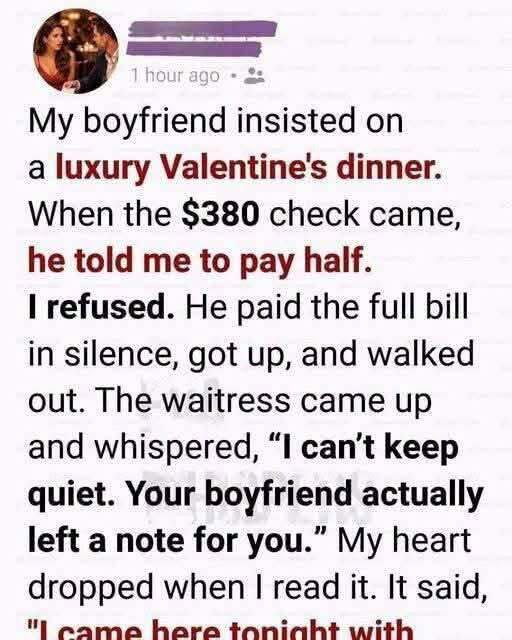
Then the server placed the bill on the table.
My boyfriend picked it up, looked at the total and casually said, “Want to split it?”
I stared at him.
“What?”
“Dinner. Fifty-fifty?”
For a moment, I genuinely thought he was joking.
This wasn’t about whether I could afford my half. We had split expenses plenty of times during our relationship.
But he had invited me out.
He had arranged everything.
He had repeatedly described it as a special Valentine’s evening.
And after spending dinner talking about our future, suddenly asking me to split the bill felt strangely transactional.
“You’re serious?” I asked.
His expression changed.
“Why wouldn’t I be?”
“I just thought you were taking me out tonight.”
“So?”
I could feel the warmth disappearing from the evening.
“I don’t know,” I said. “You planned all of this. You said it was special. I assumed dinner was your treat.”
He stared at me for several seconds.
Then he nodded.
Not angrily.
Almost thoughtfully.
That reaction bothered me more than an argument would have.
“Okay,” he said.
He took out his card and paid the entire bill.
I thought the awkwardness would pass once we left.
Instead, he stood up.
“I’ll be right back,” he said.
Then he walked away.
Several minutes passed.
I checked my phone.
Nothing.
I assumed he had gone to the restroom.
Five minutes became ten.
Finally, I asked our server whether she had seen him.
Her face immediately changed.
That was when I knew something was wrong.
“He actually left,” she said quietly.
I laughed because the alternative was believing her.
“What do you mean, left?”
“He asked me to give you this.”
She handed me a folded piece of paper.
My hands started shaking before I even opened it.
The first sentence made my stomach drop.
He had brought an engagement ring.
He had planned to propose that night.
But there was something else.
The bill had been a test.
According to his note, he wanted to know what kind of wife I would be.
He deliberately asked me to split dinner because he wanted to see how I reacted when money entered the conversation.
My hesitation, he wrote, had given him his answer.
He said he wanted a partner who would immediately offer to share financial responsibility rather than expect him to provide simply because he was the man.
And because I had questioned splitting one Valentine’s dinner, he had decided not only against proposing but against continuing our relationship.
Seven years ended in a note handed to me by a stranger.
I sat there reading it again and again.
At first, I was devastated.
Then I was furious.
Then confused.
I kept replaying the conversation.
Should I simply have said yes?
Had I sounded entitled?
Had he been worrying about money for years without telling me?
Was there some completely different issue underneath all of this?
But eventually another question became more important.
Why was the person who supposedly wanted to marry me testing me at all?
If finances mattered deeply to him, we could have talked about them.
If he wanted separate accounts after marriage, we could have discussed that.
If he expected every expense to be divided equally, he could have told me.
If he worried that I expected him to financially support me, he could have asked.
We had seven years to have those conversations.
Instead, he created a secret examination.
I didn’t even know I was taking it.
And apparently one answer was enough to determine the future of our entire relationship.
That realization changed the way I viewed what happened.
For a long time, I thought I had lost a proposal because I responded incorrectly to a restaurant bill.
Eventually, I understood that the real problem had nothing to do with dinner.
It was communication.
Long-term relationships inevitably involve money.
There are mortgages, rent payments, groceries, childcare, medical bills, vacations, emergencies and countless decisions about who pays for what.
Couples do not need to agree automatically on every financial issue.
But they do need to be able to discuss those issues honestly.
Hidden tests accomplish the opposite.
One person knows the rules.
The other does not even know a game is being played.
That night, my boyfriend believed he was learning something important about me.
But without realizing it, he showed me something important about himself too.
He showed me how he handled uncertainty.
Instead of asking, he tested.
Instead of discussing, he judged.
Instead of sitting across from me and explaining why my reaction bothered him, he walked out and left a note.
The breakup still hurt.
Seven years do not disappear because you suddenly understand why something ended.
There were memories attached to almost every part of my adult life.
There were plans I had assumed would happen.
A home.
Marriage.
Maybe children.
For a few hours that Valentine’s Day, I thought one of those plans was finally becoming real.
There really had been a ring.
There really had been a proposal planned.
But the part I eventually stopped mourning was the proposal itself.
Because marriage would not have magically solved the problem exposed at that table.
It would have carried it forward.
There would have been another test.
Another expectation I was supposed to understand without being told.
Another moment when one of us assumed something while the other knew nothing about it.
Years later, what I remember most clearly is not the bill.
It is sitting alone at that table with his note in my hands.
At the time, it felt like the cruelest ending imaginable.
Now I see it differently.
I thought I had failed his test.
But maybe the test revealed something neither of us expected.
After seven years together, we still didn’t know how to talk openly about something as basic as money.
And if you are preparing to spend the rest of your life with someone, that conversation matters far more than who pays for one Valentine’s dinner.
{"post":112064,"page":2,"next":[{"id":112061,"title":"A Practical Guide to Identifying and Managing Common Household Insects and Preventing Future Infestations","url":"https:\/\/new24.info\/112061"},{"id":112058,"title":"Understanding Acanthosis Nigricans: Why Darkened Skin Patches Require Professional Medical Attention and Lifestyle Evaluation","url":"https:\/\/new24.info\/112058"},{"id":112055,"title":"The Mirror of Desire: How Unexpected Affairs Lead Women Back to Themselves","url":"https:\/\/new24.info\/112055"},{"id":112052,"title":"Beyond the Prairie Sunset: Uncovering the Imperfect Reality of a Beloved Television Classic","url":"https:\/\/new24.info\/112052"},{"id":112049,"title":"Cemetery Board and Grieving Family Clash Over Hidden Profanity Carved Into a Father\u2019s Final Memorial Stone","url":"https:\/\/new24.info\/112049"},{"id":112042,"title":"Beach family photo goes viral after viewers spot terrifying detail","url":"https:\/\/new24.info\/112042"},{"id":112040,"title":"I Bought My Son a $400,000 Beach House \u2013 Then I Found Him Living in a Tiny Apartment","url":"https:\/\/new24.info\/112040"},{"id":112037,"title":"I Had Hardly Recovered from a Brutal Delivery \u2013 When My Husband Looked at Our Newborn Daughter, He Froze and Asked the One Question I Never Expected to Hear","url":"https:\/\/new24.info\/112037"},{"id":112004,"title":"Bridget Fonda Seen Publicly in Recent Photos After Stepping Away from Hollywood","url":"https:\/\/new24.info\/112004"},{"id":111998,"title":"Slow Cooker Beef Stroganoff","url":"https:\/\/new24.info\/111998"},{"id":111994,"title":"Most Drivers Never Realize What That Small Gap in a Cup Holder Is For","url":"https:\/\/new24.info\/111994"},{"id":111989,"title":"That Kitchen Island Shelf Isn\u2019t Just for Decoration\u2014Here\u2019s Why","url":"https:\/\/new24.info\/111989"},{"id":111979,"title":"Devoted Mother Uncovers Husband Betraying Their Family Inside An Empty Apartment","url":"https:\/\/new24.info\/111979"},{"id":111983,"title":"My Wealthy Parents Cut Me off for Marrying My Sweetheart \u2013 But on Our Wedding Night in a Cheap Motel, He Confessed, \u0027There\u0027s Something I Should Have Told You\u0027","url":"https:\/\/new24.info\/111983"},{"id":111980,"title":"My Husband Hid the Truth Behind His Tattoo for 20 Years\u2014Then I Finally Met the Woman Connected to It","url":"https:\/\/new24.info\/111980"},{"id":111975,"title":"Missing For Ten Years My Twin Sister Suddenly Called For Help","url":"https:\/\/new24.info\/111975"},{"id":111971,"title":"Missing Pregnant Paramedic Astounds Rescuers With Unconventional Survival And Emotional Reunion","url":"https:\/\/new24.info\/111971"},{"id":111965,"title":"My Fianc\u00e9 Abandoned His Ten Children But Left A Shocking Secret","url":"https:\/\/new24.info\/111965"},{"id":111961,"title":"My Husband\u0027s Brothers Called Me \u0027The Second Wife\u0027 for 20 Years \u2013 I Was His Only Wife, so I Finally Asked About the First","url":"https:\/\/new24.info\/111961"},{"id":111958,"title":"Unexpected Health Effects of Eating Avocados Revealed by Doctors","url":"https:\/\/new24.info\/111958"}]}