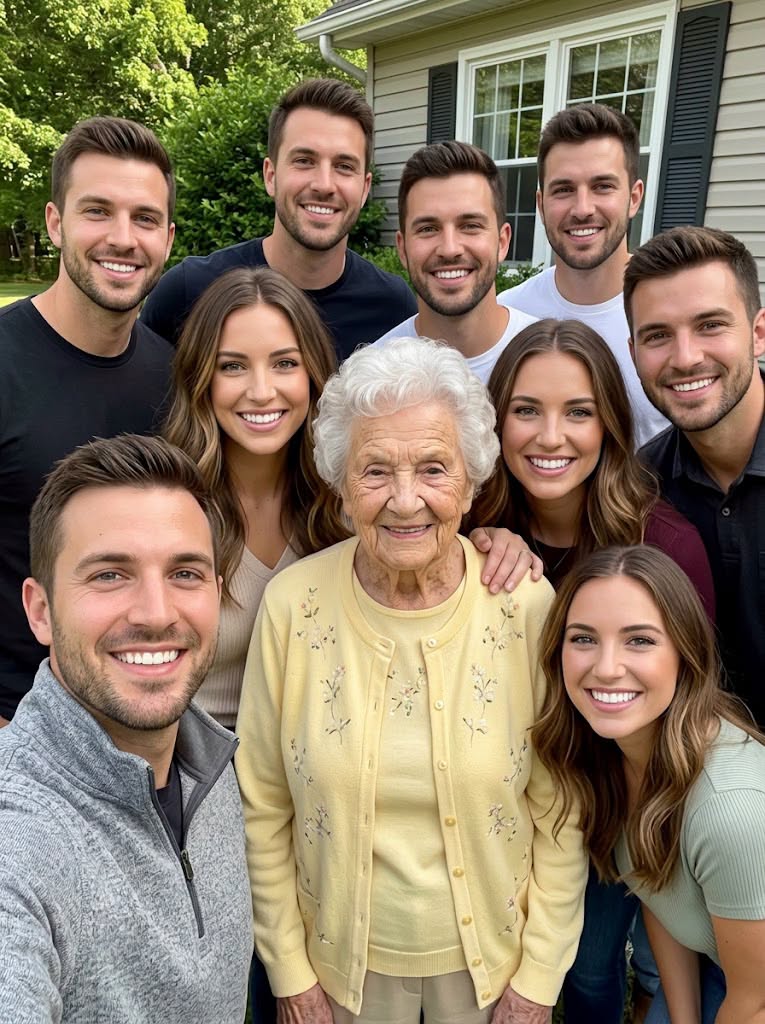
Amanda, Derrick, Sue, twins Jacob and David, Sophie, and the others gradually became part of my everyday life. Six months later, during a family dinner, Robert proposed.
My mother, Helen, was horrified.
She warned me that marrying a man with ten children would destroy my future.
I didn’t care.
I loved Robert, and I already thought of those children as family.
Then, one week before our wedding, I woke up to silence.
Robert was gone.
On the kitchen table was a short note saying he couldn’t marry me.
There was no real explanation.
Even worse, there was nothing about his ten children.
My family immediately told me to walk away. They insisted the children needed to enter foster care and that I couldn’t sacrifice my entire life for a man who had abandoned me.
For a moment, I tried to listen.
Then I looked at those children.
I couldn’t do it.
I went to the county office and applied for emergency guardianship, beginning a long legal process that eventually made all ten children officially mine.
Those first years were brutal.
I worked long shifts at a fabric warehouse and spent evenings sewing school uniforms for extra money. The older children helped with cooking, cleaning, and looking after the younger ones.
There were nights when exhaustion brought me to tears.
But I never regretted keeping them together.
A few men entered my life over the years. Most disappeared when they discovered I was raising ten children.
Eventually, I stopped looking.
My life became schoolwork, meals, bedtime prayers, birthdays, illnesses, graduations, and making sure ten children knew somebody had chosen them.
My parents remained furious about my decision and eventually stopped speaking to me.
Still, the years passed.
Amanda became a nurse.
Derrick opened an auto shop.
Sue became a teacher.
Jacob and David became engineers.
And little Sophie grew up to become a social worker helping vulnerable children herself.
Every Saturday, everyone returned to my house.
Children became adults. Adults brought spouses. Then came grandchildren.
Thirty years after Robert disappeared, one of those noisy Saturday gatherings was interrupted by a knock at the door.
A man in a gray suit introduced himself as Mr. Johnson.
He said he had been Robert’s attorney.
Then he handed me a thick envelope.
I recognized the handwriting immediately.
Robert had recently died, Mr. Johnson explained, and had left instructions that the letter be delivered to me on this exact day.
My children gathered around the kitchen table as I opened it.
For thirty years, I had believed Robert simply didn’t love us enough to stay.
The truth was different.
Robert wrote that before our wedding, he had been diagnosed with a severe illness and told he likely had only months to live.
He panicked.
He couldn’t bear the thought of marrying me only to leave me widowed, responsible for ten grieving children and potentially buried beneath medical expenses.
So he made what he admitted was a terrible decision.
He disappeared.
Robert believed that if we hated him, losing him would hurt less.
Then something happened he hadn’t expected.
An experimental treatment worked.
He survived.
Nearly two years later, after recovering, Robert secretly returned and drove past our house.
He saw the children playing outside.
He saw that we had built a stable life.
And instead of knocking on the door, he drove away.
Robert wrote that by then he believed returning would create legal confusion and reopen emotional wounds the children had begun to heal.
So he stayed gone.
But he never forgot us.
He lived modestly, never remarried, and placed money from his small business into a trust for the family he had left behind.
He had even hired a retired investigator to quietly keep him informed.
He knew about the graduations.
The careers.
The marriages.
The grandchildren.
He had watched an entire family grow from a distance without allowing himself to become part of it again.
At the end of the letter, Robert asked us to forgive him.
He thanked me for giving his children the life he had once feared he would leave unfinished.
For thirty years, I had carried one painful question:
Why weren’t we enough for him to stay?
Now I finally understood.
Robert hadn’t disappeared because we meant nothing to him.
He had made a deeply misguided decision because he believed leaving was the only way to protect us.
I was sixty-two years old, sitting at a crowded kitchen table surrounded by the ten children I had chosen and the family they had created.
I looked around at them and realized I didn’t want to carry anger into another decade.
“I forgive him,” I said.
Then we raised our teacups together.
Robert had left behind ten frightened children and one woman who had no idea how she would manage.
Thirty years later, that same table could barely hold the family we had become.
{"post":111965,"page":2,"next":[{"id":111961,"title":"My Husband\u0027s Brothers Called Me \u0027The Second Wife\u0027 for 20 Years \u2013 I Was His Only Wife, so I Finally Asked About the First","url":"https:\/\/new24.info\/111961"},{"id":111958,"title":"Unexpected Health Effects of Eating Avocados Revealed by Doctors","url":"https:\/\/new24.info\/111958"},{"id":111956,"title":"Remembering Kaleb: The Legacy of a Resilient Shriners Children\u2019s Ambassador and His Enduring Impact","url":"https:\/\/new24.info\/111956"},{"id":111953,"title":"Unlocking Visual Perception: The Cognitive Science Behind Solving the Hidden Pig Picnic Puzzle","url":"https:\/\/new24.info\/111953"},{"id":111950,"title":"Understanding the Chalaza: Why That White Strand in Your Egg Is Actually a Sign of Freshness","url":"https:\/\/new24.info\/111950"},{"id":111945,"title":"Navigating the Ghosts of Yesterday to Find a Future for Today","url":"https:\/\/new24.info\/111945"},{"id":111946,"title":"Maximizing Kitchen Efficiency: How to Transform Narrow Cabinet Gaps into Valuable Storage Solutions","url":"https:\/\/new24.info\/111946"},{"id":111941,"title":"A Quiet Act of Grace in a Fast-Food Booth Changes a Mother and Daughter\u2019s Day","url":"https:\/\/new24.info\/111941"},{"id":111938,"title":"Understanding the Functional Purpose of the Rounded Shelf Attached to Your Kitchen Island","url":"https:\/\/new24.info\/111938"},{"id":111935,"title":"The Unforeseen Legacy: How a Summer Job Revealed a Hidden Branch of Our Family Tree","url":"https:\/\/new24.info\/111935"},{"id":111932,"title":"Transform Your Backyard Into a Glowing Sanctuary With Simple Pool Noodle Lighting","url":"https:\/\/new24.info\/111932"},{"id":111928,"title":"My 13-Year-Old Son Took a Dishwashing Job Without Telling Me \u2013 Then His Boss Called and Asked, \u2018Do You Know What He Does with Every Paycheck?\u2019","url":"https:\/\/new24.info\/111928"},{"id":111925,"title":"Hidden Pig Puzzle","url":"https:\/\/new24.info\/111925"},{"id":111922,"title":"We Adopted a Teenage Brother and His Little Sister After Other Families Turned Them Down \u2013 A Month Later, Their Former Foster Mother Called and Asked, \u0027They Still Haven\u0027t Told You Why They Picked You?\u0027","url":"https:\/\/new24.info\/111922"},{"id":111915,"title":"Father Married Off His Daughter But What Happened Next Changed Everything","url":"https:\/\/new24.info\/111915"},{"id":111912,"title":"After I Lost My Husband, I Found Bills Showing He\u0027d Paid Another Woman\u0027s Rent for 27 Years \u2013 When I Went to See Her, I Nearly Fainted at Who She Was","url":"https:\/\/new24.info\/111912"},{"id":111908,"title":"Woman dancing at US Open goes viral \u2013 now people are learning who her dad is","url":"https:\/\/new24.info\/111908"},{"id":111906,"title":"My Daughter Went Hungry for a Week\u2014So I Made a Difficult Decision About My Mother\u2019s $2,800 Grocery Fund","url":"https:\/\/new24.info\/111906"},{"id":111899,"title":"He Was Born Remarkably Large, Then Chose a Quieter Path","url":"https:\/\/new24.info\/111899"},{"id":111895,"title":"A Quiet Family Moment Marks a New Chapter for Maggie McGraw","url":"https:\/\/new24.info\/111895"}]}