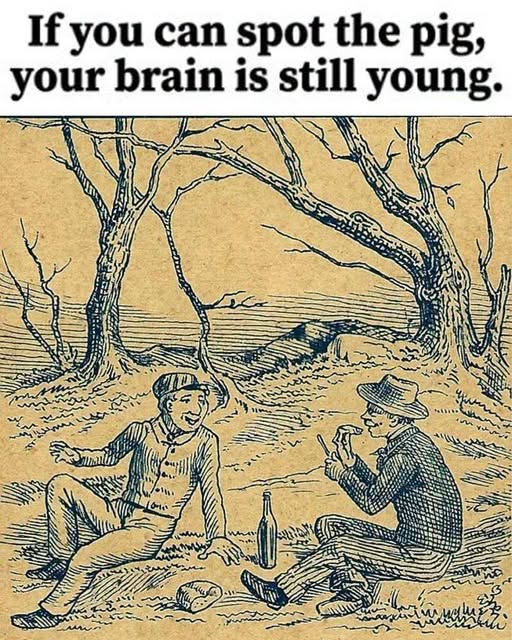
…the hidden pig that remains concealed in plain sight. This phenomenon occurs because the human brain is hardwired to prioritize familiar patterns and recognizable subjects, often ignoring the background details that do not fit into our immediate narrative. When we look at a complex image, our visual system attempts to simplify the input, which is precisely why the pig—formed by the clever manipulation of negative space—remains elusive to the casual observer for so long.
Understanding the role of negative space is essential for mastering these types of visual challenges. Negative space refers to the empty areas surrounding the primary subjects of an image, such as the gaps between tree branches or the contours created by the picnic setting. In many optical illusions, the artist does not draw the subject itself but rather draws the environment around the subject, forcing your brain to reconstruct the missing shape. By shifting your focus away from the people and toward the abstract shapes formed by the branches, you allow your brain to bypass its habitual pattern recognition and engage in a more analytical, flexible form of processing.
Engaging with these puzzles offers significant cognitive benefits that extend far beyond the momentary satisfaction of finding a hidden object. These exercises serve as a workout for your visual cortex, enhancing your ability to perform pattern recognition and improving your attention to detail. When you struggle to find the pig, you are essentially training your brain to remain persistent in the face of ambiguity. This flexible thinking—the ability to switch between different perspectives and interpret the same data in multiple ways—is a vital skill in both professional and personal problem-solving contexts.
If you find yourself stuck, there are several tactical strategies you can employ to break through the visual wall. First, try changing your viewing angle. Tilting your head or turning the image upside down can disrupt the brain’s tendency to see the image in a fixed orientation, which often reveals hidden silhouettes that were previously masked by the orientation of the branches. Second, try stepping back from the image. Viewing the puzzle from a distance allows your eyes to take in the entire composition at once, which can help you spot larger, integrated shapes that are not visible when you are focused on a single, small section of the frame.
Furthermore, consider the importance of squinting. By slightly blurring your vision, you reduce the impact of fine details that might be distracting your focus, allowing the broader, more significant outlines of the hidden figure to emerge from the background. This technique forces your eyes to rely on contrast and silhouette rather than color or intricate line work, which is a common method for identifying concealed items in complex illustrations. It is a reminder that what we see is not merely a reflection of light, but a construction built by our own expectations and cognitive habits.
The experience of solving this puzzle also highlights the fascinating diversity of human perception. When you share this challenge with a friend or family member, you will likely notice that each person approaches the image with a unique set of biases. One person might spot the pig within seconds, while another might spend several minutes scanning the same area without success. This variance demonstrates how individual experiences and neurological tendencies influence how we interpret visual information. It is not necessarily a matter of intelligence, but rather a matter of which visual cues the brain prioritizes during the initial scan.
Ultimately, the goal of these puzzles is to cultivate a more observant mindset. By practicing the art of looking beyond the obvious, you become better equipped to notice details in your everyday life that might otherwise go completely ignored. Whether you found the pig immediately or had to employ every strategy in your arsenal to locate it, the process itself is a valuable exercise in mindfulness and cognitive agility. The next time you face a complex visual task, remember to step back, change your perspective, and look for what is hiding in the empty spaces.
To solve such illusions effectively, adopt a systematic approach rather than a frantic search. Start by scanning the image in quadrants to ensure you have thoroughly examined every inch of the composition. If you feel frustrated, step away for a few minutes and return with fresh eyes; this break allows your visual system to reset, often making the hidden figure appear almost instantly upon your return. By consistently applying these techniques, you will sharpen your observational skills and learn to see the world with greater clarity and depth.