Perfect, according to Evan.
The first time he showed it to me, I offered to pay half.
He shook his head.
“No.”
“Why not?”
“I want to buy it myself.”
I remember smiling because I was proud of him.
After losing his father three years earlier, Evan rarely asked for much.
So when he said he wanted to earn the bike himself, I let him.
What I didn’t understand was that six months would pass.
The bike would never appear.
And every paycheck would disappear somewhere else.
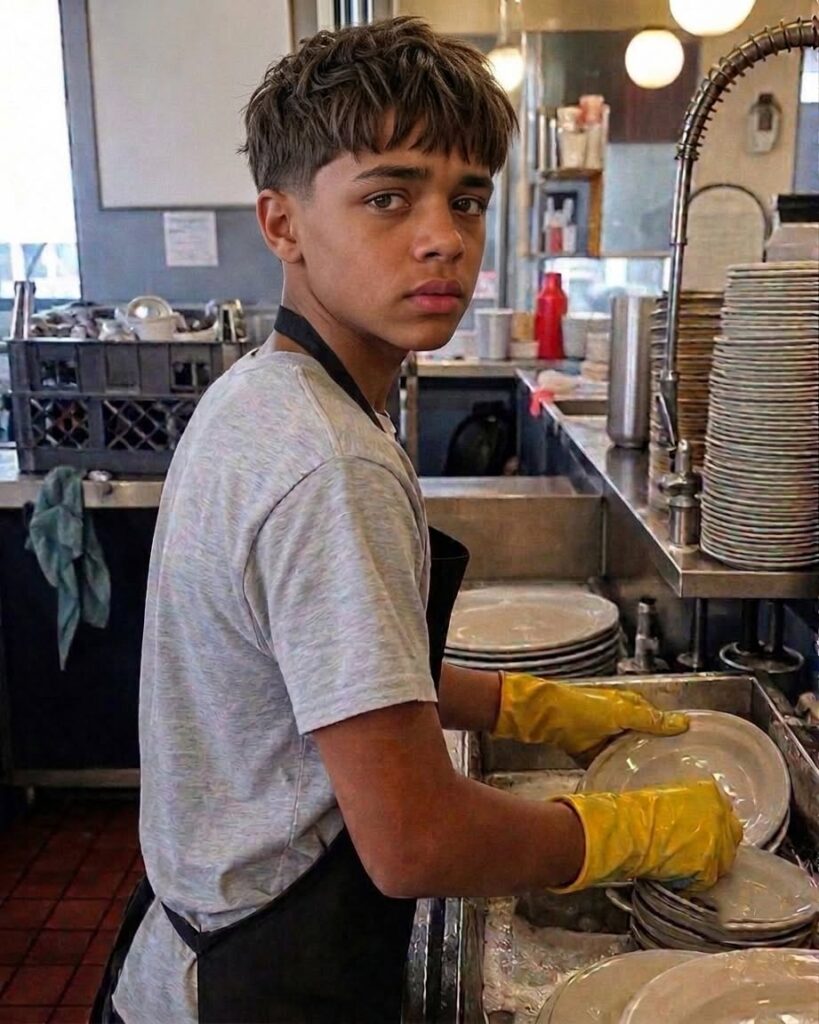
I discovered Evan had taken a job almost by accident.
He came home one Saturday evening smelling like fryer oil, dish soap, and something lemony.
I looked up from the laundry basket.
“Where have you been, buddy?”
He froze.
That should have been my first clue.
“Working.”
I blinked.
“Working where?”
“Mr. Alvarez lets me help at the diner on Saturdays.”
I set the towel down.
“You got a job without telling me?”
Evan looked at the floor.
“I wanted to earn the bike myself, Mom.”
The diner belonged to a family we knew from the neighborhood.
Mr. Alvarez had watched Evan grow up.
Once I spoke to him and confirmed that Evan was only bussing tables, doing light cleaning, and helping in the dishroom for a few hours each Saturday, I agreed to let him continue.
For the first couple of months, everything seemed normal.
He came home tired.
Sometimes greasy.
Usually hungry.
And proud.
I’d ask:
“How much closer are you to the bike?”
He always gave me some version of the same answer.
“Getting there.”
Then:
“Almost enough.”
Then:
“A little longer.”
At first, I didn’t question it.
Used bikes went up in price.
Maybe he was saving extra for a helmet.
Maybe he wanted new tires.
Then his behavior changed.
One evening, I passed his room and saw him stuffing a handful of bills into his backpack.
The instant he noticed me, he zipped it shut.
I stopped in the doorway.
“What was that?”
“Nothing.”
“Looked like money.”
“It was.”
“How much?”
He shrugged.
“My pay.”
“Why is it in your backpack?”
“I’m keeping it safe.”
I almost laughed.
“You have a drawer.”
“I know.”
He wouldn’t look at me.
That bothered me.
Still, I let it go.
A week later, he came home nearly two hours late.
His shoes were covered in dried mud.
There was a tear near the shoulder of his sweatshirt.
I stood from the couch.
“What happened to you?”
“Nothing.”
“Evan.”
He looked down at himself.
“I fell walking home.”
“Where?”
“Near the park.”
I pointed at his sleeve.
“You tore your shirt falling?”
“Yeah.”
“Where’s your paycheck?”
His eyes dropped.
“Somewhere safe.”
That phrase again.
I studied him.
“Evan, what’s going on?”
“Nothing, Mom.”
I was beginning to hate that word.
Nothing.
Nothing meant there was something.
I just didn’t know what yet.
Then one Saturday afternoon, my phone rang.
Mr. Alvarez.
I answered immediately.
“Hello?”
“Ma’am?”
His voice sounded tense.
“We need to talk about Evan.”
I stood from the kitchen table.
“Did he do something?”
A pause.
“I honestly don’t know how to answer that.”
My stomach dropped.
“What does that mean?”
Another pause.
Then he asked:
“Do you know what Evan does with every paycheck?”
I frowned.
“He’s saving for a bike.”
Silence.
“Isn’t he?”
Mr. Alvarez exhaled.
“Ma’am, almost everything that boy has told you about that money is a lie.”
Before I could respond, I heard Evan shouting somewhere in the background.
“Please! Don’t tell my mom!”
Something crashed.
Metal hitting tile.
I shot to my feet.
“Evan?”
Mr. Alvarez came back on the line, breathing hard.
“Get here.”
“What happened?”
“Your son tried to do it again.”
The line disconnected.
I didn’t even grab my purse properly.
I took my keys and ran.
When I reached the diner, the first thing I noticed was a large metal bus tub overturned on the floor.
Plastic cups had rolled beneath tables.
A stack of plates leaned dangerously against one chair.
Evan stood in the middle of it.
His apron was soaked.
One sleeve was twisted near the shoulder.
His face was red.
Across from him stood Cal, one of the older men who worked mornings at the diner.
Cal was holding one end of a white envelope.
Evan was holding the other.
“Give it back!”
“No.”
“It’s mine!”
“Exactly,” Cal snapped. “That’s why I’m not taking it.”
Mr. Alvarez saw me.
“Thank God.”
Evan spun around.
The moment he saw me, he let go of the envelope.
“Mom?”
I stopped several feet away.
“What is going on?”
Nobody answered.
I pointed toward the envelope.
“Is that your paycheck?”
Evan stared at the floor.
“Yes.”
“And why was Cal holding it?”
Cal tossed it onto the counter.
“Because your son tried to give me every cent.”
I turned toward Evan.
“What?”
“It isn’t like that.”
Cal folded his arms.
“Then explain it.”
Evan glared at him.
“Stay out of it.”
“Evan.”
He went quiet.
I picked up the envelope.
“Why would you give Cal your entire paycheck?”
Evan answered too quickly.
“Because I owed him.”
Cal slapped one palm against the counter.
“There! That’s what he always says.”
“I did owe you.”
“For what?”
“For helping me.”
Cal stared at him.
“You helped me carry twelve boxes of potatoes last month.”
Evan’s jaw tightened.
“So?”
“So am I supposed to hand over my retirement check?”
“That’s different.”
“Why?”
“Because it is.”
I looked at Mr. Alvarez.
“Can somebody please explain this?”
The diner owner leaned against the register.
“How much do you think Evan has saved toward the bike?”
The question caught me off guard.
“I don’t know.”
I glanced at my son.
“He keeps saying he’s almost there.”
Mr. Alvarez nodded.
“That’s what he tells us too.”
Evan’s face changed.
“Don’t.”
Mr. Alvarez ignored him.
“You know how many paychecks he’s actually kept in six months?”
I waited.
“One.”
I thought I’d misheard.
“One?”
“The first.”
I turned slowly toward Evan.
“Where did the rest go?”
“Mom.”
“Where?”
He looked away.
That silence frightened me more than the broken dishes.
Evan had wanted that bike for almost a year.
I could still remember him showing me the listing.
I had offered to help buy it.
He had refused.
“I want to earn it.”
Now I realized he had earned enough for it long ago.
Probably several times over.
Yet he had no bike.
And apparently almost no money.
I stepped closer.
“Tell me.”
“It is my money.”
“Yes.”
“And I can do what I want with it.”
“You are thirteen.”
“That doesn’t mean you get to know everything.”
Normally, I would have agreed that he deserved some privacy.
Not now.
“When your employer calls me because you’re fighting an adult over your entire paycheck, the privacy rules change.”
Then I noticed his backpack.
It had fallen open when the bus tub overturned.
Several envelopes had spilled out.
So had a folded city bus map.
I bent down.
Evan moved instantly.
“Mom, don’t.”
I looked at him.
That response guaranteed I was going to.
I unfolded the map across a table.
Red circles covered it.
Six.
Maybe seven.
Beside the circles were handwritten notes.
TIRES.
MR T.
HAIRCUT.
STORE LADY.
One address had been crossed out several times and rewritten farther down the street.
Beside two locations were dollar amounts.
$180.
$65.
I stared at the map.
Then at Evan.
“What is this?”
“Nothing.”
Cal made an irritated noise.
“There’s that word again.”
I pointed toward the first circle.
“TIRES?”
Evan said nothing.
Cal answered.
“The tire shop on Mason.”
I turned toward him.
“How do you know?”
“Because I followed him there.”
Evan snapped around.
“You what?”
Cal shrugged.
“You’d already tried giving me money twice.”
“You followed me?”
“I walked behind you.”
“That’s following!”
“I got tired after three blocks and took the bus.”
Despite everything, Mr. Alvarez rubbed a hand over his face like he was trying not to laugh.
I wasn’t.
I folded the map.
“Get your backpack.”
Evan’s eyes widened.
“Why?”
“We’re going to the tire shop.”
“No.”
“Evan.”
“Mom, please.”
The word sounded different this time.
Not defiant.
Scared.
I looked at him.
“What am I going to find?”
His face tightened.
“Nothing.”
Cal groaned.
I handed the paycheck to Mr. Alvarez.
“Hold this for me.”
He nodded.
“I’ve been trying to make him keep it anyway.”
Evan yanked his backpack from the floor.
“I hate all of you.”
Cal pointed at him.
“There. That’s normal thirteen-year-old behavior. Keep that part.”
Evan sat stiffly beside me the entire drive to Mason Tire.
I knew the place.
I hadn’t been there in years.
But I remembered one particular afternoon perfectly.
Jeremy had been dead four months.
It was February.
Cold.
Rainy.
Our old sedan got a flat.
I drove to Mason Tire thinking I needed a patch.
Twenty minutes later, the owner told me the tire was ruined.
Then he looked at the opposite side.
The second tire was nearly bald.
I could afford one.
Not two.
I remember standing at the counter trying not to cry.
Ten-year-old Evan sat nearby drinking hot chocolate someone had given him.
I asked:
“Can the second tire wait two weeks?”
The owner looked at me.
Then at Evan.
Then said:
“Probably shouldn’t.”
I swallowed.
“I only have enough for one.”
He disappeared into the garage.
Forty minutes later, he replaced both.
When I reminded him I could not pay for the second one, he slid the invoice across the counter.
“Then don’t today.”
I started crying before I made it to the car.
I hadn’t thought about that afternoon in years.
Not until I saw TIRES written on Evan’s bus map.
The same owner was standing behind the counter when we entered.
He had more gray hair now.
He looked up.
Then saw Evan.
His expression immediately changed.
“Oh, no.”
Evan stopped walking.
The man pointed at him.
“You promised me you were done.”
I looked between them.
“Done with what?”
Then the owner recognized me.
“Lindsay?”
“Yes.”
He closed his eyes.
“Oh, kid.”
Evan spoke fast.
“I told you not to tell her.”
“I didn’t.”
“You’re about to.”
The owner came around the counter.
“Lindsay, a few months ago, Evan came in here carrying an envelope with one hundred and eighty dollars.”
I looked at my son.
The owner continued.
“He told me he owed me for a tire.”
I stared at him.
“The tire from three years ago?”
“That one.”
My voice sharpened.
“You took money from a thirteen-year-old?”
The man’s face turned red.
“Not at first.”
Evan muttered:
“He argued with me for like twenty minutes.”
“Because I was about thirty seconds from calling your mother.”
“You said I was annoying customers.”
“You were annoying me.”
I raised a hand.
“What happened?”
The owner sighed.
“He refused to leave.”
Then he opened a drawer beneath the register.
“He kept saying his family owed me.”
From the drawer, he removed a worn white envelope.
Written across the front in Evan’s handwriting were two words.
FOR TIRES.
My throat tightened.
“You kept it?”
“Every dollar.”
Evan reached for the envelope.
I stopped him.
“No.”
His eyes flashed.
“It’s not yours.”
“Actually, sweetheart, this particular debt was supposedly mine before you were old enough to shave.”
The owner smiled.
Evan didn’t.
“We needed those tires.”
“I know.”
“So we owed him.”
“No.”
I softened my voice.
“I owed him.”
Evan frowned.
I unfolded the bus map again.
The tire shop.
The barber.
The grocery store.
A street near Evan’s old elementary school.
Different people.
Different places.
Different amounts.
And suddenly, I wasn’t asking where his money had gone.
I was asking who he believed he owed.
“How do you even remember all of this?”
Evan stared at the map.
Then he said four words that stopped me cold.
“Dad would’ve remembered.”
The tire shop owner looked away.
I lowered the map.
“What does your father have to do with this?”
Evan grabbed his backpack.
“Nothing.”
I stepped in front of the door.
“No.”
“Mom.”
“Tell me.”
“Move.”
“No.”
His eyes filled.
That frightened me more than his anger.
“Please.”
“Evan.”
He wiped his face roughly with his sleeve.
Then looked down at every red circle on the map.
Every place connected to the worst year of our lives.
Finally, he whispered:
“Because you’re going to tell me to stop.”
I crouched slightly so we were closer to eye level.
“Stop what?”
His voice cracked.
“Doing Dad’s part.”
I went still.
“What?”
He wiped his eyes again.
“Everybody helped us after Dad died.”
His finger touched the map.
“Tires.”
Another circle.
“Food.”
Another.
“Rides.”
Another.
“Haircuts.”
He looked up at me.
“Dad always said you pay people back.”
My chest tightened.
I thought about the Saturday Evan had come home two hours late with mud on his shoes.
“Where were you that day you came home late?”
He stared at the floor.
“Mrs. Donnelly’s.”
I knew the name immediately.
After Jeremy died, Mrs. Donnelly had picked Evan up from school whenever I couldn’t leave work.
For months.
“What happened to your shirt?”
“Her back fence fell over.”
I stared at him.
“You fixed her fence?”
“I helped.”
“With whom?”
“Her grandson.”
“That is why you were covered in mud?”
He nodded.
“And the money?”
“She wouldn’t take any.”
He sounded disappointed.
I didn’t know whether to laugh or cry.
I looked down at the map again.
This was not random.
My son had spent six months retracing the year after his father died.
Finding every person he remembered helping us.
Trying to pay them.
With his money.
With his Saturdays.
With labor.
With anything he had.
I drove him away from the tire shop.
But I didn’t take him home.
Instead, I drove to Jeremy’s favorite park.
There was a walking path beside a narrow bike trail.
We sat on a bench.
Evan’s battered map rested between us.
For a while, neither of us spoke.
Then I said:
“Your father kept Mrs. Donnelly’s ladder for eleven years.”
Evan looked at me.
“What?”
“Eleven.”
“No way.”
“I am completely serious.”
“But Dad always returned stuff.”
I laughed.
“Your father once borrowed twenty dollars from Mr. Alvarez and forgot about it for six months.”
Evan frowned.
“No.”
“Yes.”
“Dad?”
“Your father.”
Evan looked genuinely offended by this information.
I continued.
“He was generous.”
I touched the map.
“He helped people.”
Then I looked at him.
“But people helped him too.”
Evan’s eyes dropped.
“He would’ve paid them back.”
“Sometimes.”
“What does that mean?”
“It means life isn’t a ledger.”
He said nothing.
“Your dad did not spend every day keeping score.”
“But he said if someone helps you—”
“You help them when you can.”
“Yes.”
I nodded.
“But that does not mean you owe them forever.”
He stared at the map.
Then whispered:
“Dad can’t do his part anymore.”
That was the real wound.
Not the bike.
Not the money.
Not the people on the map.
Jeremy was gone.
And somewhere inside my thirteen-year-old son’s mind, he had decided his father’s unfinished responsibilities had become his.
I moved closer.
“Look at me.”
He did.
“You inherited your father’s kindness.”
His eyes filled again.
“You inherited his ridiculous sense of humor.”
That earned the smallest smile.
“You inherited his stubbornness.”
“That’s you.”
“Absolutely not.”
He almost laughed.
Then I said:
“But you did not inherit his unfinished chores.”
The smile disappeared.
“You are his son.”
I took his hand.
“You are not his replacement.”
Evan’s face crumpled.
For six months, he had been so controlled.
Secretive.
Determined.
Suddenly, he looked thirteen again.
“I thought you needed me.”
I pulled him against me.
“I do.”
He cried into my shoulder.
I held him tighter.
“But I need my son.”
He didn’t move.
“I don’t need another husband.”
His shoulders shook.
“I don’t need another caretaker.”
I kissed his hair.
“I don’t need you fixing everything your father cannot fix.”
We sat there for a long time.
Finally, Evan whispered:
“What about the people?”
“What about them?”
“We still owe them.”
I smiled.
“No.”
He pulled away.
“We do.”
“Then we’ll do something different.”
“What?”
“We remember them.”
He frowned.
“And when somebody else needs help someday, we help.”
He looked at me.
“That counts?”
“That’s how your dad would’ve done it.”
He studied my face.
“You sure?”
“No.”
That surprised him.
I smiled.
“Your father would’ve probably done something ridiculous.”
“Like what?”
“Show up at the tire shop with forty pounds of barbecue.”
Evan laughed.
“That sounds like Dad.”
“Exactly.”
Later that afternoon, we returned to the diner.
Cal was waiting behind the counter.
He pointed at Evan’s paycheck.
“If you try giving that to me again, I’m retiring twice.”
Evan rolled his eyes.
Mr. Alvarez handed him the envelope.
Evan stared at it.
For a moment, I wondered what he would do.
Then slowly, he put it into his own pocket.
Cal nodded.
“Growth.”
“Be quiet.”
“Normal thirteen. Excellent.”
The tire shop owner returned the $180 too.
So did two other people Evan had managed to pay before anyone realized what he was doing.
Not everyone gave the money back.
I told Evan that was okay.
He had offered it freely.
The point wasn’t to reverse every choice.
It was to stop treating kindness like debt.
We went through the map together.
Mr. T had been Jeremy’s barber.
After Jeremy died, he cut Evan’s hair free for almost a year.
“Dad would’ve wanted to pay him.”
“Maybe.”
I pointed at another circle.
“What about this?”
Evan hesitated.
“The grocery store.”
I remembered.
During the worst months after Jeremy’s death, one of the cashiers quietly gave me gift cards several times.
I had assumed they came from some store program.
Apparently, Evan eventually learned otherwise.
Then another address.
Then another.
Every circle carried a memory.
Some I had forgotten.
Evan hadn’t.
That was when I realized something else.
This had not only been about responsibility.
It had been his way of staying close to Jeremy.
Every person on the map was connected to his father.
Every debt gave Evan another reason to keep walking through that year.
To revisit places.
To repeat things Jeremy had said.
To imagine what his father would have done.
So I didn’t take the map away.
I didn’t tell him it was foolish.
Instead, we changed what it meant.
On the back, we wrote:
PEOPLE WHO HELPED US.
No dollar amounts.
No debts.
Just names.
A few weeks later, Evan added someone.
Cal.
I raised an eyebrow.
“He didn’t take your money.”
“He helped me.”
“How?”
“He annoyed me.”
I laughed.
“That doesn’t count.”
“It definitely does.”
Mr. Alvarez went on the list too.
So did the tire shop owner.
Mrs. Donnelly.
The grocery cashier.
His barber.
The list stopped being a bill.
It became a record of something much better.
Community.
Three months later, Evan showed me another online listing.
The mountain bike.
Still used.
A different one this time.
Blue frame.
Black tires.
Slightly scratched.
“How much?”
He told me.
“Do you have enough?”
He nodded.
“Actually?”
He rolled his eyes.
“Yes, Mom.”
“Just checking.”
Then he hesitated.
“Can you come with me to get it?”
That question meant more to me than he knew.
We bought it together.
Evan handed over the money himself.
Money he had earned.
Money he was finally allowing himself to keep.
The seller helped load the bike into the car.
Evan spent the entire drive home looking backward at it through the rear window.
“You’re going to hurt your neck.”
“I don’t care.”
The first place he wanted to ride was Jeremy’s park.
Of course it was.
For almost an hour, he raced the path while I timed him.
Thirty-nine seconds.
Then thirty-eight.
Then thirty-eight again.
“Your stopwatch is broken.”
“Or that’s your speed.”
“No.”
He took off again.
Near the far end of the path, a younger boy’s bicycle chain slipped off.
The boy nearly fell.
Evan stopped.
I watched from the bench.
He crouched beside the bike.
Turned it upside down.
Got grease all over his fingers.
A few minutes later, the chain was back on.
The boy’s father reached for his wallet.
“What do I owe you?”
Evan froze.
I could see him thinking.
Then he shook his head.
“Nothing.”
The man smiled.
“You sure?”
Evan glanced toward me.
Then said:
“Help somebody when they’re stuck.”
My eyes burned.
The father put his wallet away.
“I can do that.”
Evan jumped back onto his bike.
Then yelled toward me:
“Mom!”
“What?”
“Time me!”
I raised my phone.
He pushed off.
That evening, I found the old bus map sitting on the kitchen table.
I unfolded it.
The red circles were still there on one side.
TIRES.
HAIRCUT.
STORE LADY.
Names from the hardest year of our lives.
Then I flipped it over.
A new route had been drawn across the back.
The bike trail.
Beside it, Evan had written:
BEST: 38 SEC.
I smiled.
For six months, I thought my son was hiding money from me.
What he was really hiding was grief.
He had convinced himself that loving his father meant finishing every responsibility Jeremy had left behind.
But grief had turned kindness into obligation.
And obligation had turned a thirteen-year-old boy into someone who believed he had to take care of everyone before he was allowed to want something for himself.
Jeremy would have hated that.
He had loved helping people.
But he had loved Evan more.
Eventually, my son understood that too.
He didn’t stop being generous.
He simply stopped treating every act of kindness like a debt.
He stopped carrying his father’s place in the world like an unpaid bill.
And little by little, he let himself be thirteen again.
That afternoon in the park, I stood beside the trail with my phone raised.
Evan leaned over the handlebars.
“Ready?”
“Ready.”
He grinned.
“Go!”
I started the timer.
And my son kept riding forward.
{"post":111928,"page":2,"next":[{"id":111925,"title":"Hidden Pig Puzzle","url":"https:\/\/new24.info\/111925"},{"id":111922,"title":"We Adopted a Teenage Brother and His Little Sister After Other Families Turned Them Down \u2013 A Month Later, Their Former Foster Mother Called and Asked, \u0027They Still Haven\u0027t Told You Why They Picked You?\u0027","url":"https:\/\/new24.info\/111922"},{"id":111915,"title":"Father Married Off His Daughter But What Happened Next Changed Everything","url":"https:\/\/new24.info\/111915"},{"id":111912,"title":"After I Lost My Husband, I Found Bills Showing He\u0027d Paid Another Woman\u0027s Rent for 27 Years \u2013 When I Went to See Her, I Nearly Fainted at Who She Was","url":"https:\/\/new24.info\/111912"},{"id":111908,"title":"Woman dancing at US Open goes viral \u2013 now people are learning who her dad is","url":"https:\/\/new24.info\/111908"},{"id":111906,"title":"My Daughter Went Hungry for a Week\u2014So I Made a Difficult Decision About My Mother\u2019s $2,800 Grocery Fund","url":"https:\/\/new24.info\/111906"},{"id":111899,"title":"He Was Born Remarkably Large, Then Chose a Quieter Path","url":"https:\/\/new24.info\/111899"},{"id":111895,"title":"A Quiet Family Moment Marks a New Chapter for Maggie McGraw","url":"https:\/\/new24.info\/111895"},{"id":111891,"title":"Mahogany Box Reveals Shocking Family Secrets On A Freezing Christmas Morning","url":"https:\/\/new24.info\/111891"},{"id":111887,"title":"How A Supermarket Encounter Exposed My Husband And Ruined His Life","url":"https:\/\/new24.info\/111887"},{"id":111883,"title":"Secret Photographs Reveal A Deceitful Husband And His Cruel Real Estate Scheme","url":"https:\/\/new24.info\/111883"},{"id":111879,"title":"Giving My Daughter A Cheap Candle Sparked An Unforgettable Holiday Family Exile","url":"https:\/\/new24.info\/111879"},{"id":111875,"title":"Shocking Banquet Video Reveals How A Father Betrayed His Young Daughter","url":"https:\/\/new24.info\/111875"},{"id":111830,"title":"Inside Travis Kelce\u0027s $5.35M Lake Erie Estate Purchased Months Before Wedding to Taylor Swift \u2014 Photos","url":"https:\/\/new24.info\/111830"},{"id":111824,"title":"Miley Cyrus Sparks Backlash Over Surprise Name Change \u2014 Fans Quickly Rally to Her Defense","url":"https:\/\/new24.info\/111824"},{"id":111821,"title":"A Father Celebrating His Fortune Discovers His Daughter\u2019s Betrayal Hidden Inside a Toast","url":"https:\/\/new24.info\/111821"},{"id":111818,"title":"This morning, I woke up and decided to make fried eggs.","url":"https:\/\/new24.info\/111818"},{"id":111809,"title":"A Disrespected Stepdaughter Quietly Owns the House Her Family Tried to Throw Her Out Of","url":"https:\/\/new24.info\/111809"},{"id":111806,"title":"I Lost My Fifth Child After My Husband Left Me for My Younger Sister \u2013 At Their Wedding, My 9-Year-Old Daughter Did Something He Never Expected","url":"https:\/\/new24.info\/111806"},{"id":111803,"title":"My Neighbor Repainted My Car Pink, but I Had No Proof \u2013 Karma Struck Her the Very Next Day","url":"https:\/\/new24.info\/111803"}]}