Then came Holly’s turn.
Gene handed her a flimsy drugstore gift bag containing a cheap vanilla candle.
But the candle wasn’t what hurt.
Attached to it was a handwritten tag identifying Holly simply as:
“Brandon’s girl.”
Not granddaughter. Not Holly.
Just Brandon’s girl.
The room fell silent. My husband Brandon gripped his coffee cup so tightly I thought it might break, while Gene continued smiling as though nothing unusual had happened.
Later that evening, I found Holly sitting alone in the guest bedroom, still wearing her wrinkled gold Christmas dress and staring at the tag.
Before I could comfort her, Brandon walked in and knelt in front of her.
He reminded Holly that he was her father and that nothing Gene wrote on a piece of cardboard could change her place in our family.
Then he reached into Holly’s overnight bag and removed a small red velvet box.
He told her he had prepared it in case Grandma ever made her feel unwanted again.
But he didn’t tell Holly when to use it.
That decision belonged to her.
The next morning, Gene hosted her traditional Boxing Day brunch. The dining table was immaculate—white porcelain, silver napkin rings, and handwritten place cards for every relative.
Then I saw Holly’s.
Everyone else had a name.
Hers said only:
“GUEST.”
My first instinct was to grab the card and confront Gene myself.
Then I noticed Holly quietly reach into her little beaded purse.
Her fingers closed around the red velvet box.
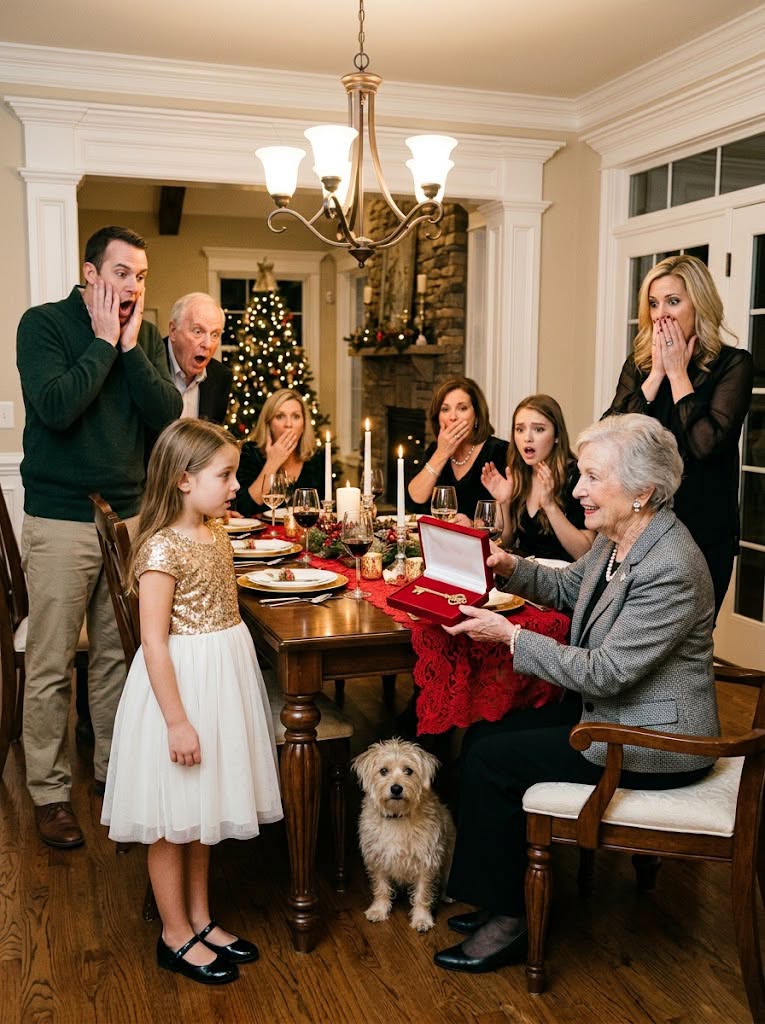
Without crying or saying a word, my seven-year-old stood and walked across the dining room toward Gene.
Conversation stopped.
Holly placed the box in front of her grandmother.
“Dad said I should give you this if you ignored me again.”
Brandon immediately stood behind Holly. He didn’t take over or speak for her. He simply made sure she knew she wasn’t standing there alone.
Gene gave an uncomfortable laugh and tried to dismiss the whole thing as childish drama.
Brandon’s expression didn’t change.
“Open it.”
Gene lifted the lid.
The smile vanished from her face.
Inside was an ordinary brass house key and a folded white card.
Gene opened the note with trembling fingers.
It was a formal notice explaining that Brandon had changed every deadbolt on our home.
Her spare key no longer worked.
Her unrestricted access to our house was permanently revoked.
From that moment forward, Gene would not enter our home, appear uninvited, or assume automatic access to our family.
And there was one final condition.
Before Gene could rebuild a relationship with us, Holly herself had to feel comfortable seeing her again.
For three years, Gene had used exclusion to remind a little girl that she supposedly didn’t belong.
Now, standing before the entire family with a useless key in her hand, she finally understood something.
Holly had never been the outsider.
Gene’s behavior had made her one.