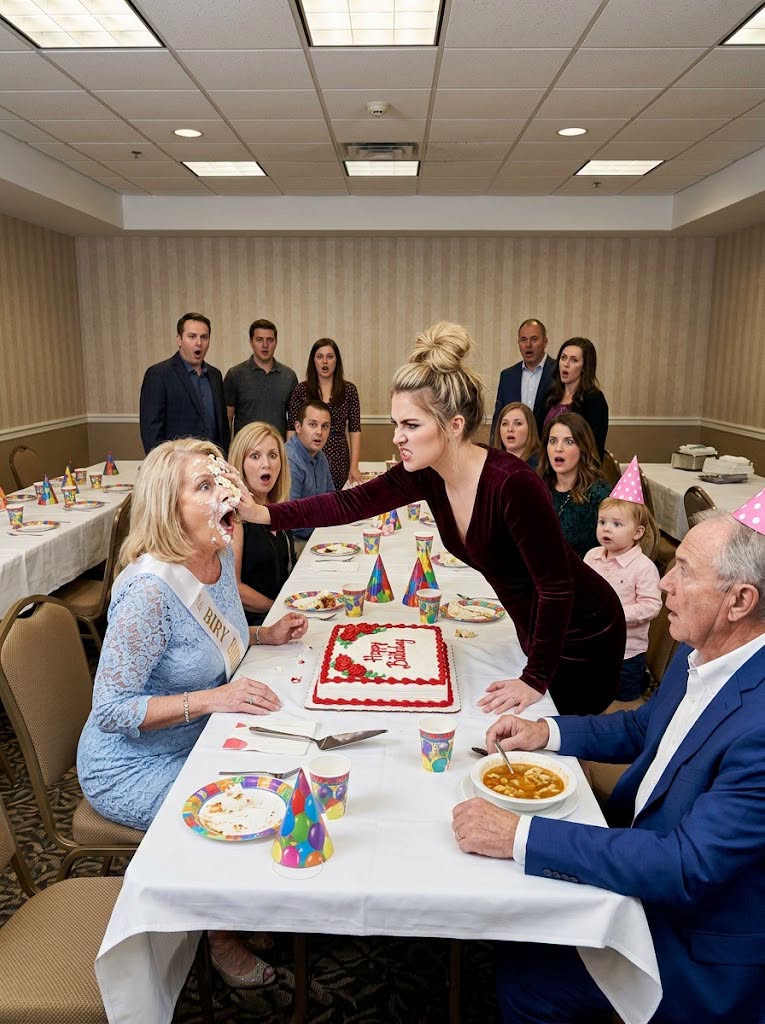
Something inside me snapped.
I lunged across the table and struck my husband hard enough that his glasses flew into his bowl of stew. Then I shoved his mother backward, sending her directly into her birthday cake.
Red frosting smeared across her clothes as everyone began shouting.
I told my husband exactly what I thought of a thirty-year-old man who could sit quietly while someone attacked his child. Then I picked up my terrified daughter and walked out.
His family had always mistaken my patience for weakness.
They were about to discover that my patience was gone.
My daughter didn’t cry until we reached the parking lot.
She pressed her face against my neck while her little body trembled. Under the streetlights, I could already see a red mark forming across her cheek.
“Grandma was angry,” she whispered.
Hearing her say it as though she had somehow caused what happened hurt more than anything said inside that banquet room.
I buckled her into the car just as my husband came running outside, covered in broth and without his glasses.
But he didn’t ask about our daughter.
He demanded that I return inside because I had humiliated his mother in front of everyone.
“Did your mother hit our child?” I asked.
He refused to answer directly.
Instead, he told me his mother had been emotional.
It was the same excuse I had heard for two years.
Whenever his mother criticized my parenting, insulted me, or crossed another boundary, he called it concern or teasing. Whenever I objected, he asked me to keep the peace.
But one month before that birthday dinner, I had quietly stopped trusting his promises.
I copied our important documents. I began putting part of my salary into an account only I controlled. I packed a small emergency bag for my daughter.
That night, we finally used it.
I drove directly to the apartment of a trusted friend who welcomed us without hesitation. I dressed my exhausted daughter in an oversized borrowed shirt and stayed beside her until she fell asleep.
Meanwhile, my phone kept vibrating.
My husband sent thirteen messages.
Nearly every one was about the ruined birthday, his humiliated mother, or what his relatives now thought of him.
Not once did he ask about the mark on our daughter’s face.
Then another message arrived.
It was from one of his cousins.
She had been recording the birthday candles from across the table and accidentally captured the entire confrontation.
I stepped into the hallway and watched.
There was my daughter reaching toward the table.
There was my mother-in-law grabbing her wrist.
And there was the strike.
The video clearly showed exactly what happened.
But then I noticed something I had completely missed during the chaos.
Seconds before his mother hit our daughter, my husband leaned toward her and whispered something.
I raised the volume.
“Don’t do that stuff in front of everyone.”
I replayed it.
Then again.
He hadn’t told his mother not to hurt our daughter.
He had told her not to do it where people could see.
Suddenly, two years of my marriage looked completely different.
Every time he had asked me to “keep the peace,” perhaps what he really wanted was silence. Every excuse, every minimized incident, every request that I stop causing problems had protected his mother rather than us.
My husband’s final message arrived shortly afterward.
He warned me that his mother intended to call the police and report me unless I returned home immediately.
For the first time that night, I almost laughed.
I sent him one final reply.
Go ahead.
I told him I had the video showing his mother striking our child. I also had the recording of his own words moments beforehand.
The following morning, I would be speaking with the police and contacting a divorce attorney.
Then I blocked his number.
I returned to the bedroom and climbed carefully beside my sleeping daughter.
Her cheek was still red, but her breathing was calm.
For years, I had believed protecting my marriage meant enduring more, forgiving more, and keeping the peace.
That night I finally understood something else.
Sometimes protecting your family means being the person willing to leave.