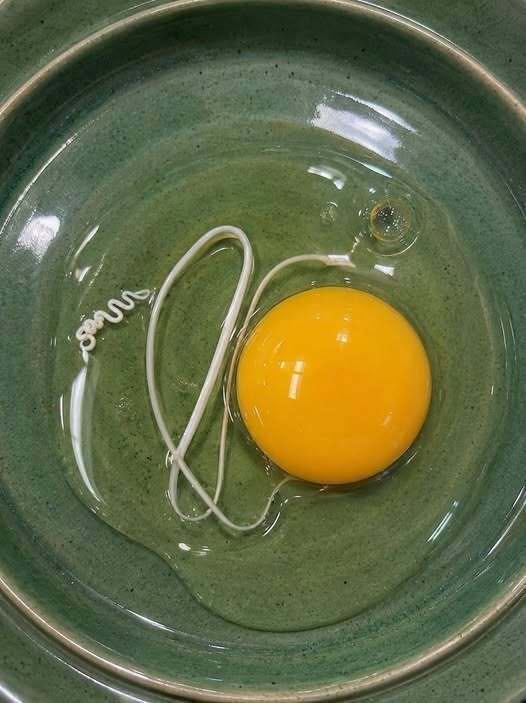
Was it a parasite?
Had the egg gone bad?
Was there something inside it that absolutely should not have been there?
The longer I stared at the strand, the more disturbing it seemed.
It looked almost like a tiny piece of white string suspended between the yolk and the surrounding egg white.
I set the bowl aside and grabbed the carton.
One by one, I cracked the remaining eggs into separate dishes, inspecting each as if I were conducting some kind of investigation.
Nothing.
Every other egg looked completely normal.
Strangely, that did not make me feel much better.
Instead, it made the first egg seem even more suspicious.
Why had only one of them contained that strange white cord?
What made that egg different?
I knew I was probably overthinking it, but once the idea of contamination entered my head, it was difficult to shake.
Eventually, curiosity won.
Before throwing the egg away, I took a photograph and started looking for an explanation.
What I discovered surprised me.
The mysterious white strand was not a worm.
It was not mold.
It was not a sign that something had gone wrong inside the egg.
It was called the chalaza, and it was supposed to be there.
The chalaza is a completely normal part of an egg’s internal structure.
These twisted, rope-like strands are made largely of protein and help keep the yolk positioned near the center of the egg.
There is typically a chalaza on either side of the yolk, almost like a pair of tiny natural anchors.
Their job is surprisingly important.
As the egg moves around inside its shell, the chalazae help stabilize the yolk and prevent it from simply drifting freely through the egg white.
And the part that surprised me most was this:
A clearly visible chalaza can actually be associated with freshness.
In fresher eggs, the chalazae tend to be stronger and more noticeable.
As an egg ages, the structure of the white gradually changes and those strands may become less prominent.
So the strange feature I had interpreted as a warning sign was essentially the opposite.
It was not evidence that the egg was contaminated.
It was part of the egg’s normal anatomy.
That realization completely changed how I saw what was sitting in front of me.
Minutes earlier, I had been debating whether I should throw away the entire carton.
Now I was looking at the same white strand as something completely ordinary.
Nothing about the egg had suddenly changed.
Only my understanding had.
It was a small reminder of how quickly unfamiliar things can trigger fear, especially when food is involved.
We rely heavily on appearance and smell to tell us whether something seems normal, so anything unexpected can feel immediately suspicious.
But nature does not always look neat or familiar.
Eggs can contain cloudy whites, small blood spots, differently colored yolks and prominent chalazae without any of those things automatically meaning the egg is unsafe.
Of course, normal egg safety rules still matter.
Eggs should be properly refrigerated, badly cracked shells should be avoided, and anything with an obviously unpleasant odor after cracking should be discarded.
But the chalaza itself is not a reason to worry.
It does not need to be removed before cooking, either.
It is perfectly edible and generally disappears into the rest of the egg as it cooks.
Some cooks remove it for particularly smooth custards or delicate recipes, but that is a matter of texture and appearance, not safety.
What began as a strangely alarming breakfast ended up becoming a tiny lesson in biology.
That unsettling white “string” was not something invading the egg.
It had been part of the egg all along, quietly doing exactly what nature designed it to do.
And the next time I saw one, I didn’t panic.
I knew its name.