Our two children had come home from school less than an hour earlier, hungry and loud in the way children always seem to be when you desperately need silence.
“Mom, what’s for dinner?”
“I don’t know yet, sweetheart.”
“Can we have pasta?”
“Probably.”
“Can mine have extra cheese?”
I closed my eyes.
“Yes.”
My phone buzzed beside me.
Nathan.
How are you feeling?
Worse. 102 now.
His reply came immediately.
Stay in bed. Seriously. Don’t cook. Order whatever everybody wants. I’ll be home around six.
I smiled despite feeling miserable.
You sure?
His response:
If I find out you stood over a stove with a 102 fever, I’m hiding every pan in this house.
That was Nathan.
Practical.
Not particularly poetic.
But when I needed him, he usually knew exactly what mattered.
So I opened a delivery app.
The kids wanted pasta.
Nathan loved steak from a nearby restaurant.
I ordered myself chicken soup because it was the only thing I could imagine swallowing.
With delivery fees and everything else, the total came to almost ninety dollars.
Normally, I would have winced.
That day, I didn’t care.
Ninety dollars seemed like a perfectly reasonable price for keeping a sick woman out of the kitchen.
The food arrived around 5:20.
I managed to shuffle downstairs in my robe while my daughter carried napkins and my son excitedly inspected the bags.
“Dad got steak?”
“Yes.”
“Can I have some?”
“Ask Dad.”
“You always say that.”
“Because it works.”
I had just started taking the containers out when the front door opened.
I froze.
Nathan wasn’t supposed to be home yet.
Then Angela walked in.
My mother-in-law.
She had an emergency key that we’d given her years earlier.
At the time, it had seemed sensible.
Angela lived fifteen minutes away.
If something happened with the children or we got locked out, she could help.
Unfortunately, Angela had gradually started interpreting “emergency key” as “family access pass.”
She stepped into the kitchen carrying her handbag.
Then stopped.
Her eyes moved from me to the takeout containers.
“What is all this?”
“Dinner.”
She frowned.
“I can see that.”
I didn’t have the energy for whatever was coming.
“I’m sick, Angela.”
“You ordered all this?”
“Yes.”
“How much?”
I should have lied.
“About ninety dollars.”
Her eyebrows rose.
“Ninety dollars?”
The kids went quiet.
“Angela, please.”
She walked toward the counter.
“Ninety dollars for food you could have made yourself?”
I stared at her.
“I have a fever.”
“So?”
For a second, I genuinely wondered whether she had heard me.
“So I’m sick.”
She picked up one of the containers.
“What is this?”
“Pasta.”
“And this?”
“Nathan’s steak.”
Her expression hardened.
“You ordered my son steak from a restaurant?”
“Yes.”
“And what are you eating?”
“Soup.”
She opened the container.
Steam rose from the chicken broth.
Angela stared at it.
Then looked at me.
“You couldn’t make soup?”
Something in me wanted to laugh.
Unfortunately, laughing hurt my throat.
“Not today.”
She shook her head.
“This is exactly the problem.”
“What problem?”
“Women have become too dependent on convenience.”
I blinked.
“Angela.”
“My mother had dinner on the table every night.”
“Good for her.”
She stiffened.
“You don’t need to be disrespectful.”
“I’m not trying to be disrespectful. I’m trying to remain conscious.”
My daughter giggled.
Angela didn’t.
She started gathering the containers.
At first, I didn’t understand what she was doing.
“Angela?”
She picked up the pasta.
Then Nathan’s steak.
Then my soup.
“What are you doing?”
“Making a point.”
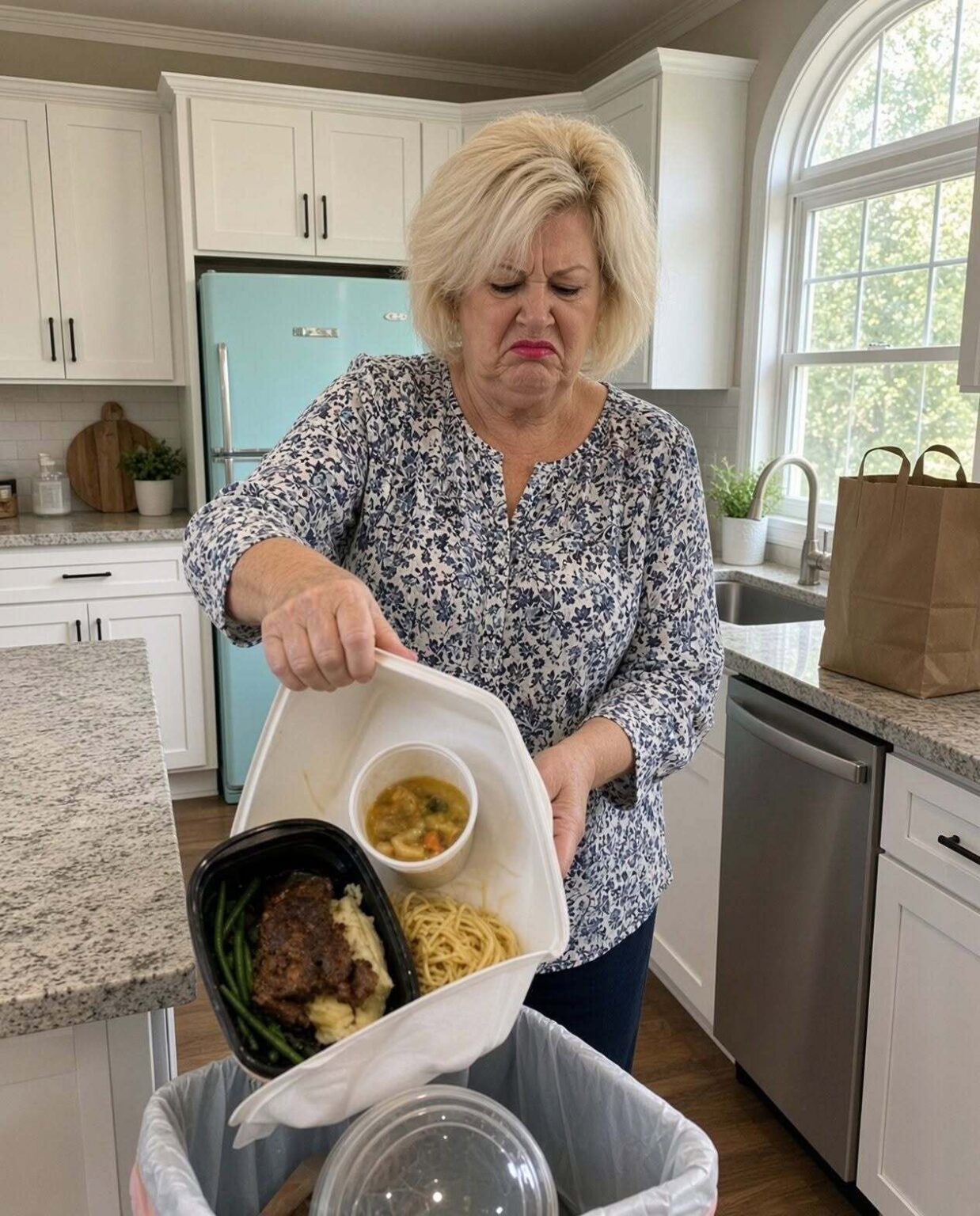
Before I could stop her, she opened the trash can.
And dropped the food inside.
All of it.
The pasta.
The steak.
The soup.
Nearly ninety dollars of untouched food landed in the garbage.
I stared at her.
The children stared too.
My son was the first to speak.
“Grandma!”
Angela closed the lid.
“There.”
My feverish brain struggled to process what had just happened.
“Why did you do that?”
“Because somebody needs to remind you that a home doesn’t run itself.”
I gripped the edge of the counter.
“I ordered dinner because I’m sick.”
“A good wife cooks dinner herself.”
I couldn’t believe she had actually said it.
“What?”
“You heard me.”
My daughter looked at me.
“Mom, are we still eating?”
That was the part that nearly made me cry.
Not Angela’s insult.
Not even the wasted money.
My children were hungry.
I was too sick to cook.
And the food I had bought for them was sitting in the garbage because their grandmother wanted to teach me some ridiculous lesson about womanhood.
“There’s peanut butter,” I whispered.
My son frowned.
“But you ordered pasta.”
“I know.”
“Can we get it out?”
“No.”
Angela answered before I could.
“Absolutely not.”
I looked at her.
“You don’t get to answer for me.”
Her face tightened.
“I’m trying to help you.”
“No, you’re not.”
“Yes, I am.”
“You threw my children’s dinner in the trash.”
“Because you’re teaching them that whenever something is difficult, you pay someone else to do it.”
I stared at her.
I wanted to fight.
Normally, I would have.
But I didn’t have the strength.
My head was pounding.
My throat burned.
I felt tears coming, and that made me even angrier because I didn’t want Angela to think she had reduced me to tears.
So I turned away.
The kids ate crackers with peanut butter.
I went back to the couch.
Angela remained in the kitchen, cleaning things that didn’t need cleaning and sighing loudly enough for me to hear.
At 6:07, the garage door opened.
Nathan was home.
“Hey!”
Then silence.
He walked into the living room.
One look at me and his expression changed.
“What happened?”
I wiped my face quickly.
“Nothing.”
He stared at me.
“You’re crying.”
“I’m sick.”
Then our son came running in.
“Grandma threw dinner away.”
Nathan stopped.
“What?”
Angela appeared behind him.
“Oh, don’t make this dramatic.”
Nathan slowly turned.
“What did he just say?”
Angela crossed her arms.
“She spent almost ninety dollars on restaurant food.”
Nathan looked at me.
“You ordered dinner?”
“Yes.”
“Like I told you?”
I nodded.
He looked back at his mother.
“And you threw it away?”
“She didn’t need to waste that kind of money.”
“Mom.”
“She is perfectly capable of making dinner.”
Nathan looked toward me.
My face must have said everything.
“She has a 102-degree fever.”
“I raised children while I was sick.”
“So?”
Angela blinked.
Nathan almost never spoke to his mother like that.
“So?”
He repeated it.
“What does that have to do with Yoli?”
“I’m saying women used to understand responsibility.”
I saw Nathan’s jaw tighten.
I expected shouting.
Instead, something strange happened.
He became completely calm.
Nathan pulled out his phone.
Angela seemed relieved, apparently believing the argument was over.
It wasn’t.
He scrolled through his contacts.
Then made a call.
“Hi, Aunt Irene.”
Angela’s expression changed instantly.
“Nathan.”
He held up one finger.
“Do you still have Mom’s Tuesday casserole dish?”
Angela went pale.
“What are you doing?”
Nathan ignored her.
Aunt Irene apparently said something on the other end.
“Yes. That one.”
Pause.
“Can you bring it over?”
Another pause.
“Right now, if you don’t mind.”
Angela stepped toward him.
“Nathan, hang up.”
He looked directly at her.
“Please bring it.”
Then he ended the call.
I stared at him.
“What casserole dish?”
Angela grabbed her handbag.
“I’m leaving.”
Nathan moved toward the doorway.
“No.”
She stared at him.
“Excuse me?”
“You wanted to teach my wife something.”
His voice remained calm.
“I think you should stay for the rest of the lesson.”
“Nathan.”
“Twenty minutes.”
Angela looked furious.
But she stayed.
Nobody said much.
Nathan made the children sandwiches.
Then he brought me water and checked my temperature.
“Still 102.”
“I know.”
“Medicine?”
“Already took it.”
He touched my forehead.
“You should be upstairs.”
“I don’t want to move.”
“Fair.”
Angela sat at the kitchen table with her arms folded.
At 6:31, the doorbell rang.
Nathan opened it.
Aunt Irene stood outside carrying a scratched old casserole dish.
She was Angela’s older sister.
She looked from Nathan to Angela.
Then to me bundled under a blanket.
“Oh.”
That single word told me she understood exactly why she had been summoned.
Nathan took the dish.
“Thanks.”
Angela stood.
“This is ridiculous.”
Aunt Irene walked inside.
“Hello to you too.”
Nathan turned the dish over.
A strip of old masking tape was stuck underneath.
The writing had faded but was still readable.
ANGELA — TUESDAY.
I looked at my mother-in-law.
Her face had gone bright red.
“What does that mean?”
Angela said nothing.
Aunt Irene answered.
“That was her Tuesday pan.”
“My what?”
“Dinner.”
Nathan set the casserole dish on the table.
“Tell her, Mom.”
Angela looked away.
“There’s nothing to tell.”
Aunt Irene sighed.
“Oh, Angela.”
“Don’t.”
“Why not?”
“Because this was forty years ago.”
Nathan leaned against the counter.
“Apparently the rules about being a good wife expire after forty years.”
Angela glared at him.
Aunt Irene pulled out a chair.
“When Nathan was little, your mother was exhausted.”
Angela shook her head.
“I managed.”
“No.”
Irene’s voice was gentle.
“You survived.”
Angela looked at her.
“That’s different.”
“Yes.”
Irene smiled sadly.
“It is.”
Then she looked at me.
“For almost a year, Angela came to my house twice a week.”
Angela immediately corrected her.
“Not every week.”
“Most weeks.”
“Irene.”
“Tuesday was chicken and rice.”
She tapped the casserole dish.
“Thursday was usually soup.”
I looked at Angela.
“You cooked for her?”
“For all of them.”
“Why?”
Irene’s expression softened.
“Because she needed help.”
Angela stared at the floor.
Nathan walked closer.
“I was sick a lot that winter.”
Irene nodded.
“You had pneumonia once. Ear infections constantly. Angela barely slept.”
Angela’s eyes filled despite herself.
“I remember.”
“I would call her Tuesday mornings and say, ‘Don’t cook tonight.’”
Nathan looked at his mother.
“And did you?”
She didn’t answer.
“Mom.”
“No.”
“No what?”
“I didn’t cook.”
“Did Dad starve?”
“No.”
“Did I?”
“No.”
“Did Aunt Irene bringing dinner make you a bad mother?”
Angela looked up.
“Of course not.”
Nathan nodded.
“Then why does ordering dinner while Yoli has a 102 fever make her a bad wife?”
Silence.
Angela rubbed her hands together.
“That was different.”
“How?”
“I was overwhelmed.”
Nathan pointed toward me.
“So is she.”
“I had a sick child.”
“She is sick.”
“Irene offered.”
“I told Yoli to order dinner.”
“That isn’t the same.”
“Why?”
Angela opened her mouth.
Nothing came out.
Nathan continued.
“Yoli and I both pay the mortgage.”
Angela looked uncomfortable.
“We both pay insurance.”
Silence.
“We both raise these children.”
He pointed toward the kitchen.
“She schedules appointments. She knows when school forms are due. She remembers birthdays I forget. She handles bills when I’m traveling. She stayed awake with our daughter for three nights when she had the flu.”
He paused.
“And today, she had a fever and ordered dinner.”
Angela looked toward me.
Nathan continued.
“That doesn’t make her lazy.”
“I didn’t call her lazy.”
“You threw her food in the trash because you thought she didn’t deserve to eat unless she cooked it herself.”
“I never said that.”
“You threw away her soup.”
Angela’s face changed slightly.
For the first time, she seemed to realize how cruel that detail sounded.
Irene spoke quietly.
“Angela.”
Her sister looked at her.
“Do you remember the pneumonia week?”
Angela nodded.
“You called me crying.”
Angela’s eyes filled.
“You said you hadn’t showered in three days.”
“I remember.”
“You said Nathan wouldn’t sleep unless you held him upright because he couldn’t breathe comfortably lying down.”
Nathan looked at her.
Angela stared at the table.
Irene continued.
“And do you remember what you said when I brought soup?”
Angela shook her head.
“I do.”
Irene smiled.
“You said, ‘I feel like such a terrible mother.’”
Angela wiped her cheek.
“And I told you that accepting help didn’t mean you loved your son less.”
The room became very quiet.
Irene reached across the table.
“You weren’t a bad mother because somebody else cooked.”
Angela looked at me.
“And she isn’t a bad wife for the same reason.”
Nathan nodded.
“Exactly.”
Angela sat there for several seconds.
Then she whispered:
“I was overwhelmed.”
Nathan’s voice softened.
“I know.”
“I thought I was failing at everything.”
“I know.”
“Irene made it look easy.”
Aunt Irene laughed.
“I had teenagers by then. Nothing was easy.”
Angela almost smiled.
Then Nathan looked toward me.
“But when you saw Yoli overwhelmed today, you didn’t remember how it felt.”
Angela’s smile disappeared.
“You judged her.”
He gestured toward the children.
“And you threw away food they were waiting to eat.”
Angela looked toward my son.
He was sitting at the counter eating his second peanut-butter sandwich.
Her expression finally cracked.
“I didn’t think about that.”
“No.”
Nathan’s voice remained calm.
“You thought about proving a point.”
Angela wiped her face.
“I shouldn’t have done it.”
“No.”
She looked at me.
For a second, I expected an apology.
It didn’t come.
Not yet.
Instead, she picked up her handbag.
“I should go.”
Nathan walked toward the front door.
“Yes.”
Angela looked surprised.
“You’re really throwing me out?”
“No.”
He opened the door.
“I’m asking you to leave my house after you came in uninvited, threw away our food, insulted my wife, and upset our children.”
She looked hurt.
Nathan didn’t back down.
“And Mom?”
“What?”
“Give me the key.”
Her face changed.
“Nathan.”
“The emergency key.”
“What if something happens?”
“We’ll figure it out.”
“You’ve trusted me with that key for years.”
“And today you used it to walk into my house without asking.”
She stared at him.
Then slowly removed the key from her ring.
She placed it in his palm.
“You don’t trust me anymore?”
Nathan closed his fingers around it.
“Trust isn’t permanent just because we’re family.”
Angela looked at me.
Then at Irene.
Without another word, she walked out.
Aunt Irene stayed.
She looked at the trash can.
“Was there really steak in there?”
Nathan nodded.
“Ninety-dollar dinner.”
She winced.
“That hurts me spiritually.”
Despite my fever, I laughed.
It hurt my throat.
But I laughed anyway.
Irene stayed long enough to make scrambled eggs for the children.
Nathan reheated some soup she had brought with the casserole dish.
Then he helped me upstairs.
“You okay?”
“Ask me when my temperature isn’t 102.”
“Fair.”
I climbed into bed.
He pulled the curtains.
Then I remembered something.
“How did you know about that casserole dish?”
Nathan smiled.
“Aunt Irene told me years ago.”
“Why?”
“Mom was giving somebody else a hard time about using frozen lasagna.”
I stared at him.
“You’ve been waiting years to use that?”
“I wouldn’t say waiting.”
“You knew exactly which pan to request.”
He shrugged.
“I keep receipts.”
I laughed again.
“Stop making me laugh. It hurts.”
“Sorry.”
He kissed my forehead.
The next morning, my fever had dropped slightly.
Nathan had already taken the kids to school.
I was half asleep when the doorbell rang.
I ignored it.
Then it rang again.
I grabbed my phone.
A message from Angela.
It’s me. I brought something. I won’t come in unless you say it’s okay.
I stared at that sentence.
That alone was different.
Come in.
A minute later, I heard the front door open.
Then footsteps.
Angela appeared at the bedroom doorway carrying a bowl.
She didn’t walk in immediately.
“Can I?”
I nodded.
She entered.
“I brought soup.”
I looked at the bowl.
“Did you make it?”
Angela hesitated.
Then something almost like embarrassment crossed her face.
“No.”
I raised an eyebrow.
“Irene did.”
A tiny smile appeared.
“I brought it.”
I smiled too.
“That counts.”
She placed the soup on the bedside table.
Then refilled my water glass.
Neither of us spoke for a moment.
Finally, Angela sat in the chair beside the window.
“I owe you an apology.”
I waited.
“I was cruel yesterday.”
Her eyes stayed on her hands.
“And hypocritical.”
That word clearly cost her something.
“I spent years telling myself I had done everything alone.”
She shook her head.
“I didn’t.”
I thought about the casserole dish.
“No one does.”
“I suppose that’s true.”
She looked toward me.
“When Nathan was little, I was terrified people would think I wasn’t managing.”
Her voice became quieter.
“Irene helped me more than I admitted.”
“Why did you hide it?”
“Pride.”
At least she answered honestly.
“Then somewhere along the way, I turned the things I was ashamed of needing into things I judged other women for needing.”
That surprised me.
I hadn’t expected her to understand it so clearly.
Angela wiped her eyes.
“I think when I saw those containers yesterday, I wasn’t really angry at you.”
“Who were you angry at?”
“Myself.”
She laughed softly.
“The younger version.”
I said nothing.
“I spent years believing I should have been stronger. So when I saw you doing something I never gave myself permission to do without guilt, I judged you.”
She looked at me.
“That wasn’t fair.”
“No.”
“And throwing away the food was ridiculous.”
“Very.”
“Ninety dollars.”
“Ninety dollars.”
She winced.
“I’ll pay you back.”
“You don’t need to.”
“I do.”
I wasn’t going to argue while sick.
“Fine.”
She nodded.
Then looked around the room.
“Do you need anything?”
I thought about it.
“No.”
Then I noticed the sunlight coming through the window.
“Actually.”
“Yes?”
“Could you close the curtains?”
Angela stood immediately.
“Of course.”
She pulled them closed.
The room became dim and quiet.
Then she returned to the bed and adjusted the water glass so it was within easy reach.
“I’ll let you sleep.”
She started toward the door.
“Angela?”
She turned.
“Thank you for the soup.”
Her eyes filled slightly.
“Thank Irene.”
“I will.”
She smiled.
Then left.
I lay there thinking about the previous evening.
Nathan could have screamed at his mother.
He could have humiliated her.
He could have listed every mistake she’d ever made.
Instead, he had brought out one battered casserole dish.
A scratched pan with faded tape underneath.
ANGELA — TUESDAY.
That was all it took.
Because the most powerful thing Nathan could show his mother wasn’t that she was wrong.
It was that she had once needed exactly the same grace she was refusing to give me.
She had been tired.
Overwhelmed.
Scared.
Someone else had cooked.
Her children had eaten.
Life had continued.
And nobody had loved anybody less because dinner came from someone else’s kitchen.
I kept thinking about something Aunt Irene had said.
Accepting help didn’t make you love your family less.
Maybe that was the lesson underneath all of it.
We have strange ideas about what love is supposed to look like.
Sometimes we imagine it’s a spotless house.
A homemade dinner.
Never asking for help.
Never admitting you’re exhausted.
Always being the person who carries everyone else.
But sometimes love looks like ordering pasta because you have a fever.
Sometimes it looks like your sister arriving with chicken and rice.
Sometimes it looks like your husband telling you to stay in bed.
And sometimes it looks like a woman swallowing her pride, carrying someone else’s soup into your bedroom, and asking if you’d like the curtains closed.
Angela and I didn’t become magically perfect after that.
She was still Angela.
She still had opinions.
Lots of them.
But she called before coming over.
She never used the phrase “a good wife” with me again.
And whenever one of us was sick, she usually showed up with food.
Sometimes she cooked it.
Sometimes Irene did.
Eventually, I stopped asking.
Because the important part wasn’t who stood over the stove.
The important part was who showed up carrying the bowl.
{"post":111766,"page":2,"next":[{"id":111746,"title":"Jane Fonda Reflects on the Enduring Professional Bond and Personal Connection Shared with Robert Redford","url":"https:\/\/new24.info\/111746"},{"id":111743,"title":"The Hidden Weight of Childhood Sacrifice and the Lesson I Learned at Summer Camp","url":"https:\/\/new24.info\/111743"},{"id":111740,"title":"Remembering Carla Jeffery: A Talented Actress Who Brought Joy to Audiences Everywhere","url":"https:\/\/new24.info\/111740"},{"id":111737,"title":"A Veteran Carpenter Shows Why Professionalism and Legal Leverage Are the Ultimate Tools for Justice","url":"https:\/\/new24.info\/111737"},{"id":111734,"title":"The Silent Guardian of the Forest: Lidia\u2019s Secret Mission to Save the Forgotten","url":"https:\/\/new24.info\/111734"},{"id":111729,"title":"After Three Sons, My Husband Put a Baby Girl in My Arms \u2013 I Cried with Joy Until the Doctor Asked to Speak to Me Alone","url":"https:\/\/new24.info\/111729"},{"id":111727,"title":"My Daughter Cut Into Her Gender Reveal Cake and Started Crying \u2013 Then the Baker Pulled Me Aside","url":"https:\/\/new24.info\/111727"},{"id":111724,"title":"After a Brutal 14-Hour Labor, I Was Holding Our Newborn Son \u2013 But What My Husband Whispered Before Walking Out Made My Blood Run Cold","url":"https:\/\/new24.info\/111724"},{"id":111720,"title":"My High School Sweetheart Proposed with a Wire Ring Days Before He Disappeared \u2013 I Wore It for 55 Years Until a Mysterious Box Appeared in My Mailbox on My Birthday","url":"https:\/\/new24.info\/111720"},{"id":111717,"title":"My MIL Saw My Newborn Daughter for the First Time, Looked Horrified, and Told Us to Give Her Up \u2013 When I Found Out Why, I Nearly Fainted","url":"https:\/\/new24.info\/111717"},{"id":111714,"title":"My Neighbor Tried to Drive Me Out of Our Neighborhood \u2014 In the End, Karma Hit Her Hard","url":"https:\/\/new24.info\/111714"},{"id":111707,"title":"A Gentle, Science-Backed Guide to Egg Carton Codes","url":"https:\/\/new24.info\/111707"},{"id":111706,"title":"Entitled Neighbor Claims My Driveway Until Thirty Classic Cars Teach Respect","url":"https:\/\/new24.info\/111706"},{"id":111702,"title":"Husband Summons Unexpected Guest After His Mother Throws Away My Delivery Dinner","url":"https:\/\/new24.info\/111702"},{"id":111698,"title":"My Parents Gave My Brother Everything Until My Hidden Lien Surfaced","url":"https:\/\/new24.info\/111698"},{"id":111693,"title":"A Rich Couple Refused to Pay My Grandpa $6,200 for Their Renovation \u2013 He Looked Around, Smiled, and Said, \u0027Okay\u0027","url":"https:\/\/new24.info\/111693"},{"id":111690,"title":"Why One Tiny Silver Key Destroyed My Husband And Saved My Life","url":"https:\/\/new24.info\/111690"},{"id":111686,"title":"Cruel Family Dinner Ambush Unintentionally Exposes Decades Of Massive Corporate Financial..","url":"https:\/\/new24.info\/111686"},{"id":111672,"title":"She was \u0027madly\u0027 in love with her co-star Robert Redford until his death \u2013 who is this legendary actress, now brokenhearted?","url":"https:\/\/new24.info\/111672"},{"id":111669,"title":"A Mother Cancels the Grocery Fund After a Cruel Remark About Her Starving Child","url":"https:\/\/new24.info\/111669"}]}