Michael was practical and protective.
Nathan was the one who could make me laugh when I was furious.
Luke, our youngest, still called me when he couldn’t remember how long chicken was supposed to stay in the oven.
My life was full.
I knew that.
Still, David understood there had always been one quiet ache inside me.
Not because I wished any of my sons had been different.
Never.
But because before them, there had been another baby.
A daughter.
A little girl I had been told I lost before I was even allowed to hold her.
I was seventeen.
And for thirty-six years, I believed she was dead.
Then, one morning at exactly 6:20, my phone rang.
David.
I reached across the bed half-asleep.
“Hello?”
“Carol.”
His voice immediately woke me.
“What happened?”
“I’m at the hospital.”
I sat straight up.
“Why?”
“Nothing happened to me.”
“Then what happened?”
There was a pause.
“Just come here.”
“David.”
“Please.”
His breathing sounded strange.
“Come as soon as you can.”
I was already getting out of bed.
“Which hospital?”
He told me.
Then, just before hanging up, he added:
“And don’t bring the boys.”
I froze.
“What?”
But the line went dead.
I called him back immediately.
No answer.
By the time I reached the hospital, my imagination had supplied every terrible possibility.
One of the boys.
An accident.
Cancer.
Something David couldn’t say over the phone.
I rushed through the main entrance and followed his text toward the maternity floor.
Then I saw him.
David was standing near the double doors.
And in his arms was a newborn baby girl.
I stopped walking.
For a moment, I genuinely thought I had gone to the wrong place.
David looked exhausted.
His eyes were red.
But the baby in his arms was sleeping peacefully.
Tiny face.
Dark hair.
Pink hospital cap.
“David?”
He looked up.
His expression crumpled.
I walked closer.
“Whose baby is that?”
His mouth opened.
Nothing came out.
“David.”
He looked down at her.
Then back at me.
“Ours.”
I stared at him.
“What?”
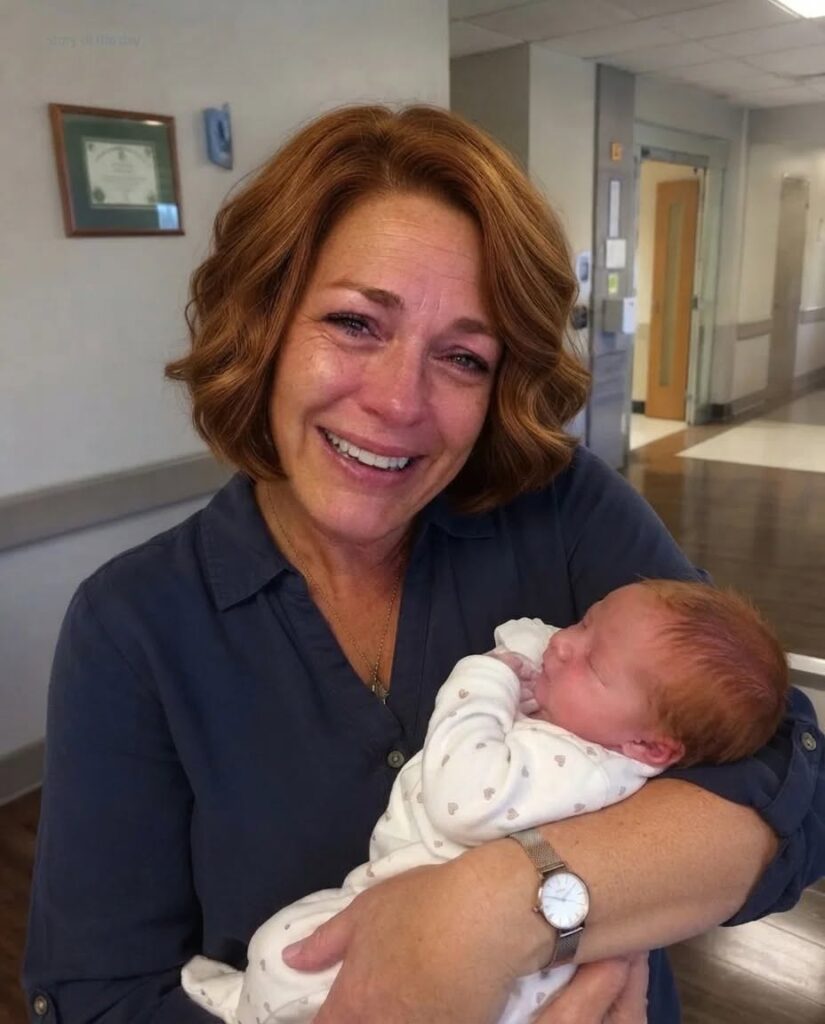
He stepped forward and carefully placed the baby into my arms.
I was too stunned to stop him.
She weighed almost nothing.
Her little hand opened against my sweater.
Then curled again.
I looked down at her face.
And something inside me broke open.
She had dark hair.
A tiny round nose.
And gray eyes that appeared for half a second when she blinked.
Beautiful gray eyes.
My eyes.
My mother’s eyes.
I immediately started crying.
Not because I understood.
I didn’t.
Nothing made sense.
David kissed my forehead.
“Her name is Grace.”
I looked up sharply.
“What are you talking about?”
“Carol—”
“Why are you holding a newborn?”
He glanced down the hallway.
“It’s complicated.”
“Then uncomplicate it.”
Before he could answer, a doctor approached us.
“Carol?”
“Yes.”
He looked at the baby.
Then at David.
“I need to speak with you privately.”
David stiffened.
“That isn’t necessary.”
The doctor barely looked at him.
“I believe it is.”
I turned toward my husband.
“What is going on?”
David said nothing.
That frightened me more than anything.
The doctor led me into a small consultation room.
I was still holding Grace.
A nurse followed and offered to take her.
I hesitated.
I had known this baby for perhaps three minutes, yet some part of me resisted handing her over.
Eventually, I let the nurse carry her back toward the maternity unit.
The doctor closed the door.
“Has your husband explained how Grace came to be here?”
“No.”
He sat down.
I remained standing.
“Then I think you should sit.”
“I’m fine.”
“Carol.”
Something in his tone made me obey.
He placed a folder on the desk.
Then slid it toward me.
“What is this?”
“Test results.”
I opened the folder.
The first page contained names and numbers I didn’t immediately understand.
Then I saw David’s name.
Below it:
Probability of paternity: 0%.
I read it again.
Then looked at the doctor.
“If David isn’t that baby’s father, why did he just put her in my arms and say she’s ours?”
The doctor turned the page.
“There is another test.”
My name.
Carol Bennett.
I followed the lines until I found the result.
Probability of biological relationship: 99.8%.
My fingers went numb.
“What relationship?”
The doctor hesitated.
I looked back down.
“This is wrong.”
“The laboratory repeated the analysis.”
“I’m fifty-four.”
“I understand.”
“You’re showing me a DNA test saying I’m biologically related to a newborn.”
“Yes.”
“How?”
The doctor didn’t answer immediately.
I pushed the folder away.
“Who is her mother?”
Before he could respond, someone pounded on the door.
“Mom!”
I knew that voice.
Michael.
The door opened.
My oldest son rushed inside.
His hair was disheveled.
His shirt looked as if he had pulled it on in the dark.
The moment he saw the folder, he stopped.
Then looked at the doctor.
“You told her?”
I stood.
“No.”
My voice came out sharper than I intended.
“Nobody has told me anything.”
Michael swallowed.
“Mom.”
“You’re going to start right now.”
David appeared behind him.
“Carol, maybe you should sit down.”
“I am sitting down.”
Neither of them spoke.
I looked at Michael.
“Is Grace yours?”
His eyebrows shot up.
“What?”
“Your daughter.”
“No.”
“Then why does DNA say I’m related to her?”
Michael looked at David.
That glance was enough.
Something had been happening behind my back.
Something both of them knew.
I slammed the folder against the table.
“Stop looking at each other.”
Michael turned back to me.
“Mom—”
“Look at me.”
He did.
His eyes were already filling with tears.
“Grace is your granddaughter.”
I stared at him.
“You just said she isn’t your child.”
“She isn’t.”
“Then whose is she?”
His lips trembled.
“Rebecca’s.”
I frowned.
“Who is Rebecca?”
Michael couldn’t say it.
David did.
“Your daughter.”
For one second, I thought I had misunderstood.
Then I laughed.
A short, shocked sound.
“My what?”
“Carol—”
“I don’t have a daughter.”
Michael crouched in front of me.
“Mom, please.”
“I have three sons.”
“I know.”
“My daughter died.”
Silence.
Something changed in Michael’s face.
Not confusion.
Pain.
“Mom.”
“No.”
He reached toward me.
I moved away.
“No.”
His voice broke.
“She didn’t.”
The room seemed to tilt.
“What did you say?”
“Your daughter didn’t die.”
I stared at him.
“You don’t say something like that to me.”
“I wouldn’t if it wasn’t true.”
“My baby died.”
“No.”
“I was told she died.”
“I know.”
“You don’t know anything about it.”
Then I looked at David.
He was staring at the floor.
That was when I understood something else.
“You knew.”
He raised his head.
“Carol.”
“How long?”
He didn’t answer.
I stood.
“How long have you known my daughter was alive?”
David whispered:
“Almost four months.”
My chair scraped backward.
“Four months?”
“Please—”
“You knew for four months?”
“Yes.”
I turned toward Michael.
“You knew too?”
He nodded.
“Longer.”
I could barely breathe.
And suddenly I was no longer fifty-four.
I was seventeen again.
Pregnant.
Ashamed because everyone around me had taught me I should be.
It was 1989.
My parents treated my pregnancy like a catastrophe.
My father barely spoke to me after he found out.
My mother stopped taking me to church because she didn’t want people asking questions.
The boy who got me pregnant disappeared almost immediately.
My parents arranged for me to finish school at home.
People were told I was ill.
When my labor began, I was terrified.
I remember bright hospital lights.
My mother’s voice.
Pain.
Doctors moving quickly.
Then nothing.
I woke hours later.
My mother was sitting beside the bed.
I asked for my baby.
Her face changed.
“It was a girl.”
I remember smiling.
Even now.
For one second, before I understood.
“A girl?”
Then she took my hand.
And told me my daughter had died.
I screamed.
I begged to see her.
My mother refused.
She said it would be better if I remembered the baby the way I had imagined her.
I was seventeen.
She was my mother.
I trusted her.
So I believed her.
For thirty-six years.
Every birthday I thought about the daughter who would have been another year older.
Every time I saw a girl with dark hair, some ridiculous part of me wondered what mine might have looked like.
When Michael was born years later, I cried because he was healthy.
And also because holding him showed me everything I had missed with her.
When Nathan arrived, I thought about her again.
Then Luke.
And eventually, I folded the tiny pink blanket I had bought at seventeen and packed it away.
Because there would be no daughter to use it.
Now Michael was standing in front of me saying she had lived.
All those birthdays.
All that grief.
Built around a lie.
“Where is she?”
Michael blinked.
“Grace?”
“No.”
My voice cracked.
“My daughter.”
David took one step toward me.
“Carol.”
“Where is Rebecca?”
Michael looked toward the door.
“She’s here.”
My knees weakened.
“Here?”
“In the hospital.”
“How close?”
“Two floors down.”
I covered my mouth.
Thirty-six years.
And my daughter was two floors beneath me.
Alive.
“Why?”
Michael’s expression changed.
“She gave birth to Grace last night.”
I stared at him.
“There were complications.”
“What kind?”
“She had to have surgery.”
Fear replaced anger instantly.
“Is she okay?”
“The surgery went well.”
“That’s not what I asked.”
The doctor spoke.
“She is stable and being closely monitored.”
“Stable?”
“Yes.”
“Is she going to live?”
“We expect her recovery to continue.”
I pressed both hands against my face.
For several seconds, nobody spoke.
Then I looked at Michael.
“Start at the beginning.”
He sat down.
“About seven months ago, I did an ancestry DNA test.”
I remembered.
Michael had become fascinated with family history.
Old census records.
Immigration documents.
Photographs.
A few weeks after taking his own test, he had arrived at my house with another kit.
“You should do one.”
“Why?”
“So I can separate your side from Dad’s.”
I had laughed.
“You’re turning into Grandpa.”
“I’ll take that as a compliment.”
I did the cheek swab without thinking twice.
Now I stared at him.
“That test.”
“Yes.”
“What happened?”
“My results showed an extremely close match.”
“To Rebecca?”
He nodded.
“She was already in the database.”
“How close?”
“Too close to be an ordinary cousin.”
He rubbed his hands together.
“She was thirty-six. Adopted at birth.”
My throat tightened.
“And?”
“She had paperwork with your maiden name.”
I closed my eyes.
“Oh my God.”
“At first I thought there had to be some mistake.”
“So you contacted her?”
“Yes.”
“What did you say?”
“That we appeared to be closely related.”
“And she told you she was adopted.”
“Yes.”
“You suspected she was mine.”
“I didn’t know.”
“So you brought me the test.”
He nodded.
I stared at him.
“You lied to me about why.”
“I needed confirmation.”
“You could have asked.”
“Mom, how was I supposed to ask, ‘Did you have a daughter nobody knows about?’”
“I would’ve told you.”
“Would you?”
“Yes.”
My voice broke.
“I would’ve told you she died.”
That silenced him.
Michael wiped his eyes.
“When your results came back, there wasn’t much doubt.”
“What exactly did they show?”
“That Rebecca is my half-sister.”
Sister.
The word landed strangely.
My oldest son had an older sister.
Nathan and Luke had a sister.
I had a daughter.
Alive.
“What did she say when she found out?”
Michael hesitated.
“She didn’t want to meet you.”
I wasn’t prepared for how much that hurt.
“Oh.”
“She wasn’t angry exactly.”
“What was she?”
“Careful.”
I nodded slowly.
“She had always known she was adopted.”
“And thought I gave her away.”
“Yes.”
I swallowed.
“Did you tell her I thought she was dead?”
“Eventually.”
“What did she say?”
“She didn’t believe me.”
Of course she didn’t.
How could she?
From her side, I was the biological mother who had disappeared.
From mine, she was a baby I had buried without ever seeing a grave.
Two women had spent thirty-six years living inside opposite versions of the same lie.
I looked at Michael.
“Why didn’t you tell me as soon as you knew?”
“I wanted to.”
“Then why didn’t you?”
David spoke.
“Because I asked him not to.”
Slowly, I turned toward my husband.
“You did what?”
“Rebecca wasn’t ready.”
“That was Rebecca’s decision.”
“I know.”
“No.”
I stood.
“You keep making decisions in this story as if they’re yours.”
David’s eyes filled.
“I was trying to protect you.”
I laughed.
“From my daughter being alive?”
“From losing her twice.”
That stopped me.
“What?”
He rubbed his forehead.
“I thought if we told you immediately, you’d run toward her.”
“Of course I would.”
“And she might reject you.”
“That would hurt.”
“Yes.”
“But at least I’d know she was alive.”
He said nothing.
“You let me continue believing my child was dead.”
“I was scared.”
“So was I.”
My voice rose.
“For thirty-six years.”
Nobody spoke.
Then I looked back at Michael.
“How did we get from Rebecca refusing to meet me to David holding her baby upstairs?”
Michael took a breath.
“We kept talking.”
“You and Rebecca?”
“Yes.”
“At first just messages.”
He smiled faintly.
“She didn’t trust me.”
“Smart woman.”
That almost made him laugh.
“Eventually we spoke on the phone.”
“Then?”
“We met.”
“How many times?”
“Five.”
My chest tightened again.
“You met my daughter five times.”
“I’m sorry.”
I held up my hand.
“Keep going.”
“Rebecca grew up an only child.”
He looked down.
“Finding out she suddenly had three brothers was a lot.”
“Do Nathan and Luke know?”
“No.”
I stared at him.
“They have a sister and they don’t know.”
“She asked me not to tell anyone else yet.”
I closed my eyes.
At least somebody had respected one of Rebecca’s choices.
Michael continued.
“A few months ago, she told me she was pregnant.”
I glanced toward the maternity floor.
“Grace.”
“Yes.”
“Where’s the father?”
“Not involved.”
“That’s all I need to know right now.”
He nodded.
“Rebecca eventually made me her emergency contact.”
“Why?”
“Because she didn’t have much family nearby.”
My throat tightened.
“She had family.”
“I know.”
“She just didn’t know if she wanted us.”
Michael looked at me sadly.
“Yes.”
The night before, Rebecca had gone into labor.
Early that morning, complications developed.
She needed emergency surgery.
Michael called David.
“Why him?”
“I panicked.”
Michael looked guilty.
“I needed someone.”
“And you didn’t call me.”
“No.”
I looked at David.
“So you came here.”
“Yes.”
“Did Rebecca know?”
“She knew Michael called me.”
“And she allowed you to come?”
“Yes.”
“Did she know you were going to call me?”
Silence.
My anger returned immediately.
“David.”
“No.”
“Of course.”
He looked ashamed.
“Seeing Grace changed something.”
“What?”
He glanced toward the door.
“When they handed her to me, all I saw was the blanket.”
I frowned.
“What blanket?”
“Your pink one.”
My throat closed.
David had seen it.
Years ago.
Before Michael was born, I had shown him the blanket I bought during my first pregnancy.
Tiny.
Pink.
Faded now.
“I watched you keep that thing through our entire marriage.”
He wiped his eyes.
“I watched you have three sons you adored and still keep one little blanket hidden in the back of the closet.”
I said nothing.
“When I held Grace, I thought about you at seventeen.”
His voice broke.
“I thought about someone taking Rebecca out of your arms before you ever got to know her.”
I looked away.
“And I couldn’t keep it from you anymore.”
“So you called.”
“Yes.”
“And said the baby was ours.”
“I meant our granddaughter.”
Despite everything, a laugh escaped me.
“You are terrible at explanations.”
“I know.”
I looked sharply at him.
“Stop saying that.”
“Sorry.”
That almost made me laugh again.
Then I remembered.
“Rebecca.”
My heart started pounding.
“I want to see her.”
Michael immediately looked uncomfortable.
“What?”
He looked at David.
“Stop doing that.”
He looked back at me.
“She knows you’re here.”
“And?”
“She doesn’t want to see you.”
Everything inside me went still.
“Oh.”
The anger left me.
Not because I wasn’t hurt.
Because suddenly I understood that this was not only my story.
For thirty-six years, my daughter had lived without me.
Whatever had happened to me at seventeen did not erase what she had felt growing up.
She didn’t owe me an instant reunion because I had been wronged too.
I looked down at my hands.
“Okay.”
Michael frowned.
“Okay?”
“If she doesn’t want to see me, I won’t force her.”
“Mom.”
“Tell her something.”
“What?”
“Tell her I didn’t give her away.”
“She knows now.”
“Tell her again.”
“I will.”
“And tell her I’m sorry.”
Michael’s face tightened.
“You have nothing to apologize for.”
“I didn’t find her.”
“You thought she was dead.”
“I know.”
Grief doesn’t listen to logic.
Neither does guilt.
I went back upstairs.
Grace was sleeping in the bassinet.
I stood beside her.
For thirty-six years, I had imagined what my baby girl might have looked like.
Now her daughter was lying in front of me.
I reached toward her.
Then stopped.
David noticed.
“What?”
“She’s Rebecca’s.”
“Yes.”
“I don’t know Rebecca.”
He waited.
“I don’t want to take something she hasn’t chosen to give me.”
David’s expression softened.
“She told Michael before surgery that if something happened, you could hold Grace.”
I stared at him.
“She said that?”
“Yes.”
“Did she know I was here when she said it?”
“No.”
I withdrew my hand.
“Then I’ll wait.”
For once, David didn’t argue.
An hour passed.
Then another.
I watched Grace sleep.
David sat beside me without speaking.
I was furious with him.
I also knew I loved him.
Both things were true.
Then the doors opened.
Michael hurried toward us.
I stood immediately.
“Rebecca?”
“She’s awake.”
Relief hit me so hard I grabbed the chair.
“Is she okay?”
“Yes.”
“Are you sure?”
“Yes.”
I exhaled.
Then noticed his face.
“What?”
“She asked for you.”
I stared at him.
“What?”
“She wants to see you.”
“Are you sure?”
“Yes.”
David stood.
Michael shook his head.
“Just Mom.”
I followed Michael downstairs.
With each floor, my hands shook harder.
When we reached the corridor, he stopped outside one of the rooms.
“You don’t have to go in immediately.”
I looked at the closed door.
“I’ve already waited thirty-six years.”
Then I walked inside.
Rebecca lay propped against white hospital pillows.
She looked exhausted.
Pale.
Dark hair loose around her face.
For a second, I saw nothing familiar.
Then she opened her eyes fully.
Gray.
My eyes.
My mother’s eyes.
Grace’s eyes.
I stopped just inside the doorway.
Rebecca stared at me.
Neither of us spoke.
Thirty-six years stood between us.
Finally, she said:
“I don’t know what I’m supposed to call you.”
My eyes filled.
“You don’t have to call me anything.”
She looked down.
“I thought you’d look different.”
I gave a shaky laugh.
“Different how?”
“I don’t know.”
“Neither do I.”
Her mouth moved slightly.
Almost a smile.
Then it disappeared.
“Did you really think I was dead?”
“Yes.”
“All this time?”
“All thirty-six years.”
Her eyes filled.
She turned toward the window.
“I spent my whole life thinking you didn’t want me.”
“I wanted you.”
“You were seventeen.”
“I was still your mother.”
She wiped her cheek.
“Michael told me what your parents did.”
“I didn’t know.”
“I believe that now.”
I closed my eyes for a second.
Those words meant more than she could possibly understand.
I wanted to ask everything.
Who raised you?
Were they kind?
Did you have a happy childhood?
What did you want to be when you were little?
Who held you when you had nightmares?
Did you like school?
When did you learn to drive?
Did anyone tell you your gray eyes were beautiful?
Did you ever wonder about me?
But I could see how tired she was.
And those thirty-six years belonged to her.
I couldn’t demand them back all at once.
So I asked:
“How are you feeling?”
Rebecca looked surprised.
“Tired.”
“I should let you rest.”
I turned toward the door.
“Wait.”
I stopped.
She looked at me.
“Is Grace okay?”
I smiled.
“She’s perfect.”
“Did you hold her?”
I hesitated.
“David put her in my arms when I arrived.”
Rebecca nodded.
“Good.”
Then she closed her eyes.
“Good.”
That was all.
And somehow, for that day, it was enough.
Rebecca went home several days later.
Not with me.
To her own home.
I was disappointed.
But I also understood.
There was no movie moment where she suddenly called me Mom and moved into the life we should have had.
She already had a life.
A history.
A childhood I had not been part of.
Our first weeks together happened mostly through text messages.
I learned very quickly not to panic when she didn’t answer.
Sometimes I sent:
How is Grace today?
She responded three minutes later.
Other times, three days.
I wanted to fill every silence.
I forced myself not to.
Our first lunch lasted forty minutes.
Rebecca ordered soup.
I barely ate.
Our second lunch lasted almost two hours.
By the third, she told me about her adoptive parents.
They had loved her.
That mattered deeply to me.
Her mother had died six years earlier.
Her father lived in another state.
“I had good parents,” she said carefully.
I reached across the table.
“I’m glad.”
She looked surprised.
“You are?”
“Of course.”
“I thought you might be jealous.”
“I missed raising you.”
My throat tightened.
“But I’m grateful somebody loved you when I couldn’t be there.”
Rebecca looked down at her coffee.
That was the first time she reached for my hand.
Eventually, she met Nathan and Luke.
We told them before she arrived.
Nathan thought we were joking.
Luke sat completely silent for almost five minutes.
Then said:
“So I’m an uncle?”
That made Rebecca laugh.
Watching my three sons sit around my dining table with their sister was one of the strangest experiences of my life.
Michael kept staring at everyone as though he had personally solved a thirty-six-year mystery.
Which, in fairness, he almost had.
David and I had a harder road.
I understood his fear.
But understanding didn’t erase what he had done.
He had known for four months.
Four months in which he kissed me goodnight while I still believed my daughter had died in 1989.
Four months in which he decided I couldn’t handle the truth.
We started counseling.
During one session, David said:
“I thought I was protecting her.”
The counselor asked:
“From pain?”
“Yes.”
Then she asked:
“Or from a decision you were afraid she might make?”
David sat quietly.
That was when he finally understood why I was so angry.
Protection without permission can become control.
Even when it comes from love.
Michael apologized too.
Constantly.
Eventually, I stopped him.
“You don’t have to keep saying sorry.”
His face relaxed.
Then I added:
“But you do have to promise me something.”
“Anything.”
“Stop deciding what you think I can survive.”
His smile disappeared.
“I will.”
“I mean it.”
“I know.”
I gave him a look.
He laughed.
“Sorry. Wrong phrase.”
By then, both of my parents were gone.
That left an anger I didn’t know where to put.
There would be no confrontation.
No kitchen table where I could place the adoption papers in front of my mother and ask:
How could you do this?
How could you look at your seventeen-year-old daughter and tell her that her baby was dead?
How did you go home afterward?
How did you watch me grieve?
Did you ever regret it?
Did you ever wonder whether I would find out?
I will never have those answers.
We found documents.
Dates.
Signatures.
Enough to reconstruct what happened.
My parents had arranged an adoption while I was still pregnant.
After the difficult delivery and while I was heavily medicated, Rebecca was placed with another family.
Then my mother told me she had died.
The lie had worked because I was young, frightened, dependent on them, and grieving.
I spent a long time furious that I had believed her.
Rebecca was the one who eventually stopped me.
“You were seventeen.”
I looked at her.
“So?”
“So stop blaming that girl.”
I started crying.
She did too.
About six months after Grace was born, Rebecca brought her to our house for the afternoon.
By then, Grace had round cheeks and an unstoppable fascination with ceiling fans.
Rebecca sat on the couch feeding her.
Eventually, Grace fell asleep against her chest.
I watched them.
Mother and daughter.
My daughter and granddaughter.
Then something occurred to me.
“I’ll be right back.”
I went upstairs.
At the back of my closet was an old storage box.
I hadn’t opened it in years.
Inside were pieces of a life I’d packed away.
Photographs.
Old letters.
A school yearbook.
And underneath everything:
The pink blanket.
The one I bought at seventeen.
It was smaller than I remembered.
Faded.
Soft from age even though almost nobody had ever used it.
I carried it downstairs.
Rebecca looked up.
“What’s that?”
I sat beside her.
“I bought this when I was pregnant.”
She stared at it.
“With me?”
I nodded.
“I used to walk past a little baby shop after school.”
I smiled through tears.
“One afternoon, I went in and spent almost everything I had on this.”
Rebecca touched one corner.
“You kept it?”
“For thirty-six years.”
“Why?”
I looked at her.
“Because after they told me you died, this was the closest thing I had to something that belonged to you.”
Her eyes filled.
I handed it to her.
Rebecca slowly unfolded the blanket.
Then looked down at Grace.
“Can I?”
I couldn’t speak.
I nodded.
She gently wrapped the faded pink blanket around her daughter.
And I broke.
I covered my mouth.
Thirty-six years vanished for one impossible second.
Not because the past had been repaired.
It hadn’t.
But because the blanket I bought for a baby I never got to hold was finally wrapped around that baby’s child.
Rebecca looked at me.
“Are you okay?”
I laughed through the tears.
“I’m working on it.”
She smiled.
“So am I.”
That became our phrase.
When things felt awkward:
Working on it.
When she accidentally called me Carol after almost calling me something else:
Working on it.
When I asked too many questions:
Working on it.
When she disappeared emotionally for a few days because everything became overwhelming:
Working on it.
We never pretended thirty-six years could be repaired in six months.
They couldn’t.
I missed her first steps.
Her first day of school.
Prom.
Graduation.
Every birthday.
Every heartbreak.
The first time she held Grace.
Those years belonged to the past.
Grief came with accepting that.
But eventually I understood something else.
If I spent every moment mourning the thirty-six years we lost, I would waste the years we had finally been given.
One evening, Rebecca was sitting at my kitchen table while Grace slept nearby.
Nathan and Luke were arguing over who was the favorite uncle.
Michael claimed seniority.
David was washing dishes.
The house was loud.
Messy.
Full.
I looked around and thought about that seventeen-year-old girl waking in a hospital bed.
Someone had told her that her daughter was gone.
She believed them.
She carried that grief for thirty-six years.
If I could have reached backward through time, I would have taken her face in my hands and told her one thing.
Your baby lived.
She grew up.
She was loved.
She had a daughter of her own.
And one day, you will sit across from her at a kitchen table while your sons argue about who gets to hold your granddaughter next.
I couldn’t give that girl the truth.
But I have it now.
The pink blanket still belongs to Grace.
Rebecca keeps it at her house.
The first time she asked if she could take it home, she sounded hesitant.
“Are you sure?”
I looked at her.
“It was always yours.”
She hugged me then.
Not the careful half-hug we had exchanged in the beginning.
A real one.
She held on.
So did I.
My life had already given me every family surprise I thought possible.
Three sons.
A long marriage.
Loss.
Grandchildren.
Then at fifty-four years old, my husband placed a newborn girl in my arms and said:
“She’s ours.”
He was wrong about one thing.
Grace wasn’t ours.
She was Rebecca’s.
And Rebecca wasn’t mine simply because biology said she was.
Not after thirty-six years apart.
Relationships aren’t restored by DNA percentages.
They are built.
Slowly.
Carefully.
With truth.
With patience.
With choices neither person is forced to make.
But six months later, when my daughter wrapped her daughter in the blanket I had bought for her at seventeen, I finally understood something.
For thirty-six years, I believed that blanket was proof of what I had lost.
It wasn’t.
It had simply been waiting.
And when I looked across the room, I no longer saw the newborn daughter I had spent most of my life mourning.
I saw Rebecca.
Thirty-six years old.
Tired.
Complicated.
Funny.
Careful.
Alive.
Sitting right beside me.
And for the first time since I was seventeen, that was enough.