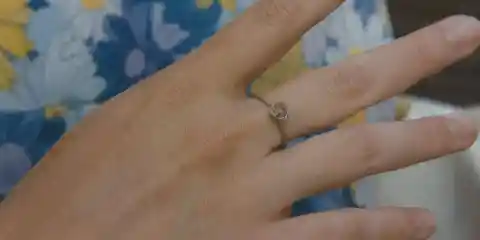
And the last promise he made before he left for war.
I thought that was all I had left of Thomas.
Then, on the morning of my seventy-third birthday, someone put a small brown package in my mailbox.
No stamp.
No return address.
Just one word written across the top.
Margaret.
I carried it into the kitchen thinking it might be something from my sister.
Maybe one of my nephews had decided to surprise me early.
Instead, when I untied the string and opened the paper, I found a small jewelry box.
Inside was a gold ring.
A beautiful one.
Simple.
Old-fashioned.
Exactly the kind of ring Thomas would have chosen.
For several seconds, I couldn’t breathe.
My thumb immediately moved to the crooked copper wire around my left ring finger.
I had worn it for fifty-five years.
The gold ring sat beside it on the counter like an accusation.
Underneath the jewelry box was a receipt from the jeweler downtown.
The date printed at the top was yesterday.
Someone had bought this ring less than twenty-four hours earlier.
Then I found the card.
Four words.
Someone owed you this.
My hands started shaking.
I read it again.
And again.
Someone owed you this.
I was still standing there when three quiet knocks came from the front door.
I froze.
Another knock.
Patient.
Not loud.
Whoever had left the package had probably waited nearby.
I couldn’t move.
I just stood in my kitchen staring at the gold ring while my mind pulled me backward fifty-five years.
Back to September.
Back to Thomas.
I was eighteen when he took me behind the high school football field.
It was warm that evening.
The kind of September night that still feels like summer even though the leaves have started changing.
Thomas was leaving in four days.
Neither of us said the word war very often.
We talked instead about when he came back.
Where we would live.
What kind of job he might find.
Whether we would have a dog.
How many children we wanted.
Everything was phrased as when.
Never if.
He had been unusually quiet that evening.
Finally, he reached into his pocket.
“I have something.”
I laughed.
“What?”
“Don’t laugh.”
“That guarantees I’m going to laugh.”
“I’m serious, Margaret.”
He opened his hand.
Inside was a thin piece of copper wire.
He had twisted it into a rough circle.
Crooked.
Uneven.
Not remotely elegant.
He looked embarrassed.
“I know it’s awful.”
I stared at it.
“What is it?”
“You know what it is.”
I did.
My heart started pounding.
Thomas took my left hand.
“I don’t have money for a real ring.”
His voice cracked.
“I was going to wait.”
He swallowed.
“But then I thought… what if I don’t get the chance?”
“Thomas.”
“I’m coming back.”
“You better.”
“I am.”
He smiled, but I saw the fear underneath it.
Then he slipped that ridiculous copper ring onto my finger.
“I’ll replace it someday.”
“With what?”
“A real one.”
He squeezed my hand.
“Gold. Something beautiful.”
I started crying.
He panicked.
“Why are you crying?”
“Because you’re an idiot.”
“That’s romantic.”
“I love it.”
“Margaret, it’s wire.”
“It’s my wire.”
He laughed.
I kissed him.
Then I told him:
“I’ll wear this one until you replace it.”
Four days later, Thomas left.
Four months after that, his mother received the letter.
I still remember the envelope.
The official seal.
The way her hand started shaking before she even opened it.
We sat at her kitchen table.
She made it halfway through before she couldn’t read anymore.
I took the letter.
I don’t remember the exact words now.
Only what they meant.
Thomas was not coming home.
I slid from the chair onto the kitchen floor.
His mother sat beside me.
We cried together.
I never removed the copper ring.
People told me I would eventually.
They meant well.
“You’re eighteen.”
“You have your whole life.”
“You’ll meet someone.”
I did meet people.
Good men.
Kind men.
Men who probably would have made wonderful husbands.
But no one ever became Thomas.
Eventually, I stopped trying.
Some people thought that was tragic.
I didn’t.
I had a full life.
Thirty-eight years as a librarian.
A small house with tall windows.
Books everywhere.
My younger sister, Carol.
Her sons, Danny and Peter, who grew up treating me like a second mother.
Birthdays.
Christmas dinners.
Summer evenings.
Friends.
Work.
Travel.
I was never sitting in a dark room waiting for a dead boy to come back.
But I never stopped loving him either.
And I never took off the copper ring.
Once, about twenty years ago, a jeweler noticed it.
“That’s bending badly,” he said. “I could straighten it for you.”
I nearly pulled my hand away like he had threatened to cut off my finger.
“No.”
He blinked.
“I wouldn’t damage it.”
“You don’t touch it.”
“All right.”
“My fiancé made this exactly this way.”
His expression softened.
“I see.”
“No, you don’t.”
I regretted snapping at him afterward.
But the crookedness mattered.
Thomas had made it with nervous hands behind a football field.
I didn’t want anyone correcting it.
And now, on my seventy-third birthday, there was a perfect gold ring sitting three feet away.
Three knocks came again.
I finally walked toward the door.
The copper wire felt strangely heavy on my finger.
I opened it.
Walter stood on my porch.
I had known Walter for nearly thirty years.
Or at least I thought I had.
He lived across the street.
Quiet man.
Widower.
Gray hair.
Always wore a cap when he worked outside.
We waved.
Sometimes spoke over the fence.
Nothing more.
When his wife died two years earlier, I brought over a casserole.
He thanked me.
That was probably the longest conversation we had ever had.
Now he stood there holding his cap in both hands.
His eyes were wet.
“Margaret.”
I stared at him.
“Did you leave the package?”
“Yes.”
My chest tightened.
“What is this?”
“Can I come in?”
“No.”
He nodded once.
“Fair.”
I held up the jewelry box.
“Walter, if this is what I think it is—”
“It isn’t.”
“I have loved one man my whole life.”
“I know.”
That stopped me.
“What?”
“I know.”
My voice sharpened.
“If this is some kind of proposal or gesture because you’re lonely now—”
“Oh, God, no.”
For one second, he actually looked horrified.
“I’m not proposing.”
“Then explain.”
Walter looked toward his house.
Then back at me.
“I left the box because I wasn’t sure I could knock.”
I said nothing.
“I stood in my doorway for almost an hour.”
“Why?”
His fingers tightened around the cap.
“Because I knew Thomas.”
Everything inside me stopped.
I stared at him.
“What did you say?”
“I knew Thomas.”
“No.”
“I served with him.”
My hand found the doorframe.
Walter continued.
“We were in the same unit.”
I shook my head.
“That’s not possible.”
“It is.”
“You’ve lived across the street from me for twenty-eight years.”
“I know.”
“And you’re telling me you knew Thomas?”
“Yes.”
“Personally?”
“Yes.”
I felt dizzy.
“How personally?”
Walter looked at me.
“He talked about you every night.”
I stopped breathing.
“The girl behind the football field.”
My knees weakened.
I stepped aside.
Walter entered.
We sat at the kitchen table.
The gold ring remained on the counter between us.
I stared at him.
“Say that again.”
“What?”
“He talked about me?”
“All the time.”
“How?”
Walter smiled faintly.
“He said you laughed too loudly.”
I covered my mouth.
Thomas used to say that.
“He said you hated tomatoes.”
I started crying.
“He said you wanted a house with yellow curtains.”
I could barely speak.
“I was eighteen.”
“He remembered.”
For fifty-five years, I had wondered whether Thomas carried me with him the way I carried him.
Now an old man across my kitchen table was telling me he had.
Then anger arrived.
Hard.
Fast.
“You lived across from me.”
Walter looked down.
“Yes.”
“For twenty-eight years.”
“Yes.”
“You knew who I was?”
“From the first day.”
I stood.
“And you said nothing?”
His face tightened.
“I couldn’t.”
“You couldn’t?”
“No.”
“You could wave from your porch.”
“Yes.”
“You could shovel my driveway.”
His eyes lifted.
I froze.
“You did that?”
He didn’t answer immediately.
“Oh my God.”
Walter looked away.
“You mowed my yard too.”
“Sometimes.”
“You fixed the loose porch step.”
“Yes.”
I stared at him.
“All these years.”
He reached inside his coat.
“There’s something else.”
He pulled out an envelope.
Old.
Yellowed.
Water-stained along one edge.
My name was written across the front.
Margaret.
The handwriting made my entire body go cold.
I knew it.
I had six letters upstairs written in that same hand.
The same slant.
The same ridiculous curl on the T.
The same way he wrote the M in my name.
I whispered:
“Thomas.”
Walter laid the envelope on the table.
“He wrote it the night before.”
My eyes snapped toward him.
“Before what?”
He couldn’t say it.
He didn’t need to.
My hand moved toward the envelope and stopped.
“What is this?”
“He gave it to me.”
“Why?”
Walter’s voice cracked.
“He said if he didn’t come back, I had to bring it to you.”
I stared at him.
“You’ve had this for fifty-five years?”
“Yes.”
My voice rose.
“You had a letter from Thomas for me?”
“Yes.”
“All this time?”
Walter closed his eyes.
“Yes.”
Something inside me broke.
I slapped the table so hard the jewelry box jumped.
“How could you?”
Walter didn’t defend himself.
“How could you live across the street from me with this?”
“I know.”
“No, you don’t.”
My voice cracked.
“You don’t know.”
I grabbed the envelope.
“I wondered if he was scared.”
Walter’s eyes filled.
“I wondered if he called for his mother.”
I was crying now.
“I wondered if he remembered me.”
“He did.”
“You let me wonder.”
“I did.”
I hated how quietly he said it.
No excuse.
No argument.
Just the truth.
“You could’ve mailed it.”
“Yes.”
“You could’ve left it in my mailbox twenty-eight years ago.”
“Yes.”
“You could’ve knocked on my door once.”
“Yes.”
“Then why didn’t you?”
Walter stared down at his hands.
“When I came home, I wasn’t right.”
I said nothing.
“I was twenty-three.”
His voice was low.
“I barely slept.”
He swallowed.
“Thomas had asked whoever made it home to do two things.”
I looked at the ring.
Walter nodded.
“Give you the letter.”
“And?”
“Buy you the ring he never got to buy.”
My chest tightened.
Walter continued.
“I didn’t have the money.”
“So you waited?”
“At first.”
“How long?”
“Too long.”
“What happened?”
“I got a job.”
He looked ashamed.
“Then I had enough money.”
“And still didn’t come.”
“No.”
“Why?”
“Because by then, I was afraid.”
I laughed bitterly.
“Afraid of what?”
“Your grief.”
I stared at him.
“Mine?”
“And mine.”
He rubbed his hands together.
“Every time I thought about knocking on your door, I saw Thomas.”
His voice broke.
“I was alive.”
I went still.
“He wasn’t.”
Walter looked at me.
“That mattered more than I knew how to explain.”
Survivor’s guilt.
I knew the phrase.
I had read about it.
I had helped veterans find books about it at the library.
But I had never imagined the quiet man across the street had carried it into his seventies.
Walter continued.
“Then I got married.”
I nodded slowly.
“Had boys.”
“Yes.”
“My wife knew about Thomas.”
“She knew about the letter?”
“Yes.”
I felt another flash of anger.
“She told me to give it to you.”
“Smart woman.”
“She was.”
Walter smiled painfully.
“But every year that passed made it worse.”
“So instead of doing it late, you did nothing.”
“Yes.”
He looked toward the window.
“Then your house went up for sale across from mine.”
“My house?”
“The one I bought.”
I stared.
“You moved here because of me?”
“Because of the promise.”
“Walter.”
“I told myself if I lived close enough, eventually I’d find the courage.”
“And?”
He looked at the copper wire.
“Every time I saw that ring, I couldn’t do it.”
I followed his eyes.
“This?”
“You still wore it.”
“Yes.”
“After thirty years.”
“Yes.”
“Forty.”
“Yes.”
“I thought you’d built a life around remembering him.”
“I built a life.”
“I know.”
Walter lowered his head.
“But I was afraid that handing you that letter would tear open something you’d learned to carry.”
“That should have been my decision.”
“I know.”
“And you still haven’t answered one thing.”
He looked up.
“Why today?”
Walter’s face changed.
I knew before he said it that the answer was bad.
“My doctor says I have pancreatic cancer.”
I stared at him.
“He thinks I have a few months.”
The anger inside me suddenly collided with something else.
Fear.
Pity.
Grief for a man I barely knew and apparently had known for decades without realizing it.
Walter continued.
“I went to the jeweler yesterday.”
His eyes moved toward the gold ring.
“I finally bought it.”
“Fifty-five years late.”
“Yes.”
“And then you left it in my mailbox.”
“I thought I might die before I found enough courage to knock.”
I looked at the envelope.
Walter whispered:
“I couldn’t take Thomas’s promise into the ground with me.”
I sat down.
For several minutes, neither of us moved.
Then I opened the letter.
The paper was fragile.
Soft from years of being folded and unfolded.
The first line destroyed me.
If you’re reading this, it means I didn’t make it back.
I stopped.
Walter stared at the floor.
I tried again.
Thomas wrote that he loved me.
That was no surprise.
But seeing the words after fifty-five years made me feel eighteen again.
He wrote that he was sorry the ring he gave me was “the ugliest engagement ring in America.”
I laughed through tears.
Of course he wrote that.
Then came the part about Walter.
I asked one of the boys to make good on my promise if I can’t.
Don’t let Margaret wear that copper thing forever.
Buy her something real.
Tell her the copper one counted, though.
It counted more than anything.
My tears fell onto the paper.
Then I read:
Don’t let her spend her whole life waiting for me.
That line hurt worst.
He told me to live.
To marry if I wanted.
To have children.
To travel.
To laugh loudly.
To remember him without making my life into a memorial.
And at the end:
I wasn’t afraid when I wrote this.
I’m only afraid you’ll think I left you willingly.
I didn’t.
I love you.
Always.
Thomas.
I put the letter down.
I couldn’t see clearly.
Walter’s face blurred across the table.
“He wasn’t afraid?”
Walter shook his head.
“Not for himself.”
“You were there?”
“Yes.”
“At the end?”
He nodded.
I squeezed my eyes shut.
“Was he alone?”
“No.”
That answer released something inside me I had carried for more than half a century.
“He wasn’t alone?”
“No.”
Walter’s voice trembled.
“I was there.”
I cried harder.
“He said your name.”
I covered my face.
“How?”
Walter waited.
Then:
“He told me not to forget.”
I looked at him.
“The ring?”
“You.”
That was when my anger returned.
Maybe it had to.
Because grief that large needed somewhere to go.
I stood.
“Get out.”
Walter nodded.
“Margaret—”
“Get out.”
“I’m sorry.”
“Not today.”
He picked up his cap.
“I understand.”
“No, you don’t.”
“No.”
He looked at me.
“But I deserve that.”
“Get out, Walter.”
He walked to the door.
Before leaving, he stopped.
“I know I failed him.”
I said nothing.
“And I failed you.”
His voice shook.
“I am sorry.”
The door closed behind him.
I stood alone in my kitchen.
The copper ring on my finger.
The gold ring on the counter.
Thomas’s letter in front of me.
Then I cried.
Not politely.
Not the quiet tears of an old woman who has learned how grief behaves.
I cried like I was eighteen again.
Like I had just been handed the official letter.
Like Thomas had died that morning instead of fifty-five years earlier.
Three hours later, my sister Carol arrived with Danny and Peter.
They brought dinner.
Cake.
Too many candles.
Danny had already started making jokes before he reached the kitchen.
Then Carol saw my face.
“Margaret.”
I tried to hide the letter.
Too late.
“What happened?”
I told them.
All of it.
The package.
The gold ring.
Walter.
Thomas.
The letter.
By the end, Danny wasn’t joking anymore.
Peter stared at the table.
Carol sat very still.
I waited for her to get angry.
Instead she asked:
“Who do you think mowed your lawn after Dad died?”
I frowned.
“What?”
“Every summer.”
“I thought it was some neighborhood boy.”
“No.”
My stomach dropped.
“Walter?”
Carol nodded.
“Who shoveled your driveway before sunrise every winter?”
I said nothing.
“Who fixed the porch step?”
I looked toward the door.
“Walter.”
“Yes.”
“How long have you known?”
“That he did little things for you? Years.”
“Why didn’t you tell me?”
“I thought you knew.”
I laughed weakly.
“Apparently I know nothing about the man across the street.”
Carol reached for my hand.
“Margaret.”
“What?”
“He did something unforgivable.”
I looked at her.
“He kept that letter.”
“Yes.”
“For fifty-five years.”
“Yes.”
“So don’t defend him.”
“I’m not.”
She squeezed my hand.
“But maybe understand what kind of person failed you.”
I waited.
“He wasn’t some cruel man who enjoyed watching you wonder.”
Carol looked across the street.
“He was a frightened nineteen-year-old who came home when Thomas didn’t.”
Danny nodded slowly.
“And then he became a frightened twenty-three-year-old.”
Peter added:
“Then thirty.”
Carol looked at me.
“Then forty.”
I understood what she meant.
Fear had aged with him.
So had shame.
“That doesn’t excuse it.”
“No.”
Carol shook her head.
“But it explains why he kept trying to pay the debt in every way except the one Thomas actually asked.”
I looked at the gold ring.
Later that evening, after everyone left, I sat alone on the porch.
Walter’s house was dark except for one lamp in the front room.
I put the gold ring in my sweater pocket.
Then I crossed the street.
Walter opened the door almost immediately.
He was wearing slippers.
His cap was in his hand again.
For some reason, that nearly made me laugh.
“I’m still angry.”
“I know.”
“Don’t say that.”
He nodded.
“Sorry.”
“I don’t forgive you.”
“I understand.”
“Not completely.”
“Yes.”
I pulled out the gold ring.
Walter stared at it.
“But I read everything.”
His eyes filled.
“And you answered the question I’ve had for fifty-five years.”
He waited.
“Thomas wasn’t alone.”
“No.”
“He remembered me.”
“Yes.”
“He loved me.”
“Until the end.”
I swallowed.
“You were the one he trusted with that.”
Walter’s face crumpled.
“I failed.”
“Yes.”
He looked down.
“But you carried him too.”
Walter started crying.
I held out the gold ring.
“Put it on.”
He stared at me.
“What?”
“Beside the copper one.”
His hands started shaking.
“Margaret.”
“Don’t make me repeat myself.”
That made him laugh through tears.
I held out my left hand.
It took him three attempts.
His fingers trembled too badly.
Finally, the gold band slid onto my finger beside the crooked copper wire.
We both stared at it.
The perfect ring beside the imperfect one.
Fifty-five years apart.
Walter covered his face.
I reached out and touched his arm.
That was all.
No grand forgiveness.
No declaration that everything was suddenly all right.
Some things deserve more time than that.
Walter and I started having coffee together after that.
Mostly on my porch.
Sometimes his.
There was never romance between us.
People occasionally assumed there was.
At our age, two widowed or unmarried people sitting together apparently still creates gossip.
I found that funny.
Walter and I had something else.
A strange friendship built around a boy neither of us ever stopped carrying.
He told me stories about Thomas I had never heard.
How he snored.
How terrible he was at cards.
How he kept one photograph of me folded inside his shirt pocket.
How he once traded half his dinner for paper so he could write me.
I gave Walter things too.
Stories of Thomas before the war.
Before uniforms.
Before fear.
The boy behind the football field.
The teenager who once climbed onto my parents’ roof because I told him I didn’t believe he could.
The boy who couldn’t dance but insisted he could.
In those final months, Walter and I slowly gave each other back the versions of Thomas that the other had never known.
Sometimes we spoke about him.
Sometimes we didn’t.
Some mornings we simply sat quietly with coffee.
Walter’s health worsened.
He became thinner.
His voice weaker.
But he told me something shortly before he died.
“I thought carrying the promise was punishment.”
I looked at him.
“It wasn’t?”
He shook his head.
“The punishment was refusing to finish it.”
I thought about that for a long time.
Walter died in early spring.
His sons were with him.
So was I.
Before he closed his eyes for the last time, I held up my hand.
Copper and gold.
“Debt paid.”
He smiled.
“Late.”
“Very.”
“Sorry.”
“I know.”
This time I let him say it.
I still wear both rings.
The copper one remains crooked.
Darkened.
Uneven.
Exactly as Thomas made it when we were eighteen.
The gold one sits beside it.
Not replacing it.
Never replacing it.
One is the promise.
The other is the keeping of it.
For most of my life, I believed the story of Thomas ended when the official letter arrived.
I thought I knew every part that mattered.
I was wrong.
Sometimes love leaves pieces of itself in other people.
A story.
A letter.
A promise.
A debt.
And sometimes those pieces take far too long to find their way home.
Thomas never got to place the gold ring on my hand himself.
Walter was fifty-five years late.
I was angry enough to hate him for that.
But in the end, I also understood something.
Love does not always arrive when it should.
Courage doesn’t either.
Sometimes they arrive late, trembling on an old man’s hands, carrying an envelope that should have been delivered half a century earlier.
Late cannot become on time.
Nothing changes that.
But late can still matter.
And every morning when the sunlight catches the gold beside that crooked piece of copper, I remember both truths.
Thomas kept his promise as long as he could.
And eventually, Walter found the courage to finish it.
{"post":111720,"page":2,"next":[{"id":111717,"title":"My MIL Saw My Newborn Daughter for the First Time, Looked Horrified, and Told Us to Give Her Up \u2013 When I Found Out Why, I Nearly Fainted","url":"https:\/\/new24.info\/111717"},{"id":111714,"title":"My Neighbor Tried to Drive Me Out of Our Neighborhood \u2014 In the End, Karma Hit Her Hard","url":"https:\/\/new24.info\/111714"},{"id":111707,"title":"A Gentle, Science-Backed Guide to Egg Carton Codes","url":"https:\/\/new24.info\/111707"},{"id":111706,"title":"Entitled Neighbor Claims My Driveway Until Thirty Classic Cars Teach Respect","url":"https:\/\/new24.info\/111706"},{"id":111702,"title":"Husband Summons Unexpected Guest After His Mother Throws Away My Delivery Dinner","url":"https:\/\/new24.info\/111702"},{"id":111698,"title":"My Parents Gave My Brother Everything Until My Hidden Lien Surfaced","url":"https:\/\/new24.info\/111698"},{"id":111693,"title":"A Rich Couple Refused to Pay My Grandpa $6,200 for Their Renovation \u2013 He Looked Around, Smiled, and Said, \u0027Okay\u0027","url":"https:\/\/new24.info\/111693"},{"id":111690,"title":"Why One Tiny Silver Key Destroyed My Husband And Saved My Life","url":"https:\/\/new24.info\/111690"},{"id":111686,"title":"Cruel Family Dinner Ambush Unintentionally Exposes Decades Of Massive Corporate Financial..","url":"https:\/\/new24.info\/111686"},{"id":111672,"title":"She was \u0027madly\u0027 in love with her co-star Robert Redford until his death \u2013 who is this legendary actress, now brokenhearted?","url":"https:\/\/new24.info\/111672"},{"id":111669,"title":"A Mother Cancels the Grocery Fund After a Cruel Remark About Her Starving Child","url":"https:\/\/new24.info\/111669"},{"id":111666,"title":"A Granddaughter Drives Nine Hours and Uncovers a Cruel Secret Hidden Inside a Nursing Home","url":"https:\/\/new24.info\/111666"},{"id":111663,"title":"I Broke My Arm and Asked My Husband to Help with Our 5-Month-Old Twins, but He Said, \u0027Moms Don\u0027t Get Sick Days\u0027 \u2013 So I Taught Him a Lesson He\u0027d Never Forget","url":"https:\/\/new24.info\/111663"},{"id":111660,"title":"My MIL Ordered Me a Dress Four Sizes Too Small for Her Party, Saying, \u0027It\u0027s Time for You to Lose Weight\u0027 \u2013 Karma Didn\u0027t Take Long to Catch up with Her","url":"https:\/\/new24.info\/111660"},{"id":111656,"title":"My Son Came Home Acting Strange Until I Realized Something Was Wrong","url":"https:\/\/new24.info\/111656"},{"id":111654,"title":"Dolly Parton Is Alive and Well as Her Hollywood Walk of Fame Star Undergoes Professional Restoration","url":"https:\/\/new24.info\/111654"},{"id":111651,"title":"A Childhood Vow Kept: The Deep Bond Between Two Friends on a Night to Remember","url":"https:\/\/new24.info\/111651"},{"id":111648,"title":"Bunny Levine, the Librarian Who Became a Late-Blooming Actress, Dies at 97","url":"https:\/\/new24.info\/111648"},{"id":111642,"title":"\u2018Grey\u2019s Anatomy\u2019 Star Eric Dane Dies at 53 After Courageous Battle With ALS","url":"https:\/\/new24.info\/111642"},{"id":111638,"title":"Most Folks Don\u2019t Recognize This Item Anymore","url":"https:\/\/new24.info\/111638"}]}