Soon the school bus arrived and the children came inside.
Then the kitchen became strangely quiet.
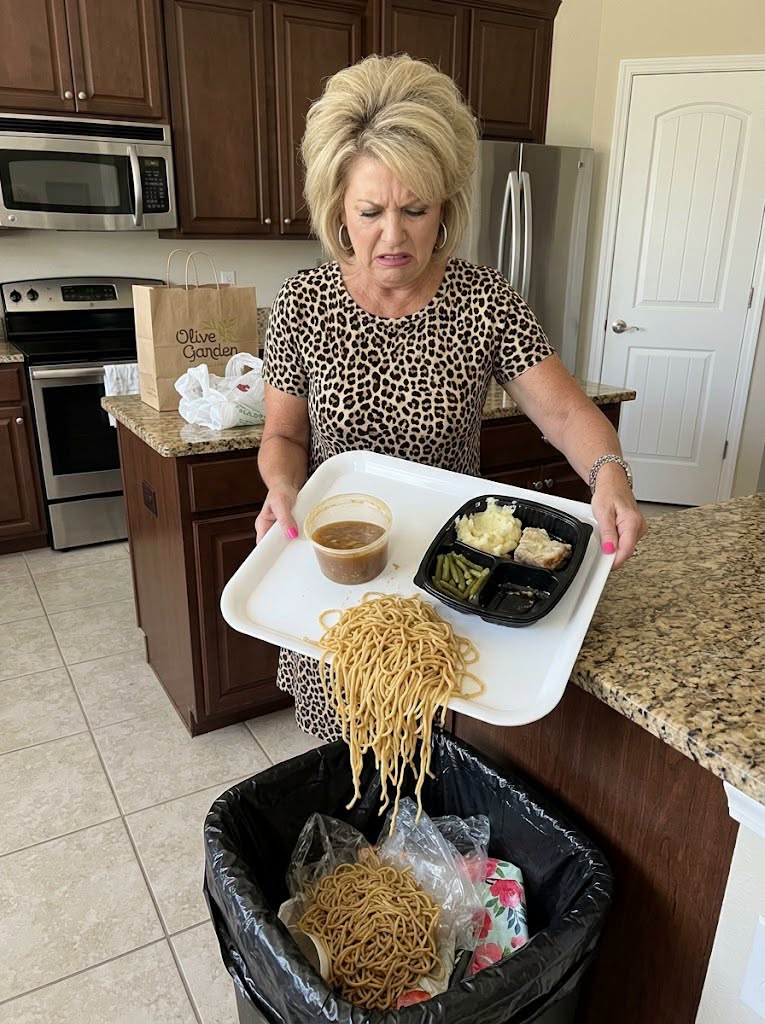
I forced myself downstairs and found Angela standing over the open trash can. Every sealed container of our $90 dinner had been thrown away.
She looked at me as though I should be grateful.
Angela explained that she was protecting her son from eating delivery food because his wife was apparently too lazy to cook. When I reminded her that I had a high fever, she replied that a good wife cooks for her family regardless of illness.
Too exhausted to fight, I sat at the kitchen table while Owen and Lily ate crackers. Angela began preparing dinner herself, turning my illness into another opportunity to prove that she was the better homemaker.
I started crying from sheer exhaustion just as Nathan walked through the door.
He took one look at me, his mother standing at the stove, and our untouched dinner sitting in the garbage.
But he did not yell.
Instead, Nathan smiled calmly and thanked Angela for caring so deeply about his needs. Then he announced that he was going to make a phone call so he could give her a proper reward for her dedication.
Angela looked triumphant.
Twenty minutes later, the doorbell rang.
Nathan opened it for a woman named Ruth.
Angela’s face went completely pale.
Ruth was Nathan’s father’s first wife—and a clinical social worker with thirty years of experience dealing with complicated family dynamics. Angela had spent decades defining herself in bitter opposition to this woman.
Nathan knew his mother would dismiss anything we said. Ruth, however, understood exactly where Angela’s behavior came from.
Angela protested that our disagreement was private.
Nathan simply replied that Ruth was family too.
Sitting at our kitchen table, Ruth calmly questioned Angela about why she had thrown away our dinner. Eventually, Angela admitted that she believed cooking every night was part of keeping a husband happy and maintaining a successful marriage.
Ruth quietly pointed out the contradiction.
Angela had cooked for her husband every night.
He had still left.
The room went silent.
Ruth explained that Angela had spent decades carrying unresolved pain from her own marriage and was now projecting those expectations onto mine. She was demanding that I follow rules that had never protected her own relationship in the first place.
For the first time that evening, I found enough strength to speak.
I told Angela that she had thrown away food meant not only for me, but for her hungry grandchildren. I was sick, I had followed Nathan’s instructions, and she no longer had permission to enter our home and make decisions for our family.
While we talked, Nathan quietly ordered the exact same dinner again.
Soon another delivery driver arrived.
Nathan placed fresh pasta in front of the children, steak at his place, and a warm container of chicken soup directly in front of me.
We ate together in a noticeably calmer kitchen. Ruth chatted with the children while Angela remained mostly quiet and eventually admitted that the food was actually good.
Before leaving, Angela promised she would call and knock before entering our home again. She also acknowledged that she had failed to understand how sick I truly was.
Later, Nathan told me he had considered involving Ruth for six months but had waited until his mother crossed a boundary so undeniable that she could no longer dismiss the problem.
That night, I understood something important about my husband.
He did not protect our marriage by screaming louder than his mother.
He protected it by setting a boundary, confronting the real problem, caring for our children, and making sure his sick wife finally got what she needed.
And somehow, after everything that happened, the part I remembered most was the simplest.
He reordered my soup.