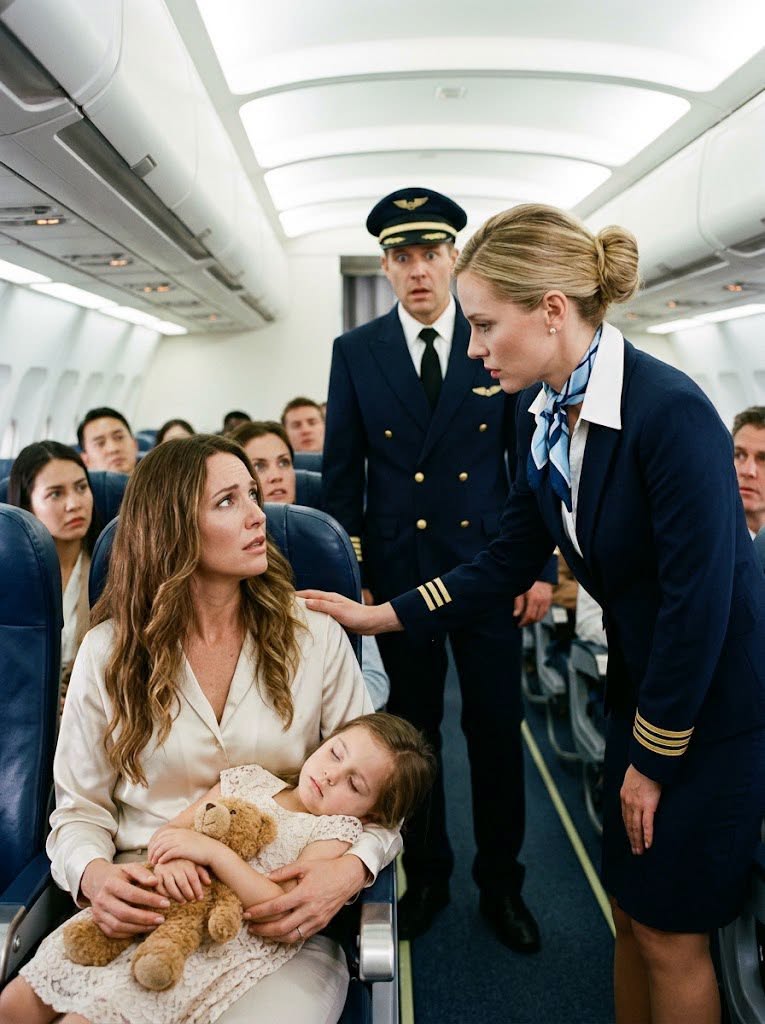
I left that life after my husband Ronald was lost during a classified aviation mission. His death shattered me, and I resigned my commission to protect our young son, Christopher. I moved to Minneapolis, traded fighter jets for carpools, and built the safest life I could.
Then a frightened voice came over the intercom.
“Is there anyone aboard with military aviation experience?”
The cabin erupted in nervous whispers.
My instincts returned before I had time to think. I unbuckled my seat belt, approached a flight attendant, identified my military background, and told her to take me to the cockpit.
She hurried me forward and unlocked the reinforced flight deck door.
I expected malfunctioning instruments or injured pilots.
Instead, I walked into a takeover.
Three armed operatives controlled the cockpit while Captain Raymond and his co-pilot had been incapacitated. My training immediately took over as I assessed the situation.
Then their leader placed a red folder on the console.
The emblem on its cover belonged to the Apex Syndicate—the same international network connected to the classified mission that had taken Ronald from me six years earlier.
The man looked directly at me.
“Valkyrie.”
Hearing my old tactical callsign told me everything.
This wasn’t a random hijacking.
They had engineered the crisis specifically to get me into the cockpit.
Their leader ordered me to fly the aircraft at low altitude through a route designed to avoid regional defense radar. Three hundred passengers had been placed in danger simply because the Syndicate needed someone with my experience.
So I pretended to cooperate.
With trembling hands and a frightened expression, I entered their coordinates into the navigation computer. But hidden inside the sequence was an emergency transmission routed through the aircraft’s automated weather system toward a military satellite.
Help was coming.
The question was whether it would arrive soon enough.
Then I noticed a powerful storm system glowing across the weather radar.
I told the leader our new route would force us directly through it and warned that changing course would expose us to radar.
He ordered me forward.
Exactly what I wanted.
The aircraft entered the storm and immediately began shaking under severe turbulence. The three operatives struggled to remain standing inside the cramped cockpit.
Captain Raymond looked toward me.
I gave him a subtle hand signal and tightened my harness.
Then I disengaged the autopilot and forced the aircraft into a sudden, steep descent.
The maneuver threw the unrestrained operatives upward and violently off balance while Raymond and I remained secured in our seats. In the confusion, we moved quickly, overpowering the men before they could regain control.
Warning alarms screamed around us.
I pulled back on the controls and stabilized the aircraft over the ocean.
For several seconds, nobody spoke.
Then Captain Raymond looked at me.
“Where are we going?”
“Somewhere they can’t follow us.”
We redirected Flight 402 toward a secure military airfield in Spain while the surviving crew restrained the intruders. I secured the red folder they had brought aboard, which contained detailed operational records belonging to the Apex Syndicate.
The information would later help authorities identify key members of the network and dismantle much of the organization that had operated in the shadows for years.
Three hours later, the wheels touched down on an isolated runway.
Military tactical teams surrounded the aircraft and removed the operatives while emergency crews attended to the passengers and injured pilots.
Reporters were already gathering outside, but I refused interviews.
There was only one person I wanted to see.
Inside a secure room, I opened a video connection to Minneapolis.
Christopher appeared on the screen.
“Mom?”
“I’m okay.”
I hadn’t realized how badly my hands were shaking until I heard his voice.
For six years, I had treated my military past as something dangerous—a world that had taken Ronald from us and needed to remain buried.
Flight 402 changed that.
My experience hadn’t endangered my family that night.
It had protected hundreds of others.
Months later, when defense leadership offered me a position training future aviation teams as a Senior Tactics Director, I accepted.
Three years afterward, I stood on a sunlit flight line at an elite training base in Nevada, wearing military insignia again as advanced fighters climbed into the clear desert sky.
Christopher stood beside me watching them disappear into the distance.
For the first time since Ronald’s death, the sound of jet engines didn’t bring back only grief.
It sounded like purpose.
I had spent years believing I needed to choose between being the mother Christopher needed and the officer I had once been.
Eventually, I understood that I never had to choose.
Phoenix had survived.
And she had finally come home.