But behind the familiar sets and beloved performances was a surprisingly complicated story.
The show nearly took place in a completely different decade. Fonzie almost looked nothing like the man audiences came to love. Henry Winkler was hiding a struggle that affected the way he auditioned, and one of the most famous comedians in history got his breakthrough because of a bizarre alien who landed in Milwaukee.
Even the title almost changed.
When creator Garry Marshall was first developing the concept in the early 1970s, the original idea was reportedly to create a sitcom set in the 1920s or 1930s.
There was just one problem.
Marshall did not feel particularly comfortable writing about that period.
What he did understand was the 1950s.
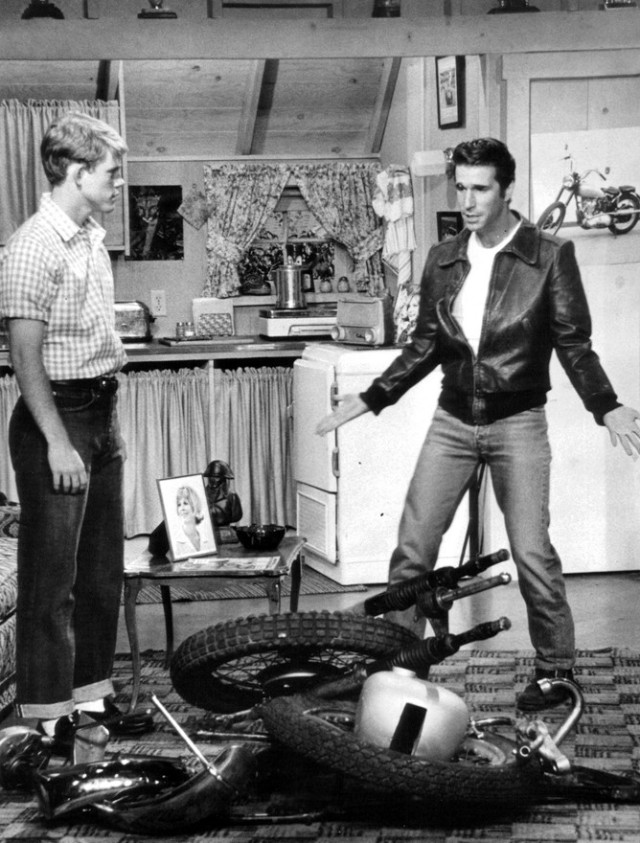
So he began developing a story about a Midwestern family experiencing a changing America, including the arrival of television in their home and the teenage adventures of their son.
That early pilot failed to become a full series and was eventually shown as a segment of Love, American Style.
But the concept did not disappear.
It eventually evolved into Happy Days.
Even then, the series nearly had another name.
Marshall reportedly considered calling it COOL, but test audiences associated the word too strongly with cigarettes.
Producer Carl Kleinschmitt later suggested Happy Days.
The name stuck, and in hindsight, it was almost impossible to imagine the show being called anything else.
Ron Howard, meanwhile, was not immediately eager to become Richie Cunningham.
Howard had already spent much of his childhood acting and worried that another television series might leave him permanently associated with teenage roles.
His larger ambition was directing.
He had enrolled at the University of Southern California and was already thinking seriously about what might come next behind the camera.
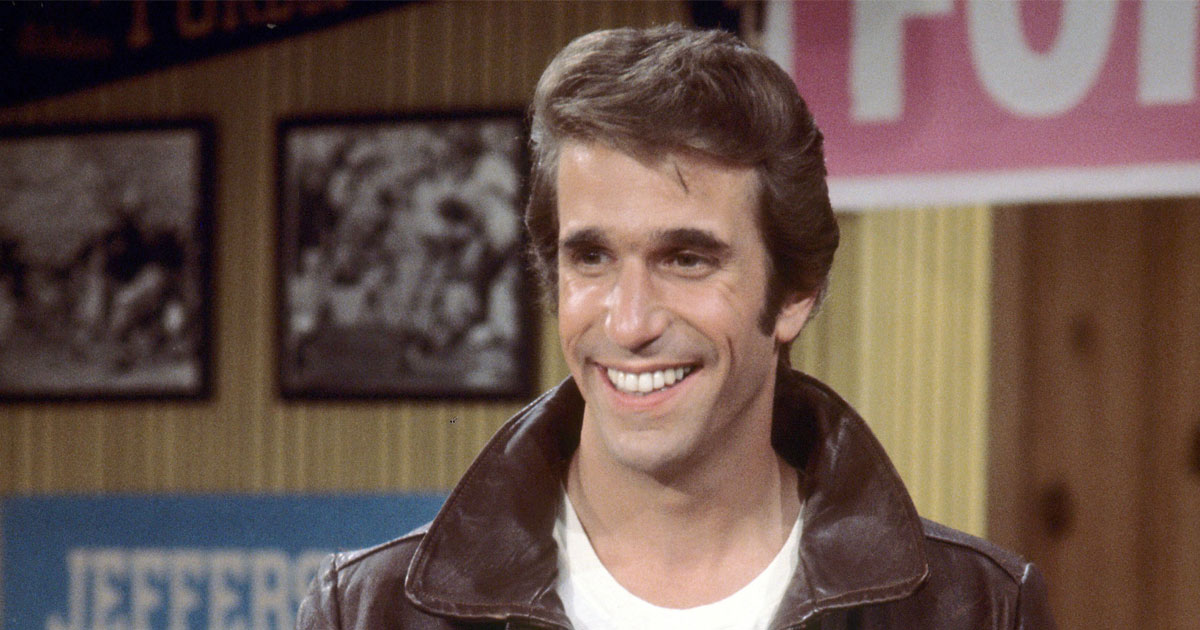
According to accounts of the show’s early development, Marshall helped convince Howard by promising that Richie would not remain frozen as a teenager forever.
If the series continued, Richie and his friends would eventually graduate, mature and move into adulthood.
Even Fonzie would eventually return to school.
That was enough to help persuade Howard.
There was another practical consideration at the time as well.
Howard was living during the Vietnam-era military draft and reportedly had a low draft number. His work at Paramount may have helped him obtain an occupational deferment under the company’s employment arrangements.
Whatever combination of reasons ultimately persuaded him, accepting the role of Richie Cunningham became one of the defining choices of Howard’s early career.
And then there was Fonzie.
Arthur Fonzarelli became the breakout character almost immediately, but Henry Winkler was not the kind of actor Marshall originally imagined for the role.
Marshall had reportedly pictured someone physically imposing, closer to the tough-guy image associated with actors such as Sylvester Stallone or Perry King.
Winkler was shorter and did not immediately resemble the stereotypical television greaser.
Former Monkees drummer Micky Dolenz was among the actors considered for the part.
At roughly six feet tall, however, Dolenz would have towered over Ron Howard.
Then Winkler auditioned.
The physical appearance mattered less once he delivered Fonzie’s attitude.
Ironically, Winkler had previously worked with Stallone in The Lords of Flatbush, and he reportedly drew on some of that swagger when creating his own interpretation of the character.
The result was unmistakable.
Marshall realized that Fonzie’s coolness did not depend on size.
Winkler had found the character.
Fonzie quickly became so popular that network executives eventually considered changing the title of the series to Fonzie’s Happy Days or even simply Fonzie.
Marshall resisted.
He understood that the show worked because it was an ensemble, even if Fonzie had become its most recognizable face.
What audiences did not know was that Winkler had spent much of his life struggling with reading.
He was not diagnosed with dyslexia until adulthood.
As a child, he had difficulty in school and was often made to feel that he simply was not trying hard enough.
Those struggles followed him into acting.
When Winkler auditioned for Happy Days, he reportedly had only a handful of lines.
Because reading them exactly as written was difficult for him, he improvised.
When producers noted that his performance did not match the script, Winkler reportedly responded that he had given them the “essence” of the character and would deliver it properly if he got the job.
He got the job.
Years later, the irony became especially meaningful when Happy Days used Fonzie to promote reading.
In one episode, the famously cool character goes to a library and checks out a book.
The message was simple: “Everybody is allowed to read.”
A story later circulated claiming that the episode caused library card registrations to increase by an astonishing 500 percent.
It became one of those feel-good pieces of television trivia that people repeated for years.
The problem is that the American Library Association reportedly found no evidence supporting anything close to such a dramatic increase.
Still, the underlying idea mattered.
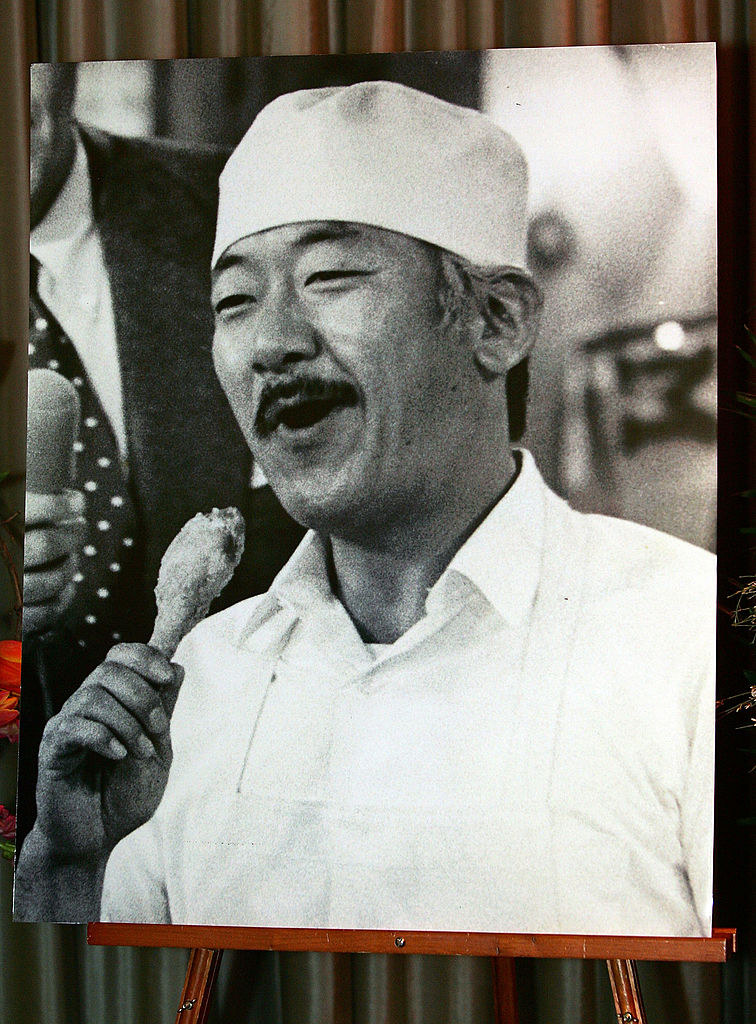
Fonzie had helped make reading look cool.
Music was another essential part of the show’s identity.
Bill Haley & His Comets’ “Rock Around the Clock” became deeply associated with the earliest seasons.
But the version viewers heard throughout the series was not always the original commercial recording.
The original recording was reportedly used for the first episode, while Haley later recorded another version specifically for Happy Days, which became associated with the opening during the first two seasons.
One of Fonzie’s other defining traits was his motorcycle.
On screen, he looked completely comfortable leaning against it, riding away or arriving with the effortless confidence expected of the coolest man in Milwaukee.
In reality, Henry Winkler was reportedly terrified of motorcycles.
That created an obvious production problem.
Rather than have Winkler constantly ride, the crew sometimes used tricks.
The motorcycle could be secured to a platform and pulled along, creating the illusion that Fonzie was cruising while Winkler remained relatively safe.
The contrast between actor and character could hardly have been greater.
Fonzie might have been fearless.
Winkler was not pretending about his fear.
Yet audiences rarely noticed.
His connection with viewers became so strong that one incident went far beyond ordinary fandom.
At the height of the series’ popularity, Paramount reportedly received a call from a teenage boy who was contemplating suicide.
The boy did not ask for a producer.
He asked for Fonzie.
Winkler took the call.
Rather than dismissing it as something outside his responsibility, he stayed on the phone with the teenager and tried to offer encouragement.
The story became a powerful example of how intensely viewers can connect with fictional characters.
For that teenager, Fonzie apparently was not merely entertainment.
He represented someone worth calling when everything felt impossible.
Another beloved character came with a very different behind-the-scenes complication.
Pat Morita, who played Arnold, was born and raised in California and spoke English without the exaggerated accent associated with his character.
According to later accounts, network executives wanted Arnold to sound more recognizably Asian to audiences.
Morita reportedly adopted the accent at their request.
That decision reflected the limited and stereotypical way Asian-American characters were often portrayed on television during the era.
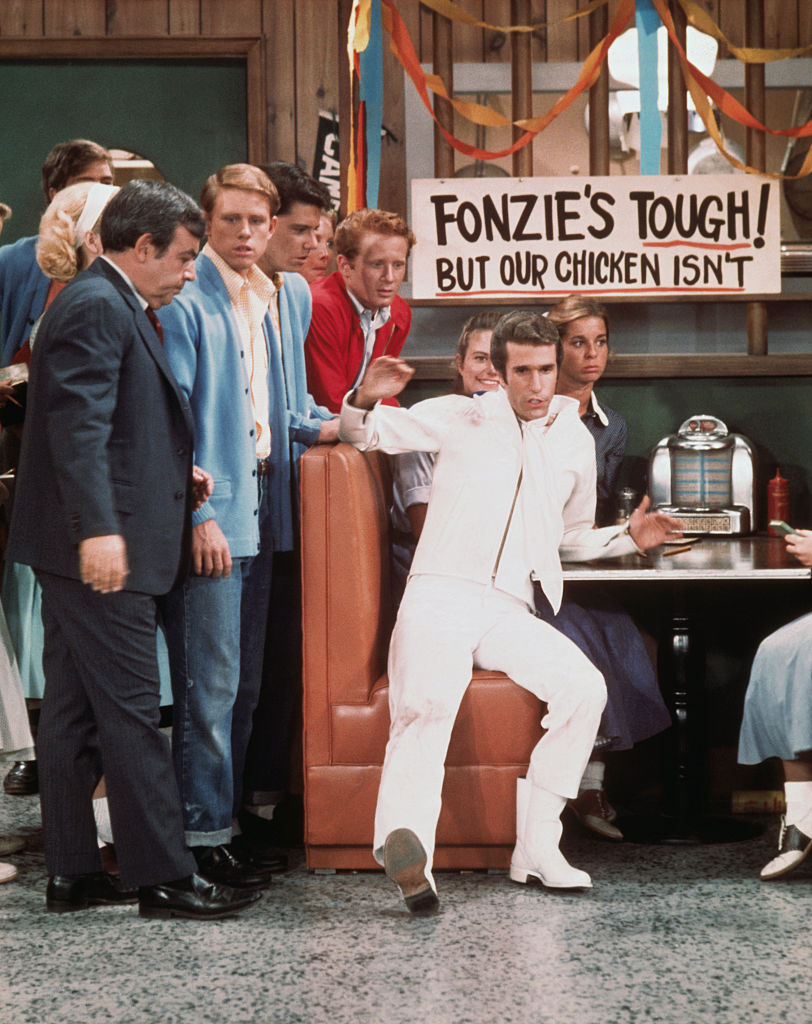
Morita later went on to become internationally famous as Mr. Miyagi in The Karate Kid, earning an Academy Award nomination and proving how much range he had beyond Arnold.
Romance also played a major role in several Happy Days storylines.
One of the most heavily promoted was “Fonzie Loves Pinky,” which introduced Pinky Tuscadero, played by Roz Kelly.
Pinky was designed almost as Fonzie’s female equivalent — confident, tough and capable of matching him.
For a time, the character was positioned as a potential great love for Fonzie.
The storyline received major publicity.
But the pairing never developed into the long-term relationship producers initially envisioned.
Pinky disappeared from the series, becoming one of those characters fans still remember despite her relatively brief presence.
Years later, another future television star appeared alongside Fonzie before most viewers had any idea who she would become.
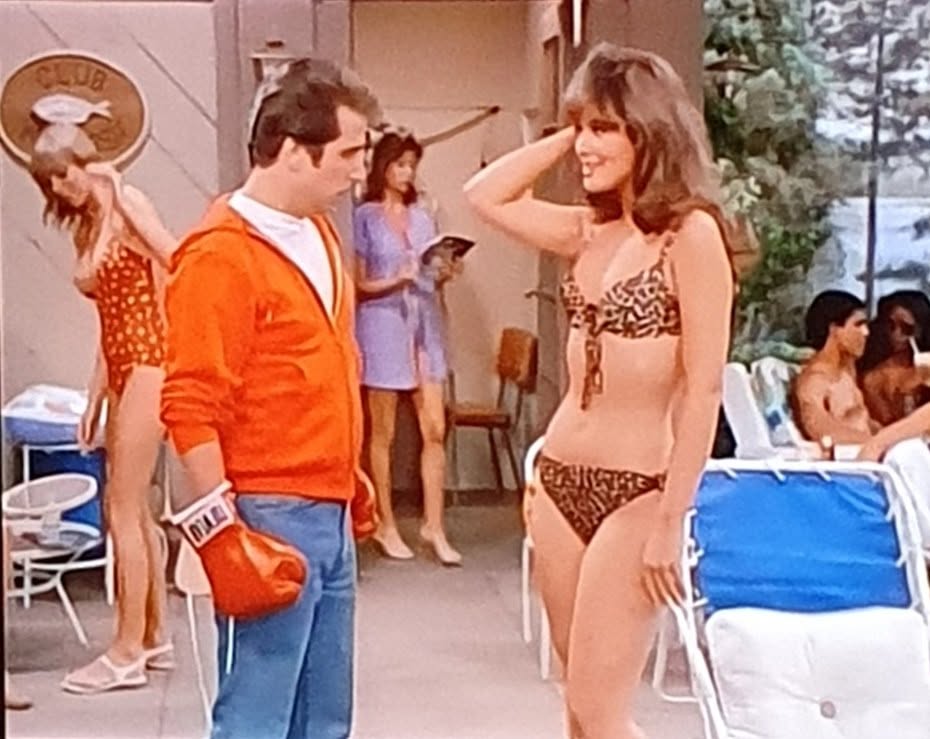
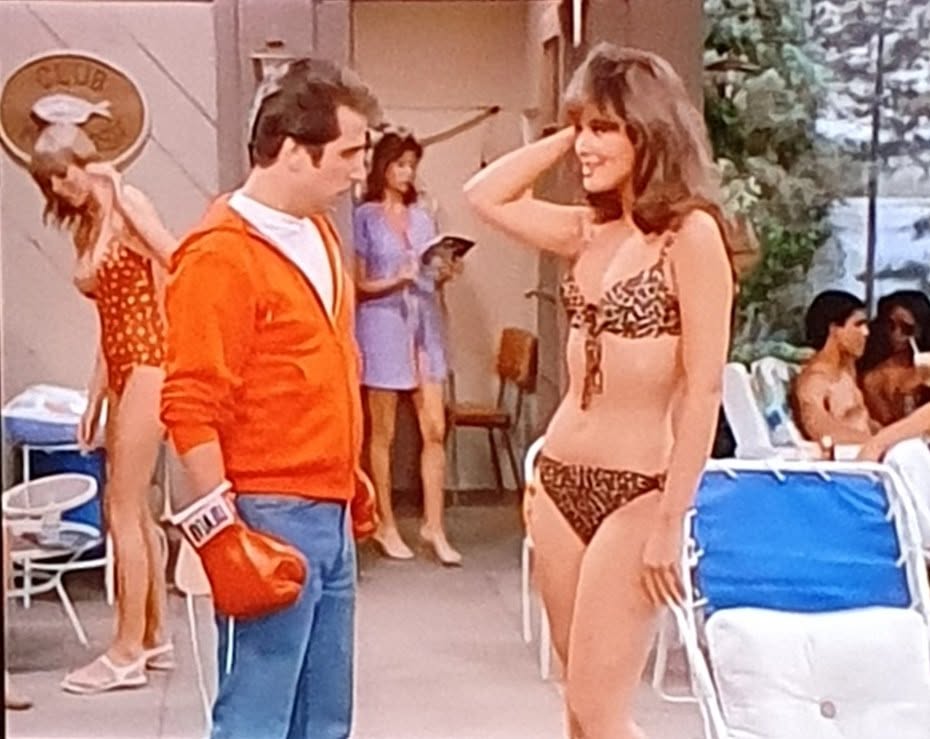
In 1983, Janine Turner appeared in an episode titled “Where the Guys Are.”
The story follows Roger, Potsie and Chachi attempting to help Fonzie recover from his breakup with Ashley by sending him to a singles resort.
There, Fonzie meets Debbie, played by Turner.
At the time, she was still building her career.
Years later, she would become best known for playing Maggie O’Connell on Northern Exposure, along with roles in films and shows including Cliffhanger and Friday Night Lights.
An old image of Turner standing beside Fonzie may look like ordinary television nostalgia today, but her later comments about Hollywood give it a different meaning.
Turner has spoken about growing frustrated with the kinds of roles she was repeatedly offered, including parts she characterized as “bikini roles.”
She eventually began turning some of them down.
That decision reportedly cost her financially.
At one point, she said she was down to only a few dollars before winning the role on Northern Exposure that changed everything.
Looking back, her appearance on Happy Days captures an actress still years away from the role that would finally allow audiences to see much more of what she could do.
The show also found clever ways to reference Ron Howard’s own past.
In one episode, members of the Cunningham family leave a theater after seeing The Music Man.
Mrs. Cunningham notices the young boy in the movie and comments that he looks exactly like Richie did as a child.
Howard Cunningham dismisses the comparison.
But viewers who knew Ron Howard’s career understood the joke.
The child on screen really was Ron Howard.
At eight years old, he had played Winthrop Paroo in the 1962 film adaptation of The Music Man.
It was a wonderfully subtle piece of television self-reference.
The set also welcomed some extraordinary visitors.
In 1975, John Lennon reportedly stopped by the Paramount lot with his son Julian, who was a fan of Happy Days.
Cast members suddenly found themselves meeting a former Beatle.
Lennon spent time talking with the actors and reportedly signing autographs.
For a show obsessed with 1950s nostalgia, having one of the defining musicians of the following decade casually appear behind the scenes must have felt surreal.
Then came Robin Williams.
Long before he became a film superstar, Williams was still trying to establish himself as a comedian.
Garry Marshall needed someone to play an alien named Mork from the planet Ork.
Marshall’s sister Ronny had reportedly seen Williams performing and recommended him.
Williams got the opportunity.
His performance was unlike anything else on the show.
Mork was chaotic, unpredictable and seemingly impossible to contain.
Williams’ energy immediately stood out.
The character was so successful that he received his own spinoff, Mork & Mindy, turning Robin Williams into a national star.
It remains one of the most remarkable examples of a guest appearance launching an entire career.
Even the characters’ names contained pieces of Garry Marshall’s real life.
Marshall reportedly knew someone named Richie Cunningham through church.
His wife had gone to school with someone named Potsie Webber.
Fonzie also almost had a different surname.
Marshall at one point considered calling him Arthur Masciarelli, using his own family’s original surname.
Instead, Arthur Fonzarelli survived.
And “the Fonz” became part of popular culture.
Perhaps no Happy Days moment influenced television language more than one of its strangest stunts.
In a famous episode, Fonzie goes water-skiing while wearing his leather jacket and jumps over a shark.
Henry Winkler performed much of the water-skiing himself.
But producers would not allow him to perform the actual shark jump.
The scene later became symbolic of television shows becoming increasingly outrageous in an effort to maintain attention.
The phrase “jump the shark” entered popular culture as shorthand for the moment when a series goes too far.
It is remarkable that a few seconds from Happy Days produced an expression that people still use decades later.
The series had much smaller inconsistencies too.
In the original pilot, the diner where the characters spent time was reportedly called Arthur’s.
When the program returned as a regular series, the restaurant had become Arnold’s.
Most viewers probably never noticed.
Eventually, Arnold’s became so central to the series that it was difficult to imagine the characters gathering anywhere else.
The sense of camaraderie did not stop when filming ended.
Garry Marshall wanted the cast and crew to behave like a team away from the studio as well.
He helped organize the Happy Days All-Star Softball Team, made up of performers and crew members.
They competed against other celebrity teams, raised money for charity and even traveled internationally, including appearances at military bases in Europe and Japan.
That sense of unity was something Marshall worked hard to protect.
Henry Winkler later described one recurring guest actor who apparently violated that unwritten rule.
According to Winkler, the actor repeatedly boasted about the amount of fan mail he was receiving.
Winkler remembered trying to make clear that the cast did not talk that way on set.
“I got 50,000 letters a week,” he recalled telling the actor. “We don’t talk about that on the set. We are all here as one.”
But according to Winkler, the bragging continued.
He initially avoided naming the actor, offering only one clue: “He played Eugene.”
Fans quickly connected that clue with Denis Mandel, who played Eugene Belvin during the later seasons.
Even Fonzie’s famous leather jacket came with its own battle.
When Happy Days premiered in 1974, ABC reportedly did not want Fonzie wearing leather because executives feared the look would make him seem like a “hoodlum.”
Instead, Winkler initially appeared in a blue windbreaker.
Eventually, the producers found ways to justify putting him in leather, particularly around his motorcycle.
By the second season, the brown leather jacket was becoming inseparable from Fonzie.
It eventually became one of the most recognizable costumes in television history.
Several jackets were made during production.
One ultimately became part of the Smithsonian’s collection, preserving Fonzie’s look as a piece of American cultural history.
After years of laughter, friendships, romances and countless visits to Arnold’s, Happy Days eventually reached its end.
The final episode included one moment that longtime viewers never forgot.
Tom Bosley, who played Howard Cunningham, briefly moved beyond the usual boundaries of the character and addressed the audience directly.
He thanked viewers for allowing the Cunningham family into their homes and for spending so many years with them.
It was a simple gesture.
But after a decade of watching these characters grow up, it felt personal.
And perhaps that is why Happy Days still holds such a strong place in television memory.
The show was never really about historical accuracy.
It offered something more emotional than that.
It created a version of the past where friends gathered at the same diner, parents were usually waiting at home, problems could be solved in 30 minutes and the coolest guy in town could make almost anything work with a snap of his fingers.
All these decades later, one glimpse of Fonzie adjusting his leather jacket or Richie walking into Arnold’s can still bring back the feeling of watching television with people you loved.
For many fans, those really were happy days.