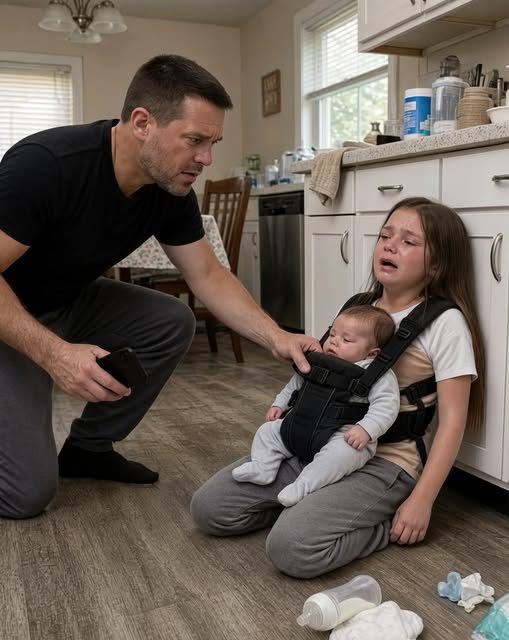
When I finally burst through the front door, the scene was heartbreaking: Tessa was slumped against the kitchen cabinets, her small frame trembling under the weight of the baby carrier, her face pale with exhaustion. She had been left alone since before lunch, tasked with caring for an infant while her mother was supposedly running errands. When I asked why she hadn’t called me sooner, her answer shattered my perception of our home. She pointed toward the bedroom, whispering about a second phone—a device she had been strictly forbidden to touch—that buzzed with messages whenever I was away. I found the device tucked deep inside a dresser drawer, hidden beneath a folded T-shirt. The screen lit up with a notification from a contact saved simply as R, demanding she leave the children and come immediately. The timestamp confirmed that this was no emergency; it was a calculated, recurring abandonment. My wife had been using our daughter as a silent accomplice in a secret life, relying on Tessa’s maturity to cover for her absences while she pursued an affair. When she finally returned home, the confrontation was inevitable.
She didn’t offer excuses for the neglect; she offered only the hollow defense that she felt overwhelmed and needed a break, as if that justified placing our children in such peril. I refused to let the argument devolve into a spectacle for the kids, prioritizing their stability above all else. I took charge of the household, ensuring the children were fed, bathed, and comforted, while the weight of the betrayal hung heavy in the air. In the days that followed, the reality of her deception became clear: this was not a single lapse in judgment, but a systemic pattern of neglect facilitated by the very person who should have been protecting them. I made the difficult decision to restructure my work life to ensure the children were never again left in such a vulnerable position. While the future of our marriage remains uncertain, my focus has shifted entirely to the safety and emotional well-being of Tessa and Miles. We are navigating the aftermath with a commitment to honesty, ensuring that no child is ever again expected to maintain a secret that jeopardizes their own security.
The hidden phone is powered off, a silent relic of a life that no longer exists, and we are slowly rebuilding a home where trust is earned, not manufactured through lies. The process of picking up the pieces has been slow and often painful, but the clarity that came with that discovery was necessary. I had spent years believing we were a team, working toward the same goals, yet I was blind to the fact that my wife had carved out a separate, dangerous existence. The messages on that phone revealed a timeline of months, not days. They detailed conversations about my work schedule, my commute, and even specific instructions on what Tessa should say if I happened to call the house. It was a cold, calculated strategy that used my own daughter’s love and loyalty against her, forcing a nine-year-old to become the primary caregiver for an infant while her mother pursued a life she had chosen to keep hidden from me.
When I sat down with my wife in the days after the discovery, I did not look for a way to save the marriage; I looked for a way to understand the depth of the deception. She spoke of feeling invisible and overwhelmed, but those words felt hollow against the backdrop of the danger she had invited into our home. She had not reached out for help; she had reached out for an escape, and she had used our children as the bridge to get there. The realization that she had prioritized her own desires over the physical safety of our son and the mental well-being of our daughter was a turning point. It was no longer about whether I could forgive her; it was about how I could ensure that such a betrayal of trust would never happen again.
Tessa has begun to heal, though the process is fragile. She no longer watches the clock with the same frantic intensity, and she has stopped asking me how long I will be gone every time I step out the door. We have established new routines that prioritize their security and their childhoods. I have taken on a more active role in their daily lives, and I am present in ways I hadn’t realized were missing before. The house remains the same, but the atmosphere has changed. The tension that once defined our home has been replaced by a quiet, steady effort to build something authentic. I know that the road ahead is long, and I know that the scars of this experience will not fade overnight. However, I also know that I am no longer living in the dark. I have the truth, and for the first time in a long time, I am confident that I can protect the two people who matter most.
We are moving forward, one day at a time, focused on the simple, essential tasks of being a family. I have learned that the most important part of my job as a father is not just providing for them, but creating an environment where they feel safe enough to speak the truth, no matter what. Tessa knows now that she never has to carry the weight of an adult’s secret again, and that is a lesson she will carry with her for the rest of her life. We are building a future where trust is the foundation, and where the safety of our children is never sacrificed for the sake of a lie. The hidden phone is gone, the secret life is exposed, and we are finally, truly, moving on.