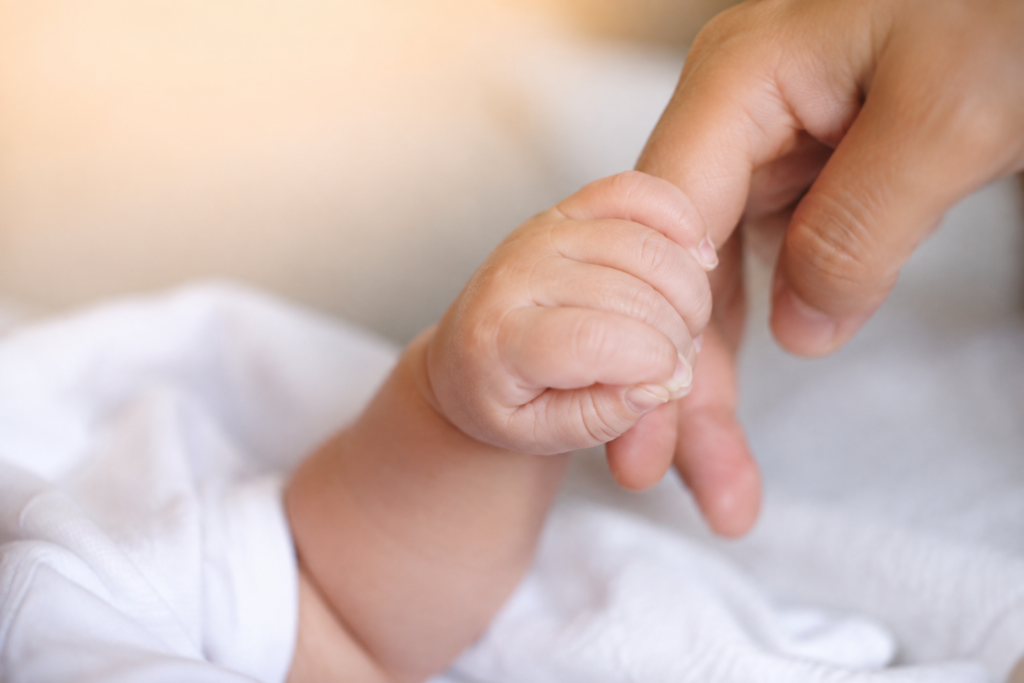
Then Nathan.
Then Luke.
Three beautiful boys.
Three sons I adored more than anything in the world.
But David knew there was still one quiet ache I never talked about much.
I had always wondered what it would have been like to raise a daughter.
Eventually, I accepted that some dreams belonged to another version of your life.
I packed the blanket away.
And for seventeen years, I barely touched it.
Then, at 6:20 one morning, my phone rang.
It was David.
He sounded breathless.
“Carol?”
I sat up.
“What happened?”
“I need you to come to the hospital.”
My heart immediately started pounding.
“Are you hurt?”
“No.”
“Is it one of the boys?”
“No.”
“David, what is going on?”
He paused.
“Just come.”
“Why?”
“Please.”
Something in his voice frightened me.
I threw on the first clothes I could find.
Then, just as I reached for my keys, he added:
“Don’t bring the boys.”
I stopped.
“What?”
“Come alone.”
Then he hung up.
By the time I reached the hospital, I had imagined every terrible possibility.
A car accident.
Someone David knew.
Some emergency involving one of our sons that he was trying to hide from me.
I rushed through the entrance and called him.
“I’m here.”
“Maternity floor.”
I stared at the phone.
Maternity?
For one bizarre moment, I wondered whether he had given me the wrong floor.
Then the elevator doors opened.
David was standing near the nurses’ station.
Holding a newborn baby girl.
I stopped walking.
Everything around me seemed to disappear.
The nurses.
The carts.
The bright lights.
The voices.
All I could see was my husband with a tiny baby tucked against his chest.
“David?”
He looked at me.
His eyes were full of tears.
I took one step closer.
“Whose baby is that?”
His mouth trembled.
Then he said:
“Ours.”
I actually looked behind me.
That is how little sense the word made.
“What?”
David walked toward me.
“Carol.”
“Whose baby is she?”
He carefully placed the newborn into my arms.
I should have demanded an explanation.
Instead, instinct took over.
I adjusted her head.
Pulled the blanket beneath her chin.
Stared down at the smallest face I had seen in years.
She had dark hair.
A perfect little mouth.
Tiny fingers curled beside her cheek.
Then she opened her eyes.
Gray.
The same strange gray-blue eyes my mother had.
The same eyes I saw every morning when I looked in the mirror.
My throat closed.
“Oh my God.”
David put one hand on my shoulder.
“Her name is Grace.”
I started crying.
Not gently.
Not elegantly.
I sobbed.
I had no idea who this baby was or why my husband had called her ours.
But something about holding a newborn girl after so many years cracked open a place inside me I thought had long ago scarred over.
David kissed my forehead.
Then a voice behind us interrupted.
“Carol?”
I turned.
A doctor stood several feet away.
“Yes?”
“I need to speak with you privately.”
David stiffened.
Immediately.
“There’s no need.”
The doctor looked at him.
Then at me.
“There is.”
I felt the baby grow heavier in my arms.
“What is happening?”
David reached for Grace.
“Carol, let’s just go somewhere and talk.”
The doctor said calmly:
“I think Mrs. Bennett should see the information herself.”
I looked at my husband.
“What information?”
He didn’t answer.
That frightened me more than anything.
A nurse took Grace.
I followed the doctor into a small office.
David tried to come with us.
The doctor stopped him.
“Please wait outside.”
“Doctor—”
“Outside.”
The door closed.
I sat.
My hands were shaking.
The doctor opened a folder.
“Has your husband explained how Grace came to be here?”
“No.”
His expression changed.
Not dramatically.
Just enough.
Then he pushed the folder toward me.
“There were questions regarding biological relationships, and testing was done.”
I looked down.
The first page contained David’s name.
Probability of paternity:
0%.
I read it twice.
Then a third time.
I looked at the doctor.
“I don’t understand.”
He waited.
“If David isn’t her father, why did he tell me she was ours?”
The doctor turned the page.
There was another result.
My name.
Carol Bennett.
Probability of biological relationship:
99.8%.
My fingers went numb.
I stared at the number.
Then at him.
“That’s impossible.”
He said nothing.
“I’m fifty-four.”
“I understand.”
“I did not give birth to a baby.”
“No.”
“Then what does this mean?”
He hesitated.
I felt panic rising.
“Who is her mother?”
Before he could answer, someone pounded on the door.
“Mom!”
I froze.
I knew that voice.
Michael.
My oldest son.
The doctor opened the door.
Michael rushed inside.
He was pale.
His hair was a mess.
His shirt looked like he had pulled it on while running.
Then he saw the folder in my hands.
He stopped.
“You told her?”
I stared at him.
“No.”
My voice came out sharper than I intended.
“Nobody has told me anything.”
Michael looked toward the doctor.
Then over his shoulder.
David appeared behind him.
That was when I knew.
Whatever this was, they both knew.
I held up the DNA report.
“Someone starts talking now.”
“Mom—”
“Now.”
David stepped into the room.
“Carol, maybe we should sit down.”
“I am sitting down.”
Nobody spoke.
I looked at Michael.
“Is Grace your daughter?”
His eyes widened.
“No.”
“Then why does this report say I’m biologically related to her?”
He glanced toward David.
It was a tiny movement.
But mothers notice tiny movements.
Especially when their sons are hiding something.
“Stop looking at each other.”
Michael’s eyes returned to mine.
“Look at me.”
He did.
His eyes filled.
“Grace is your granddaughter.”
I stared at him.
“You just said she isn’t yours.”
“She isn’t.”
“Then whose daughter is she?”
Michael swallowed.
“Rebecca’s.”
The name meant absolutely nothing to me.
“Who is Rebecca?”
He opened his mouth.
Nothing came out.
David answered for him.
“Your daughter.”
I laughed.
One short sound.
Almost a bark.
Then silence.
“My what?”
“Carol.”
“I don’t have a daughter.”
Michael crouched in front of me.
“Mom, listen.”
“I have three sons.”
“I know.”
“My daughter died.”
The room went silent.
Something cold moved through my chest.
I looked at Michael.
Then David.
“My daughter died.”
Michael’s face crumpled.
“No, Mom.”
I shook my head.
“No.”
“She didn’t.”
I stood.
The chair scraped loudly against the floor.
“Do not say that to me.”
“Mom—”
“Don’t you dare.”
“I’m telling you the truth.”
I turned toward David.
He would not meet my eyes.
And suddenly, there was another truth inside the room.
A worse one.
“You knew.”
His head lifted.
“Carol.”
“You knew.”
“Please let me explain.”
“How long?”
He didn’t answer.
“How long have you known my daughter was alive?”
“Almost four months.”
I think I stopped breathing.
“Four months?”
Michael stood.
“Mom—”
“You knew too?”
His face twisted.
“Yes.”
“How long?”
“Longer than Dad.”
I stepped away from both of them.
I was seventeen when I became pregnant.
It was 1989.
My parents reacted as if I had burned down the house.
My boyfriend disappeared almost immediately.
My mother stopped taking me to church because she was ashamed of the questions people would ask.
My father barely spoke to me.
They arranged for me to finish school from home.
My pregnancy became something we hid.
Something whispered about.
Something that embarrassed them.
But that baby never embarrassed me.
I loved her before I ever saw her.
I bought one little thing with money I had saved myself.
A pink blanket.
I hid it in my room.
When I went into labor, there were complications.
I remember pain.
Bright lights.
People speaking above me.
Someone telling me to stay awake.
Then nothing.
When I woke up, my mother was sitting beside the bed.
She was holding my hand.
For once, she wasn’t angry.
That scared me.
“Where’s my baby?”
She looked at my father.
Then back at me.
“It was a girl.”
I smiled.
Even exhausted, I smiled.
“A girl?”
My mother’s eyes filled.
Then she told me my baby had died.
I screamed.
I begged to see her.
My mother refused.
“Please.”
“No, Carol.”
“I want to hold her.”
“You shouldn’t.”
“She’s mine.”
“It will only make this harder.”
“How can it be harder?”
My mother said something I remembered for the rest of my life.
“It’s better if you remember her the way you imagined her.”
I was seventeen.
Terrified.
Drugged.
Heartbroken.
And my parents were the people I trusted to tell me what had happened.
So I believed them.
For thirty-six years.
I believed my daughter had died.
Now my oldest son was standing in a hospital office telling me she had been alive the entire time.
“Where is she?”
Michael blinked.
“Grace?”
“No.”
My voice cracked.
“My daughter.”
David moved closer.
“Carol.”
“Where is Rebecca?”
Michael answered.
“She’s here.”
I stared at him.
“In this hospital?”
“Yes.”
“Where?”
“Two floors down.”
I covered my mouth.
My daughter was alive.
Not somewhere across the country.
Not a name buried in an old file.
Not a ghost I had spent thirty-six years mourning.
She was two floors beneath me.
“Why is she here?”
Michael looked toward the doctor.
“She had complications after Grace was born.”
My fear changed instantly.
“What kind of complications?”
“She needed surgery.”
“Is she okay?”
“The surgery went well,” the doctor said. “She’s being monitored closely.”
“Will she be okay?”
“We’re optimistic.”
Optimistic.
Hospital words.
Carefully chosen words.
I sat back down.
Then I looked at Michael.
“Start at the beginning.”
He nodded.
“About seven months ago, I took one of those DNA ancestry tests.”
I remembered.
Michael had suddenly become interested in genealogy.
He built a family tree.
Asked about great-grandparents.
Started sending me links to records.
Then one afternoon, he showed up at my house with another testing kit.
“Remember when I asked you to do one?”
“Yes.”
“You said you wanted to compare my side and Dad’s.”
“I know.”
“You lied.”
He looked down.
“Yes.”
“Why?”
“Because I had already found Rebecca.”
My stomach turned.
He explained that when his DNA results came back, one match made no sense.
A woman named Rebecca.
Thirty-six years old.
The amount of DNA they shared suggested an extremely close biological relationship.
Not a distant cousin.
Not some family-tree surprise several generations back.
Close family.
Michael contacted her.
Rebecca told him she had been adopted as a newborn.
Her adoption records were limited.
But in paperwork she had managed to obtain, she had found my maiden name.
“Your maiden name was there, Mom.”
I felt sick.
“And that’s why you tested me?”
“I needed to know for sure.”
“You could have asked.”
“I didn’t know what I was asking yet.”
I turned toward David.
“When did you find out?”
“After your results came back.”
“And those results showed?”
Michael answered.
“That Rebecca is my half-sister.”
Sister.
My son had a sister.
Nathan had a sister.
Luke had a sister.
And somewhere in the world, for all these years, I had had a daughter.
“What did Rebecca say when she learned who I was?”
Michael hesitated.
“She didn’t want to meet you.”
I wasn’t prepared for how deeply that hurt.
I looked away.
“Why?”
“She wasn’t looking for a mother.”
He said it carefully.
“She told me she only wanted information about where she came from.”
“Did she know I thought she was dead?”
“Not at first.”
“You told her?”
“Eventually.”
“And did she believe you?”
“No.”
A sad laugh escaped me.
Of course she hadn’t.
Why would she?
Rebecca had lived thirty-six years believing one story.
I had lived thirty-six years believing another.
She believed she had been surrendered.
I believed she had been buried.
Two women.
Two completely different lives.
Both built around the same lie.
“Why didn’t you tell me?”
Michael’s eyes filled.
“I wanted to.”
“Then why didn’t you?”
David answered.
“Because I asked him not to.”
I slowly turned.
“You what?”
“Rebecca wasn’t ready.”
“That was Rebecca’s choice.”
“I know.”
“No, apparently you don’t.”
My voice rose.
“Because you made my choice too.”
“Carol, I was trying to protect you.”
“From what?”
He looked miserable.
“From losing her again.”
I stared at him.
“You let me keep believing she was dead.”
“I thought if we told you she was alive and she refused to meet you—”
“At least I would have known she was alive!”
My voice echoed through the office.
“You watched me grieve a death that never happened.”
David’s eyes filled.
“I was scared.”
I shook my head.
“So was I.”
My voice cracked.
“For thirty-six years.”
Nobody said anything.
I looked at Michael.
“How did we get from Rebecca refusing to meet me to David standing upstairs holding her baby?”
Michael took a breath.
After their first contact, he and Rebecca continued speaking.
Slowly.
Text messages first.
Then phone calls.
Then coffee.
Rebecca had grown up as an only child.
Learning she suddenly had three younger half-brothers overwhelmed her.
She wasn’t ready to meet Nathan or Luke.
But she liked Michael.
Trusted him.
Eventually, she told him she was pregnant.
The baby’s father was not involved.
Michael became the person she called if she needed help.
Her emergency contact.
Then, the previous evening, Rebecca went into labor.
Complications developed.
Michael panicked and called David.
“And David came here?”
“Yes.”
“Did Rebecca know?”
“She knew he was coming.”
I looked at my husband.
“Did she know you planned to call me?”
Silence.
I already had my answer.
“She didn’t.”
“No.”
I closed my eyes.
One more choice.
One more person David had decided for.
“Why did you call me?”
His voice broke.
“Because I saw Grace.”
I opened my eyes.
He wiped his face.
“They handed me that little girl and all I could think about was you.”
I said nothing.
“I thought about that blanket.”
My throat tightened.
Of course he knew.
I had shown him the pink blanket years ago.
Before Michael was born.
I told him everything.
How I had bought it during that first pregnancy.
How I couldn’t throw it away after my mother told me the baby died.
When we married, I secretly imagined maybe one day I would finally use it.
Then we had Michael.
Nathan.
Luke.
After Luke, I packed it away.
David continued.
“I knew Rebecca wasn’t ready.”
His voice shook.
“I knew you were going to be furious with me.”
“I am.”
“I know.”
“But when I saw Grace, I couldn’t keep sitting on this secret.”
“So instead you called me here and told me the baby was ours.”
He winced.
“I meant our granddaughter.”
“You skipped several important nouns.”
For the first time that morning, a miserable little smile crossed his face.
Then disappeared.
“I wasn’t thinking.”
I looked at Michael.
“I want to see Rebecca.”
His expression immediately changed.
“Mom.”
“What?”
“She knows you’re here.”
My heart began pounding again.
“And?”
He looked down.
“She doesn’t want to see you.”
The words landed quietly.
That somehow made them hurt more.
“Oh.”
I sat very still.
For thirty-six years, my daughter had existed in my mind only as a newborn.
She never learned to walk.
Never started school.
Never had a first boyfriend.
Never got angry at me.
Never formed opinions about me.
Now she was thirty-six years old.
A grown woman.
A mother herself.
And she had every right to decide whether I entered her room.
“Okay.”
Michael looked surprised.
“Okay?”
“If she doesn’t want to see me, I’m not going to force her.”
He nodded.
“But tell her something.”
“What?”
“Tell her I didn’t give her away.”
“She knows.”
“Tell her again.”
“I will.”
“And tell her I’m sorry.”
Michael frowned.
“For what?”
I looked at my hands.
“For not finding her.”
“Mom.”
“I know.”
“You believed she was dead.”
“I know.”
“You couldn’t look for someone you thought was dead.”
“I know.”
But grief does not care what is reasonable.
Neither does guilt.
I went back upstairs.
Grace was sleeping in a bassinet beside the nurses’ station.
I stood there staring at her.
Thirty-six years earlier, someone had taken my newborn daughter away before I was allowed to memorize her face.
Now her newborn daughter slept less than two feet from me.
I wanted to pick Grace up.
But suddenly, I couldn’t.
She belonged to Rebecca.
And Rebecca had not given me permission to become anything to her.
David stood behind me.
“She told Michael that if something happened during surgery, you could hold Grace.”
I turned around.
“She said that?”
“Yes.”
“Before she knew you called me?”
He nodded.
I looked at the baby again.
“Then I’ll wait until she asks again.”
David didn’t argue.
For once, that helped.
We sat nearby for almost an hour.
I watched nurses come and go.
Every time a door opened, my heart jumped.
Then Michael appeared.
“Mom.”
I stood so quickly my knees almost gave out.
“Is Rebecca okay?”
“She’s awake.”
Relief washed through me.
Then I noticed his expression.
“What?”
“She asked to see you.”
I stared at him.
“No.”
He blinked.
“What?”
“I mean—are you sure?”
“Yes.”
“Did you ask her to?”
“No.”
“Did David?”
“No.”
“She asked?”
Michael nodded.
“Just you.”
David stood too.
Michael shook his head.
“Dad, she specifically said Mom.”
David sat back down.
I followed Michael downstairs.
With every step, my legs felt weaker.
When we reached Rebecca’s room, I stopped outside.
Through the narrow glass panel, I could see part of the bed.
Michael touched my shoulder.
“You don’t have to go in right this second.”
I looked at him.
“I’ve waited thirty-six years.”
Then I opened the door.
Rebecca was lying against white pillows.
She looked exhausted.
Pale.
Her dark hair fell loosely around her face.
For several seconds, I could not move.
Then she turned toward me.
Her eyes stopped me.
Gray.
My mother’s eyes.
My eyes.
Grace’s eyes.
Rebecca stared at me.
I stared back.
Neither of us spoke.
How do you greet the daughter you were told was dead?
How does she greet the mother she spent her life believing had given her away?
There is no sentence for that.
Eventually, Rebecca broke the silence.
“I don’t know what I’m supposed to call you.”
My eyes filled.
“You don’t have to call me anything.”
She looked away.
“I thought you’d look different.”
A shaky laugh escaped me.
“Different how?”
“I don’t know.”
“I don’t either.”
For half a second, the corner of her mouth moved.
Almost a smile.
Then it disappeared.
“Did you really believe I died?”
“Yes.”
“For all those years?”
I nodded.
“Every single one.”
Her eyes filled.
She turned toward the window.
“I spent most of my life believing you didn’t want me.”
“I wanted you.”
“You were seventeen.”
“I was still your mother.”
She wiped a tear from her cheek.
“Michael said your parents arranged everything.”
“I knew nothing.”
“He showed me the DNA results.”
I waited.
“And some records.”
I swallowed.
“He thinks your parents arranged the adoption.”
“I believe they did.”
Rebecca’s expression hardened slightly.
“Did you ever wonder?”
“About what?”
“Whether maybe they lied?”
I thought about it.
“No.”
She looked surprised.
“I was seventeen.”
My voice shook.
“They were my parents.”
I looked down.
“When my mother told me you were dead, I thought my world had ended.”
Rebecca’s lips trembled.
“I begged to hold you.”
She closed her eyes.
“They wouldn’t let me.”
A tear ran down her cheek.
I desperately wanted to walk to the bed.
Touch her hand.
Hold her.
I didn’t.
That choice belonged to her.
“There are so many things I want to ask you.”
Rebecca looked back at me.
“I know.”
“But I don’t have to ask them today.”
She seemed surprised.
“You don’t?”
“No.”
I swallowed.
“I lost thirty-six years.”
My voice broke.
“I’m not going to lose whatever comes next by trying to force all thirty-six years into one conversation.”
For the first time, Rebecca really looked at me.
Not at a biological match.
Not at a woman from an adoption file.
At me.
I asked:
“How are you feeling?”
“Tired.”
“Does it hurt?”
“A little.”
“Then you should rest.”
I turned toward the door.
“Carol.”
I stopped.
It was the first time she had said my name.
I turned around.
“Is Grace okay?”
My face softened.
“She’s perfect.”
Rebecca swallowed.
“Did you hold her?”
“Earlier.”
She nodded.
“Good.”
That was all.
It was enough.
I walked out crying.
Not because the meeting had gone badly.
Because for thirty-six years, I had imagined what I would say if some impossible miracle returned my daughter to me.
And when that miracle finally happened, the most important thing I could give her was room.
Rebecca went home several days later.
Not with me.
To her own home.
That mattered.
There was no magical reunion.
No instant mother-daughter bond.
No montage where we somehow replaced thirty-six lost years in a week.
For a while, we texted.
Carefully.
Sometimes she answered immediately.
Sometimes she disappeared for three days.
The first few times, panic grabbed me.
Then I reminded myself:
She is not disappearing.
She is living.
There is a difference.
Our first lunch lasted forty minutes.
Our second lasted almost two hours.
On the third, she told me about the parents who had raised her.
Good people.
Not perfect.
But loving.
Hearing that was complicated.
Part of me felt jealous.
I hated myself for that.
Another part of me felt grateful beyond words.
Somebody had held my daughter when she had nightmares.
Somebody sat beside her when she was sick.
Somebody taught her to drive.
Somebody celebrated birthdays I never knew were happening.
They had not stolen those moments from me.
The people who lied had.
Rebecca’s parents had simply loved the child placed in their arms.
Eventually, she met Nathan and Luke.
Watching my three sons sit across a table from the sister they never knew existed felt like watching two versions of my life collide.
Nathan kept staring at her.
Finally, Rebecca laughed.
“What?”
“You look like Mom.”
Michael nearly choked on his drink.
Luke said:
“No, she looks like Grandma.”
Rebecca looked at me.
“Apparently the genetics are aggressive.”
I laughed so hard I cried.
David and I had much harder work ahead.
I understood why he had been afraid to tell me.
That did not mean he had been right.
Love does not give someone permission to control the truth.
Protection can become another form of betrayal when the person being protected never gets a choice.
We started counseling.
Michael apologized repeatedly.
One afternoon, after his fourth or fifth apology in the same conversation, I stopped him.
“You can stop saying you’re sorry.”
His entire body relaxed.
Then I added:
“But you cannot ever decide again what I’m strong enough to know.”
He nodded.
“I understand.”
“I mean it.”
“I know.”
My parents had both died years earlier.
That became its own form of grief.
There would never be a confrontation.
I would never stand in front of my mother and ask how she could sit beside a hospital bed, hold my hand, and tell me my living daughter was dead.
I would never hear my father explain what papers he had signed.
Whether they believed they were saving me.
Saving the family.
Saving themselves from embarrassment.
Maybe they thought seventeen-year-old Carol would eventually forget.
She didn’t.
I spent years grieving a grave that did not exist.
Some questions simply do not receive answers.
Eventually, I had to accept that too.
About six months after Grace was born, Rebecca brought her to our house for the afternoon.
By then, Grace had chubby cheeks and a habit of grabbing anything within reach.
My glasses.
Rebecca’s hair.
David’s nose.
At one point, Grace fell asleep against Rebecca’s chest.
I looked at them.
Mother and daughter.
My daughter and her daughter.
Then I remembered something.
“I want to show you something.”
I went upstairs.
At the back of my closet sat an old storage box.
I hadn’t opened it in years.
Inside were photographs.
Baby clothes from my sons.
Cards.
Things people save because they cannot bring themselves to throw them away.
At the bottom was the pink blanket.
Its color had faded.
The edges were worn.
I held it against my chest for a moment.
Then carried it downstairs.
Rebecca looked up.
“What’s that?”
I sat beside her.
“I bought this when I was pregnant with you.”
Her expression changed.
“You still have it?”
“Yes.”
“For thirty-six years?”
I nodded.
“I thought it was all I had of you.”
She stared at the blanket.
Then reached out and touched the edge.
I watched her fingers move across the faded fabric.
“I bought it with money I saved.”
I smiled faintly.
“My mother hated it.”
“Why?”
“Too pink.”
Rebecca laughed.
“Grandma had opinions.”
“That is a polite way of putting it.”
Grace shifted in her arms.
The blanket she was using slipped slightly.
Rebecca looked down at the pink one.
Then at me.
“Can I?”
I could not speak.
I nodded.
Very carefully, Rebecca unfolded the blanket.
Then she wrapped it around Grace.
My granddaughter disappeared beneath the faded pink fabric I had bought for her mother when I was seventeen years old.
I covered my mouth.
Rebecca looked over.
“Are you okay?”
I started laughing through my tears.
“I’m working on it.”
She smiled.
“So am I.”
And somehow, those four words meant more to me than if she had suddenly called me Mom.
We were both working on it.
That was real.
Thirty-six years had been stolen from us.
We could not recreate Rebecca’s childhood.
I would never see her first steps.
Never hear her first word.
Never send her to kindergarten.
Never embarrass her at prom.
Never watch her graduate as a girl becoming a woman.
Those losses were real.
Pretending otherwise would not heal them.
But loss was not the only truth anymore.
My daughter was alive.
She was sitting on my couch.
Her daughter was sleeping in the blanket I had once bought for her.
And for the first time in thirty-six years, that pink blanket no longer represented a baby I had been told was gone.
It represented something I had almost stopped believing life could give me.
Not a second chance at the past.
The past was gone.
Something better.
A chance at the future.
Rebecca looked down at Grace and adjusted the blanket around her tiny shoulders.
Then she leaned slightly toward me.
Not much.
Just enough that our arms touched.
I stayed perfectly still.
I didn’t reach for my phone.
I didn’t try to turn it into some enormous symbolic moment.
I simply sat beside my daughter while my granddaughter slept between us.
And for once, thirty-six missing years were not the loudest thing in the room.
We were.