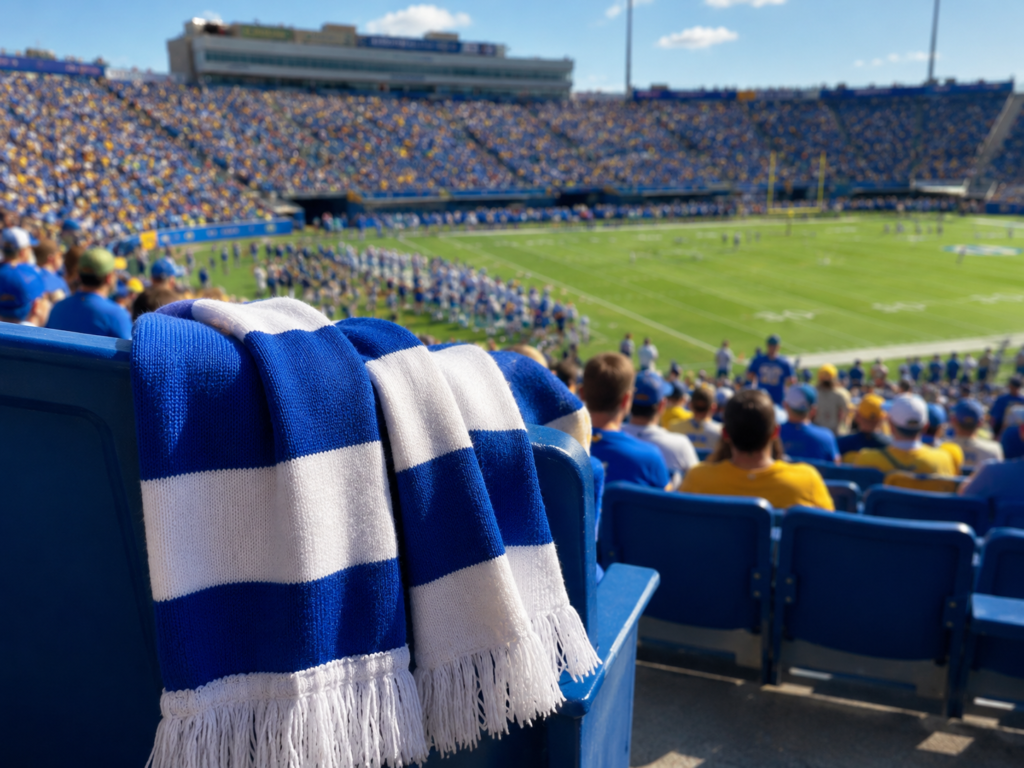
Then, halfway through the game, our faces appeared on the stadium’s enormous screen.
The announcer said Ethan’s name.
Then he told the three of us to turn around.
I expected some surprise from the team.
Instead, I saw a man walking down the stadium steps toward us.
My husband saw him too.
Chris went completely still.
All the color disappeared from his face.
“Leo?” he whispered.
And beside me, Ethan tried very hard to hide a smile.
Three months earlier, football had still been ordinary in our house.
Sunday afternoons meant Chris yelling at the television, Ethan arguing with him about statistics, and me insisting I didn’t care about football while somehow becoming the loudest person in the room whenever a referee threw a flag I disagreed with.
“Mom,” Ethan told me once, “you don’t even know the rules.”
“I know cheating when I see it.”
“That wasn’t cheating.”
“It looked suspicious.”
Chris nearly choked on his chips.
Ethan laughed so hard he fell sideways against the couch.
That was before everything changed.
Before football became one of the few pieces of our old life we could still recognize.
Ethan had been fighting cancer.
For a while, there had been hope.
Treatments.
Numbers.
Scans.
New plans whenever the old plans failed.
You learn a strange language when your child becomes seriously ill.
You learn to understand percentages you never wanted to know.
You memorize medication names.
You learn which expression on a doctor’s face means sit down before he has even opened his mouth.
One afternoon, Ethan’s doctor asked Chris and me to step into the hallway.
I remember looking through the glass in Ethan’s door while the doctor spoke.
Our son was lying in bed watching football highlights.
A little paper football he had colored blue was taped above the television.
The doctor’s voice was gentle.
Too gentle.
“I’m truly sorry.”
Chris immediately started asking questions.
“What about the other treatment?”
The doctor explained.
“What about the trial you mentioned?”
Not anymore.
“Another hospital?”
Possibly, but it was unlikely to change the outcome.
“Another medication?”
Chris kept going.
There had to be another door somewhere.
Another doctor.
Another idea.
Another miracle hiding behind the right question.
I barely heard any of it.
I was stuck on one sentence.
“We may be looking at much less time than we hoped.”
I stared at the little football taped to Ethan’s door.
Ten years.
That was all the time my son had been given.
Ten years.
When we walked back into his room, a game was playing.
Neither of us knew what to say.
Then our team scored.
Chris forgot himself.
“YES!”
He shot out of his chair.
Ethan burst out laughing.
Chris immediately stopped celebrating.
He bent toward him.
“You okay, Captain?”
Ethan’s smile faded.
“Dad.”
“What?”
“I laughed.”
“I know.”
“I’m allowed.”
Chris sat back slowly.
“Of course you are.”
I reached for my phone.
Click.
Ethan looked at me.
“What?”
“Nothing.”
I smiled.
“Keep watching.”
But after that conversation with the doctor, I started photographing everything.
Ethan eating cereal.
Ethan asleep with one sock on.
Ethan making a disgusted face at hospital gelatin.
Ethan arguing with Chris over football statistics.
Ethan smiling.
Ethan frowning.
Ethan doing absolutely nothing.
Pictures.
Videos.
Voice recordings.
I wanted proof of every ordinary second.
I told myself I was preserving our life.
I didn’t realize that Ethan had noticed what we were doing.
A few days later, a woman from a wish organization came into his hospital room.
She pulled a chair beside his bed.
“If you could choose one really special thing to do, Ethan, what would it be?”
I expected him to name a famous quarterback.
Maybe a vacation.
Maybe some enormous experience we could never have arranged ourselves.
Ethan answered immediately.
“A football game.”
The woman smiled.
“Any football game?”
He named his favorite team.
Then he added:
“With Mom and Dad.”
Chris squeezed his shoulder.
“Obviously, Captain.”
Ethan rolled his eyes.
“You have to come. Mom doesn’t understand football.”
“I understand plenty.”
“You thought a field goal was worth four points.”
“That happened once.”
“Twice.”
The woman laughed.
Over the next several weeks, everything was arranged.
Accessible seating.
Transportation.
Medical accommodations.
A place where Ethan could rest if he became tired.
Every detail was handled.
We thought we knew the entire plan.
We didn’t.
Apparently, Ethan had spoken privately with the wish coordinator.
He had made another request.
And somehow, several people had decided to take that request much further than he ever expected.
On the morning of the game, Ethan woke up exhausted.
For one terrifying moment, I thought we might have to cancel.
Then I walked into his room holding his blue jersey.
His eyes opened.
“Game day?”
“Game day.”
He sat up.
“Where’s Dad?”
“Packing enough medical supplies for a three-month expedition.”
From downstairs, Chris yelled:
“I HEARD THAT.”
Ethan grinned.
By the time we reached the stadium, he was tired but determined.
The moment we stepped inside, he stopped walking.
Thousands of voices rolled through the concrete corridors.
Vendors shouted.
Music pounded through the speakers.
Fans streamed past us in jerseys.
The smell of popcorn, hot dogs, and cold autumn air mixed together.
Chris leaned down.
“Too much, Captain?”
Ethan shook his head.
Then he smiled.
“It’s awesome.”
When we reached the opening overlooking the field, Ethan stopped again.
For months, I had watched his world become smaller.
Hospital rooms.
Waiting rooms.
Our house.
Doctor appointments.
Treatment schedules.
Carefully planned outings based on how much energy he had.
Now the world in front of him was enormous.
Green grass stretched beneath bright stadium lights.
Players warmed up on the field.
Thousands of people shouted around him.
Ethan looked alive in a way I hadn’t seen in months.
Not healthier.
Not magically cured.
Just alive.
Completely present.
He shouted with the crowd.
Booed when everyone else booed.
Cheered until his voice became scratchy.
He ate half a pretzel.
Then claimed he wasn’t hungry before stealing three bites of Chris’s hot dog.
I photographed everything.
Of course I did.
At one point, Chris leaned over.
“You tired?”
“No.”
“Cold?”
“No.”
“Need water?”
“No.”
“Pain?”
“Dad.”
“What?”
“Watch the game.”
Chris laughed.
“I am watching.”
Ethan pointed at him.
“No, you’re not.”
“What am I doing?”
“You’re watching me watch the game.”
Chris’s smile disappeared for half a second.
Ethan turned toward the field before either of us could respond.
I raised my phone.
Click.
By halftime, Ethan was fading.
I could see it.
So could Chris.
But Ethan refused to admit it.
“Maybe we should rest for a few minutes,” I said.
“No.”
“Captain.”
“Ten more minutes.”
Chris looked at his watch.
“You said ten more minutes twenty minutes ago.”
Ethan shrugged.
“That was a different ten.”
Then the stadium camera found us.
Suddenly, the three of us appeared on the giant screen.
Ethan’s entire face lit up.
“Mom! LOOK!”
I looked overhead.
There we were.
Chris on one side.
Me on the other.
Our son in the middle wearing his blue jersey.
For one glorious second, he looked exactly like every other ten-year-old boy in the stadium.
Not a patient.
Not a diagnosis.
Not a child people looked at with sadness.
Just Ethan.
I waved.
Chris threw both hands into the air.
Ethan shouted:
“WE’RE FAMOUS!”
The people around us laughed.
Some waved at the camera.
I automatically reached for my phone.
Then the announcer spoke.
“Ethan, we’re very happy you could be here with us today.”
My son stopped bouncing.
His face remained enormous above the field.
The announcer continued.
“But there’s something you don’t know about this trip.”
I looked at Chris.
He looked just as confused as I felt.
Ethan grabbed my hand.
“What?”
“I don’t know.”
Then the announcer said:
“All three of you, please turn around and look behind you.”
People in the surrounding rows turned too.
We looked toward the stairs.
A man was walking toward us.
Chris saw him first.
His entire body stiffened.
“Leo?”
Behind Leo came Ray from the hospital.
And Ray was carrying the most ridiculous object imaginable into a professional football stadium.
Ethan’s battered plastic tabletop football game.
Ethan’s mouth dropped open.
“No way.”
Behind Ray came one of Ethan’s nurses.
Then Cody, a teenage patient from Ethan’s floor, and Cody’s mother.
Ethan stared.
Then he started laughing.
“RAY!”
Ray lifted the plastic game over his head.
“Captain!”
Ethan covered his face.
“You brought that?”
“Official league equipment.”
“It’s broken!”
“Vintage.”
One of the tiny goalposts was leaning sideways.
“It’s garbage.”
“Show some respect for the league, Captain.”
The crowd around us laughed.
But I wasn’t watching Ray anymore.
I was watching Leo.
And Chris.
Because I knew exactly who Leo was.
Months earlier, Leo’s son had been receiving treatment on the same hospital floor.
One afternoon, his family received good news.
Wonderful news.
The kind every parent on that floor desperately wanted.
I had been with Ethan when we heard cheering in the hallway.
Leo was crying.
His wife hugged him.
A nurse hugged them both.
Their son’s treatment was working.
Chris had just come from another meeting about Ethan.
Another treatment had failed.
Another door had closed.
He walked into the hallway at exactly the wrong moment.
Leo laughed through his tears.
And Chris snapped.
“Could you celebrate somewhere else?”
The hallway went silent.
I will never forget Leo’s face.
His happiness vanished instantly.
“I’m sorry.”
Chris regretted it almost immediately.
I knew he did.
But grief can make pride strange.
He never apologized.
He never went back.
Ethan had seen everything from his doorway.
The next afternoon, Leo appeared in Ethan’s room.
He didn’t mention what had happened.
He didn’t offer pity.
He simply pointed toward Ethan’s tabletop football game.
“You any good?”
Ethan narrowed his eyes.
“Better than you.”
“You don’t even know me.”
“Still better.”
Leo sat down.
“Prove it.”
Ethan destroyed him.
Leo accused him of cheating.
Ethan adored him immediately.
After that, whenever Leo was at the hospital, he stopped by.
And he followed the only rule Ethan had for visitors.
Nobody watched.
Everybody played.
If a nurse entered and stood near the wall, Ethan handed her a plastic player.
If Ray came to fix something, he played.
If another patient wandered in, they played.
“Everybody plays,” Ethan always said.
I had never thought much about it.
Until that day.
Now Ray reached our row and placed the battered game carefully on Ethan’s lap.
The announcer spoke again.
“Ethan told our wish team that if this was going to be his football day, he wanted his hospital league to somehow be part of it too.”
Ethan covered his face.
“Oh no.”
“What he didn’t know was that a few members of that league decided watching from home wasn’t good enough.”
The crowd cheered.
Ethan looked at Ray.
“You snitched.”
Ray pointed toward himself.
“I’m Commissioner Ray.”
“Coach Ray.”
“Commissioner.”
“You cheat.”
“Still unproven.”
The nurse laughed.
Then the announcer continued.
“We’re told Ethan’s league has one very important rule.”
Ethan immediately shook his head.
“No.”
Ray grinned.
The announcer finished:
“Everybody plays.”
The people around us applauded.
Ethan looked embarrassed.
But he was smiling.
Then I noticed something.
He looked at Chris.
Not the field.
Not the giant screen.
Chris.
And there was something in that look I didn’t understand yet.
A stadium staff member came over a few minutes later and told us there was a quiet family room nearby where Ethan could rest.
By then, he was leaning against Chris.
So we went.
The silence inside felt strange after the roar of the stadium.
Ray put the tabletop game on a small table.
One plastic player immediately fell over.
Ray stared at it.
“Cheap equipment.”
Ethan dropped onto the couch.
“Bad coaching.”
Cody laughed.
Everyone lingered.
Then Ray looked at Ethan.
Then at Chris and me.
Something passed between them.
Ray clapped his hands.
“Okay, people. Out.”
The nurse frowned.
“Why?”
“Captain’s got a family meeting.”
Ethan looked up.
“I do?”
“You do now.”
Ray started herding everyone toward the door.
Leo was last.
He paused beside Chris.
For a moment, neither man spoke.
Then Leo gave him a small nod.
Chris returned it.
Leo left.
The door closed.
Now it was just the three of us.
I sat beside Ethan.
Chris pulled over a chair.
The plastic football field sat between us.
I looked at my son.
“What exactly did you tell Ray?”
“Nothing.”
Chris pointed toward the door.
“Nothing? The man transported twelve plastic football players across town.”
“They’re not plastic players.”
Chris raised an eyebrow.
“What are they?”
“Athletes.”
I laughed.
Ethan tried not to smile.
Then he looked down.
I waited.
Finally, I asked:
“Why did you want everyone here?”
He shrugged.
“Because.”
“Because why?”
He picked at a loose thread on his jersey.
Then he looked at my phone.
“They’re normal.”
I frowned.
“What?”
“Ray. Cody. Leo.”
He shrugged again.
“They act normal around me.”
Chris leaned forward.
“And we don’t?”
Ethan immediately looked uncomfortable.
“I didn’t mean it like that.”
“Like what?”
“Bad.”
I put my phone down.
“What do we do?”
Ethan stared at the plastic field.
“Dad pauses football games to ask if I’m tired.”
Chris opened his mouth.
Ethan continued.
“You ask if I need water even when I’m holding water.”
Chris closed his mouth.
“And Mom takes pictures when I eat cereal.”
I looked at my phone.
“You like cereal.”
“Mom.”
“Sorry.”
He looked at Chris.
“You used to yell at football.”
“I still yell.”
“No.”
Ethan shook his head.
“Now you yell and then look at me.”
Chris went silent.
Ethan turned toward me.
“And you used to yell at referees.”
“Because referees are often wrong.”
“You don’t even know the rules.”
“I know injustice.”
For a second, he smiled.
Then the smile disappeared.
“That’s why I picked football.”
I felt something tighten inside my chest.
“What do you mean?”
He looked frustrated.
Like we were making him explain something painfully obvious.
“I wanted us to have fun.”
“We are having fun.”
“No.”
His voice cracked.
“You’re trying to remember having fun.”
That silenced me.
Ethan wiped his nose with the back of his hand.
“Everything is special now.”
Neither of us spoke.
“Breakfast is special.”
He looked at me.
“Watching TV is special.”
Then at Chris.
“Me falling asleep on the couch is special.”
My eyes filled.
“Everybody keeps acting like everything has to mean something because I’m going to die.”
There are sentences no parent should ever hear from their child.
That was one of them.
Chris lowered his head.
I felt tears slide down my face.
Ethan looked between us.
“I know.”
His own eyes filled.
“I know you’re sad.”
I reached for him.
Then stopped.
For once, I waited.
He continued.
“I’m sad too.”
Chris wiped his face.
“But I’m still here.”
Chris looked at him.
“I know, Captain.”
“No.”
Ethan shook his head.
“That’s what I’m trying to tell you.”
His voice softened.
“I’m still here.”
The words broke something open inside me.
Ethan pointed toward my phone.
“Sometimes I don’t want a picture.”
I turned it facedown.
“Okay.”
“Sometimes I don’t want Dad asking if I’m tired.”
Chris nodded.
“Okay.”
“Sometimes I want to watch football and have Mom yell something wrong at the referee.”
“I am rarely wrong.”
“Mom.”
“Sorry.”
He smiled through his tears.
Then he said:
“Sometimes I just want stuff to be stuff.”
That was it.
The entire lesson.
From a ten-year-old.
Sometimes he didn’t want a memory.
He wanted a moment.
Not something we would someday look back on.
Something he could live right now.
Chris moved from the chair and sat beside him.
“I’m sorry, Captain.”
Ethan shrugged.
“I know.”
Chris covered his hand.
“I think I got scared.”
“I know.”
“I thought if I watched closely enough, maybe I wouldn’t miss anything.”
Ethan looked at him.
“But you were missing it.”
Chris closed his eyes.
Then laughed softly.
“Yeah.”
He squeezed Ethan’s hand.
“I was.”
Ethan leaned against him.
“So I’m right?”
Chris looked offended.
“Absolutely not.”
“You just admitted it.”
“I admitted nothing.”
“I have witnesses.”
“Your witnesses are unreliable.”
Ethan laughed.
A real laugh.
Then someone knocked.
Leo stood outside the door.
Chris looked at him.
For a moment, I wondered whether he would let the moment pass again.
He didn’t.
He stood.
Opened the door.
“Leo.”
“Hey.”
Chris swallowed.
“How’s your son?”
Leo looked surprised.
Then smiled.
“He’s home.”
Chris nodded.
“Good.”
“Driving his mother insane.”
“Even better.”
Leo laughed.
Chris looked down.
Then back at him.
“About that day in the hospital.”
Leo waited.
“I’m sorry.”
The words were simple.
“I was hurting.”
Chris shook his head.
“But that didn’t give me the right to make your good news feel wrong.”
Leo studied him.
Then nodded.
“I understood.”
“That doesn’t make it okay.”
“No.”
Leo held out his hand.
Chris took it.
For months, Chris had acted as though another child getting better somehow made Ethan’s situation worse.
That afternoon, he finally allowed someone else’s good news to simply be good.
A few minutes later, I looked at Ethan.
My instinct was to say:
Ready to go home?
Instead, I remembered what he had just told us.
“What do you want to do?”
He looked through the glass toward the stadium.
“Go back.”
“You sure?”
He gave Chris a look.
Chris immediately raised his hands.
“Sorry.”
Ethan smiled.
“Ten more minutes.”
Chris checked his watch.
“Ten.”
We returned to our seats.
Nobody made another announcement.
No camera followed us.
No player came over.
Nobody handed Ethan a signed helmet.
The game simply continued.
Exactly as he wanted.
Chris complained about a play.
Ethan told him he didn’t understand football.
Then a referee threw a flag.
I forgot myself.
“Oh, COME ON!”
Ethan burst out laughing.
“Mom!”
“What?”
“You don’t even know what happened!”
“I know injustice when I see it!”
Chris laughed.
My hand moved automatically toward my phone.
Then stopped.
Ethan noticed.
“You’re not taking a picture?”
“No.”
“Why?”
I looked at him.
“I’m watching.”
He studied me for a moment.
Then nodded.
That was enough.
Late in the fourth quarter, our team scored.
The entire stadium exploded.
Chris jumped to his feet.
I jumped too.
Ethan grabbed his father’s arm with one hand and mine with the other.
He laughed so hard he could barely shout.
For once, Chris didn’t ask if he was tired.
I didn’t reach for my phone.
We just screamed.
The battered tabletop football game slid sideways across Ethan’s lap.
One of the tiny plastic players popped loose and disappeared beneath my seat.
I saw it happen.
Normally, I would have immediately bent down.
Saved it.
Protected it.
Preserved it.
Instead, I stayed where I was.
Because Ethan was laughing.
Chris was yelling.
I was yelling.
And the game was still happening.
Only after the cheering faded did Ethan look down.
His eyes widened.
“Mom!”
“What?”
“My player!”
I laughed and reached beneath the seat.
My fingers found the tiny plastic figure.
I handed it to him.
Ethan snapped it back into place.
Then he looked at the little football field.
“Everybody plays.”
Chris put an arm around him.
I took Ethan’s hand.
And the three of us turned back toward the real field.
For the rest of the game, I took no pictures.
That terrified me at first.
There was a voice in my head saying I might regret it.
That one day I might desperately wish I had another photograph of Ethan’s face beneath those stadium lights.
Maybe I will.
But Ethan had given us something more important than another picture.
He reminded us that he was not already a memory.
He was our son.
He was ten.
He loved football.
He hated hospital gelatin.
He thought his father knew less about the game than he claimed.
He thought I knew absolutely nothing.
He cheated shamelessly at tabletop football.
And he was still here.
So we stopped trying to preserve every second long enough to actually live one with him.
We stayed until Ethan finally leaned against Chris and whispered:
“Okay.”
Chris looked down.
“Okay what?”
“I’m tired.”
Chris smiled.
“Want to go?”
Ethan nodded.
“Yeah.”
No bargaining.
No fear.
No sadness in the question.
Just a tired ten-year-old ready to go home after a football game.
As we walked toward the exit, Ethan carried the battered tabletop field under one arm.
Ray had insisted he take it.
At the gate, Ethan turned around one last time.
The stadium lights glowed behind us.
I almost reached for my phone.
Almost.
Then Ethan slipped his hand into mine.
Chris took his other hand.
And we walked out together.
I don’t have a photograph of that moment.
For a long time, I thought that would hurt.
It doesn’t.
Because some memories don’t need proof that they happened.
Sometimes you put the phone away.
Sometimes you stop preparing to miss someone.
Sometimes you simply hold their hand while you still can.
And sometimes, just as Ethan taught us that day, you let stuff be stuff.
The game was a game.
The cheering was cheering.
The bad call was a bad call.
And for one beautiful afternoon, our son wasn’t a patient whose time was running out.
He was simply Ethan.
Our Captain.
Ten years old.
Sitting between Mom and Dad.
Watching football.
{"post":111528,"page":2,"next":[{"id":111525,"title":"The Simple Honey Test People Are Talking About Can Flipping the Bottle Reveal the Truth","url":"https:\/\/new24.info\/111525"},{"id":111519,"title":"Overhearing A Phone Call Completely Changed My Upcoming Wedding Day Plans","url":"https:\/\/new24.info\/111519"},{"id":111516,"title":"Understanding Why Hand Veins Become Visible and When to Seek Professional Medical Advice","url":"https:\/\/new24.info\/111516"},{"id":111508,"title":"Slow Cooker 4-Ingredient Cabbage and Potatoes: A Simple, Hearty Side Dish","url":"https:\/\/new24.info\/111508"},{"id":111510,"title":"When My Daughter Was Excluded, a Single Phone Call Exposed My Husband\u0027s Hidden Life","url":"https:\/\/new24.info\/111510"},{"id":111506,"title":"Analyzing the 1872 Victorian Portrait and the Origins of Its Persistent Photographic Mystery","url":"https:\/\/new24.info\/111506"},{"id":111500,"title":"How Dolly Parton spent her final day on earth is melting hearts everywhere","url":"https:\/\/new24.info\/111500"},{"id":111270,"title":"This golden-haired baby was born to 2 rock icons - but today, he\u0027s a beared 18-year-old man who might become contry music\u0027s newxt star","url":"https:\/\/new24.info\/111270"},{"id":111487,"title":"This is Why You Should Stop Boiling Mashed Potatoes in Water","url":"https:\/\/new24.info\/111487"},{"id":111483,"title":"A Mysterious Discovery on Our Bathroom Floor Left Us Searching for Answers","url":"https:\/\/new24.info\/111483"},{"id":111479,"title":"Poor Man\u0027s Caramel Fudge: A Depression-Era Secret That Never Fails","url":"https:\/\/new24.info\/111479"},{"id":111475,"title":"Southern 3-Ingredient Cheesy Sausage Squares","url":"https:\/\/new24.info\/111475"},{"id":111473,"title":"The Quiet Art of Preserving: Finding Meaning and Mindfulness Through Homemade Jam in a Rushed World","url":"https:\/\/new24.info\/111473"},{"id":111470,"title":"The Enduring Legacy of Darrell Sheets and the Reality of His Professional Journey","url":"https:\/\/new24.info\/111470"},{"id":111460,"title":"With heavy hearts, we announce the passing of this wonderful man and legendary singer at the age of 95","url":"https:\/\/new24.info\/111460"},{"id":111457,"title":"My DIL Made Me Sleep in a Tent in Her Backyard While My Son Was Away on a Business Trip \u2013 But She Didn\u0027t Expect Him to Come Home Early","url":"https:\/\/new24.info\/111457"},{"id":111455,"title":"Robert Duvall, Master of Subtle Intensity and Academy Award-Winning Actor, Dies at 95","url":"https:\/\/new24.info\/111455"},{"id":111451,"title":"My Son and I Got on My Pilot Husband\u0027s Flight to Surprise Him \u2013 Then He Said Something over the Speakers That Made Us Stop Smiling","url":"https:\/\/new24.info\/111451"},{"id":111449,"title":"The Three Words That Silenced a Backyard Revealed Who My Son Had Become","url":"https:\/\/new24.info\/111449"},{"id":111447,"title":"Miley Cyrus Sparks Rebranding Speculation Following the Passing of Her Godmother Dolly Parton","url":"https:\/\/new24.info\/111447"}]}