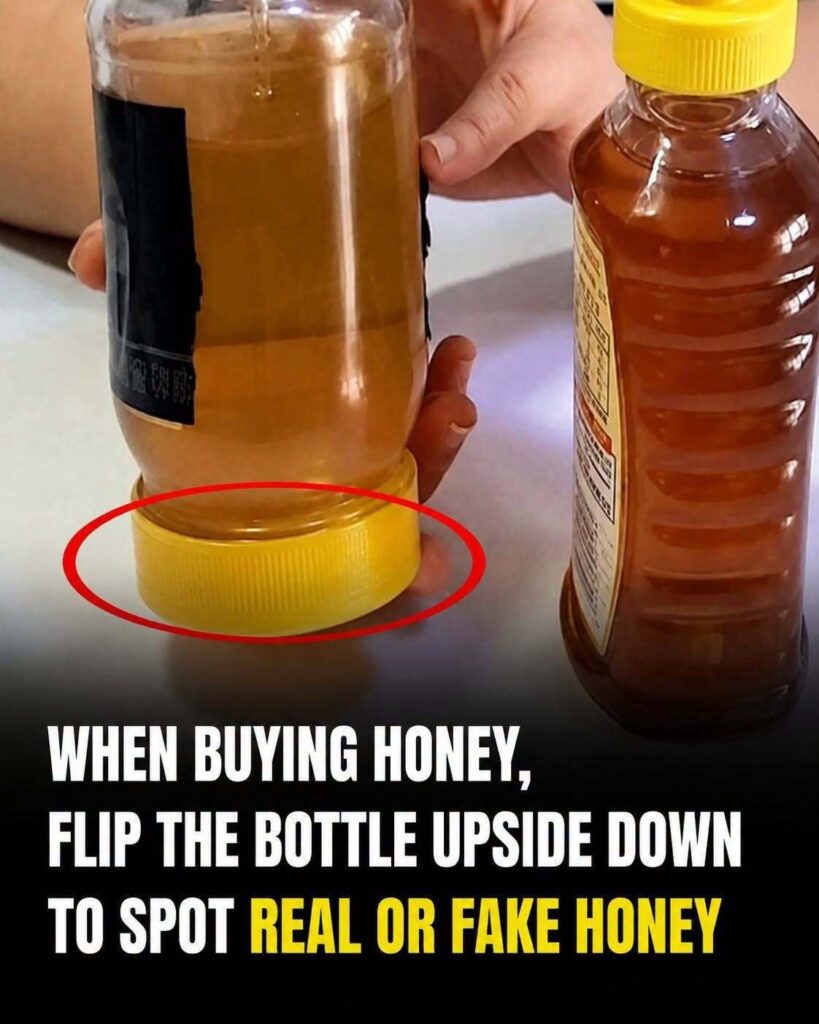
It sounds convincing.
But the truth is far more complicated.
What the test actually shows is how thick the honey is, not whether it is authentic.
Honey’s viscosity can change for several reasons, and adulteration is only one possible factor. Temperature alone can completely alter the result.
Warm honey flows much more easily than cold honey. If one bottle has been sitting near a stove or in a warm kitchen, the air bubble may rise quickly even if the honey is completely genuine.
Take the same bottle and place it somewhere cooler, and the honey will thicken considerably.
The bubble will move more slowly.
Nothing about the honey’s purity has changed.
That means comparing two bottles stored under different conditions can produce a dramatic visual difference while revealing almost nothing about whether either product has been diluted.
Water content does play a role in how honey behaves, but even that cannot provide a simple yes-or-no answer.
Honey naturally contains water, and the amount varies from batch to batch.
Too much moisture can increase the risk of fermentation and affect shelf stability, but thinner honey is not automatically fake.
The flowers visited by the bees, weather during the harvest, processing methods, storage conditions and even the age of the honey can all influence its texture.
Different varieties also behave differently.
Acacia honey, for example, can remain relatively fluid for a long period, while other types may become thick or crystallize much sooner.
Clover, orange blossom, manuka and countless regional honeys all have slightly different combinations of sugars and other compounds.
Those differences can affect everything from color and aroma to thickness and crystallization.
Crystallized honey is another feature that frequently causes confusion.
Some people assume that seeing crystals means sugar has been added.
In reality, crystallization is a completely natural process.
Honey contains both glucose and fructose, and under the right conditions, some of the glucose separates from the liquid and forms crystals.
Certain honeys crystallize rapidly, while others can remain liquid for months or even years.
The process does not mean the product is fake.
Gentle warming can usually return crystallized honey to a more fluid consistency.
The upside-down bottle trick is far from the only questionable home test circulating online.
Another popular claim says that pure honey will sink or remain intact when dropped into water, while adulterated honey will dissolve immediately.
That test is unreliable for the same reason.
How honey behaves in water depends heavily on its viscosity, temperature and moisture content.
Genuine honey can disperse.
Adulterated honey can remain clumped.
Neither result proves much on its own.
Other demonstrations suggest placing honey on a thumb to see whether it spreads, attempting to burn it on a wick, or pouring it onto a plate and adding water to look for a honeycomb-like pattern.
These tricks may produce interesting visuals, but they do not authenticate honey.
They confuse basic physical properties with chemical proof.
Modern honey adulteration can also be far more sophisticated than simply adding water.
Some fraudulent products may contain sugar syrups designed to resemble honey’s natural sugar profile.
That kind of adulteration may be impossible to detect by appearance, thickness, taste or any kitchen experiment.
Proper authentication can require laboratory techniques that examine sugar composition, stable isotopes, pollen, enzymes or other chemical markers.
And even laboratories may use several tests together rather than relying on a single method.
That alone should make consumers skeptical of any viral video claiming that one bottle flip can provide absolute certainty.
There are much better ways to reduce the chances of buying questionable honey.
One of the most useful is knowing where it comes from.
Buying directly from a trusted beekeeper or reputable producer can provide information that a home experiment cannot.
A good supplier may be able to tell you where the hives were located, which flowers were blooming, when the honey was harvested and how it was processed.
Labels can also provide useful clues.
Depending on local regulations, packaging may identify the country of origin, floral variety, batch number and whether the honey has been filtered, pasteurized or sold raw.
Independent certification or testing programs may offer additional reassurance.
Still, no label should be treated as perfect proof, because standards and enforcement vary between countries.
Price is another detail worth considering carefully.
Real honey requires healthy bee colonies, access to suitable land and flowers, harvesting equipment, labor, processing and packaging.
That means a product sold at an unusually low price may deserve closer scrutiny.
But price alone cannot prove authenticity either.
Expensive packaging and premium marketing can be used on poor-quality products just as easily as on excellent ones.
The reputation and transparency of the producer matter more than the size of the price tag.
Proper storage is also important once honey reaches the kitchen.
Honey should generally be kept tightly sealed and protected from excessive heat and moisture.
Because it naturally absorbs moisture from the surrounding environment, poor storage can eventually affect its quality.
A fermented smell, foaming or unusual pressure inside the container may indicate that something has gone wrong.
Those signs are more relevant to spoilage and moisture problems than to whether the honey was originally authentic.
There are also some basic safety considerations that should not be overlooked.
Honey should never be given to infants under one year old because of the risk of infant botulism.
And although honey is often viewed as a natural alternative to refined sugar, it is still a concentrated source of sugars.
People monitoring blood glucose should account for it accordingly.
So is there any value at all in flipping a bottle upside down?
Yes, but only if the goal is to compare thickness.
If two honey samples are at the same temperature and tested under similar conditions, the movement of an air bubble may reveal which one is more viscous.
That can be interesting.
It simply doesn’t tell you why.
A slow bubble does not certify purity.
A fast bubble does not prove fraud.
Honey is a naturally variable product, and one of its defining characteristics is that different batches can look and behave differently.
Even honey from the same beekeeper may change from one season to the next.
Weather influences which plants produce nectar.
Different flowers alter the sugar profile.
Heat, rainfall and harvest timing can affect moisture levels.
As a result, a jar collected this summer may not resemble one collected from the same hives the year before.
That variation is not automatically suspicious.
In fact, it is often part of what makes genuine honey distinctive.
Consumers who are genuinely concerned about misleading labeling have better options than performing social-media tricks.
They can contact the retailer or manufacturer, preserve the receipt and batch number, and report suspected fraud to the appropriate food-safety authority.
That creates a path toward formal testing and, if necessary, recalls or enforcement.
Pouring honey into water or timing an air bubble creates no comparable evidence.
Honey authentication is ultimately a problem of sourcing, traceability and laboratory analysis.
It cannot be reduced to a single kitchen experiment.
So the next time a video claims that one quick bottle flip can expose fake honey, remember what the test is really showing.
It is measuring how easily the honey flows under those particular conditions.
Nothing more.
The better questions are where the honey came from, who produced it, how transparent the supplier is and whether meaningful testing backs up the label.
Sometimes, asking the beekeeper about the flowers and the harvest can tell you far more than watching one bubble slowly travel through a bottle.
{"post":111525,"page":2,"next":[{"id":111519,"title":"Overhearing A Phone Call Completely Changed My Upcoming Wedding Day Plans","url":"https:\/\/new24.info\/111519"},{"id":111516,"title":"Understanding Why Hand Veins Become Visible and When to Seek Professional Medical Advice","url":"https:\/\/new24.info\/111516"},{"id":111508,"title":"Slow Cooker 4-Ingredient Cabbage and Potatoes: A Simple, Hearty Side Dish","url":"https:\/\/new24.info\/111508"},{"id":111510,"title":"When My Daughter Was Excluded, a Single Phone Call Exposed My Husband\u0027s Hidden Life","url":"https:\/\/new24.info\/111510"},{"id":111506,"title":"Analyzing the 1872 Victorian Portrait and the Origins of Its Persistent Photographic Mystery","url":"https:\/\/new24.info\/111506"},{"id":111500,"title":"How Dolly Parton spent her final day on earth is melting hearts everywhere","url":"https:\/\/new24.info\/111500"},{"id":111270,"title":"This golden-haired baby was born to 2 rock icons - but today, he\u0027s a beared 18-year-old man who might become contry music\u0027s newxt star","url":"https:\/\/new24.info\/111270"},{"id":111487,"title":"This is Why You Should Stop Boiling Mashed Potatoes in Water","url":"https:\/\/new24.info\/111487"},{"id":111483,"title":"A Mysterious Discovery on Our Bathroom Floor Left Us Searching for Answers","url":"https:\/\/new24.info\/111483"},{"id":111479,"title":"Poor Man\u0027s Caramel Fudge: A Depression-Era Secret That Never Fails","url":"https:\/\/new24.info\/111479"},{"id":111475,"title":"Southern 3-Ingredient Cheesy Sausage Squares","url":"https:\/\/new24.info\/111475"},{"id":111473,"title":"The Quiet Art of Preserving: Finding Meaning and Mindfulness Through Homemade Jam in a Rushed World","url":"https:\/\/new24.info\/111473"},{"id":111470,"title":"The Enduring Legacy of Darrell Sheets and the Reality of His Professional Journey","url":"https:\/\/new24.info\/111470"},{"id":111460,"title":"With heavy hearts, we announce the passing of this wonderful man and legendary singer at the age of 95","url":"https:\/\/new24.info\/111460"},{"id":111457,"title":"My DIL Made Me Sleep in a Tent in Her Backyard While My Son Was Away on a Business Trip \u2013 But She Didn\u0027t Expect Him to Come Home Early","url":"https:\/\/new24.info\/111457"},{"id":111455,"title":"Robert Duvall, Master of Subtle Intensity and Academy Award-Winning Actor, Dies at 95","url":"https:\/\/new24.info\/111455"},{"id":111451,"title":"My Son and I Got on My Pilot Husband\u0027s Flight to Surprise Him \u2013 Then He Said Something over the Speakers That Made Us Stop Smiling","url":"https:\/\/new24.info\/111451"},{"id":111449,"title":"The Three Words That Silenced a Backyard Revealed Who My Son Had Become","url":"https:\/\/new24.info\/111449"},{"id":111447,"title":"Miley Cyrus Sparks Rebranding Speculation Following the Passing of Her Godmother Dolly Parton","url":"https:\/\/new24.info\/111447"},{"id":111443,"title":"I Finally Brought My New Boyfriend Home to Meet My Son \u2013 The Moment My Boyfriend Saw Him, He Went Pale and Said, \u0027I Have to Go Right Now\u0027","url":"https:\/\/new24.info\/111443"}]}