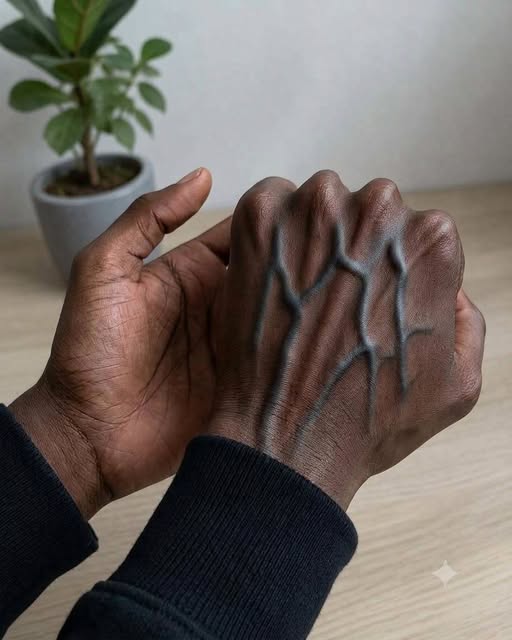
…and throughout our lives. For the vast majority of individuals, the appearance of these veins is entirely normal and does not signal a cause for concern. The primary drivers behind this visibility are often related to your body composition, including your current levels of body fat and muscle mass. When body fat decreases, the layer of tissue between your skin and your underlying vascular system thins, effectively bringing these vessels closer to the surface where they become more easily observed.
Muscle mass plays a similarly significant role in this process. Individuals who engage in regular physical activity or strength training often find that their veins become more pronounced. This is not necessarily because the veins themselves are changing, but rather because the increased muscle volume pushes the vascular structures outward toward the skin. Furthermore, the physical act of exercise itself causes temporary changes in your circulatory system. As your heart rate increases and your body generates heat, your blood vessels undergo vasodilation to help dissipate that heat and improve blood flow to your extremities.
Skin characteristics are another essential piece of the puzzle. As we age, our skin naturally loses some of its elasticity and thickness, which can make the structures beneath it, including veins, appear more prominent than they were during our younger years. Additionally, individuals with lighter or thinner skin tones may find that their veins are naturally more visible simply due to the contrast between the vessel color and the surrounding skin. These factors are entirely natural and generally do not require any medical intervention or lifestyle changes.
Environmental factors also play a substantial role in how your veins appear on any given day. Exposure to high temperatures, such as during a hot summer day or while relaxing in a sauna, causes the body to work harder to regulate its internal temperature. To facilitate this cooling process, the blood vessels near the surface of the skin expand, which can make them appear larger or more distinct. This is a standard physiological response designed to maintain homeostasis and is typically temporary, subsiding once your body temperature returns to its baseline level. Understanding that this is a normal reaction to environmental stress can help alleviate unnecessary worry.
While it is reassuring to know that these changes are usually harmless, it is equally important to remain observant of your body and recognize when a change might warrant a professional opinion. You should pay closer attention if you notice that the appearance of your veins is accompanied by symptoms that deviate from your normal baseline. For instance, if you experience persistent pain, tenderness, or a feeling of heaviness in your hands, these could be indicators that your vascular system requires a clinical evaluation.
Swelling is another factor that should be monitored carefully. If the area around a visible vein becomes puffy, inflamed, or noticeably swollen, it may suggest that the vein is struggling to return blood to the heart efficiently. Similarly, any unexplained changes in skin color, such as redness, darkening, or bruising that appears without a clear physical injury, should be addressed with a healthcare provider. These signs, while not always indicative of a severe condition, serve as important clues that your body is communicating a need for closer inspection.
Sudden changes that occur without an obvious trigger—such as a rapid increase in prominence that does not resolve with rest or cooling—are also worth discussing with a doctor. While many people worry that visible veins are a sign of poor circulation or heart disease, they are rarely the sole indicator of such conditions in the absence of other symptoms. However, a medical professional can provide a thorough examination to rule out issues like venous insufficiency or other localized circulatory concerns, offering you peace of mind and personalized guidance based on your specific health history. It is always better to seek clarity from a professional than to rely on speculation. Being proactive about your health means recognizing that while most vein visibility is a benign, expected part of human anatomy, your body deserves attention when it signals distress through pain or swelling.
In summary, the visibility of hand veins is a common human trait influenced by genetics, body composition, age, and environmental conditions. Most instances are purely cosmetic and reflect the natural architecture of your body. By maintaining an awareness of your baseline and keeping an eye out for symptoms like localized pain, persistent swelling, or unusual discoloration, you can effectively distinguish between normal physiological variations and situations that genuinely require medical attention. When in doubt, consulting a qualified healthcare provider remains the most reliable way to ensure your health and well-being are properly supported through evidence-based assessment and care.
{"post":111516,"page":2,"next":[{"id":111508,"title":"Slow Cooker 4-Ingredient Cabbage and Potatoes: A Simple, Hearty Side Dish","url":"https:\/\/new24.info\/111508"},{"id":111510,"title":"When My Daughter Was Excluded, a Single Phone Call Exposed My Husband\u0027s Hidden Life","url":"https:\/\/new24.info\/111510"},{"id":111506,"title":"Analyzing the 1872 Victorian Portrait and the Origins of Its Persistent Photographic Mystery","url":"https:\/\/new24.info\/111506"},{"id":111500,"title":"How Dolly Parton spent her final day on earth is melting hearts everywhere","url":"https:\/\/new24.info\/111500"},{"id":111270,"title":"This golden-haired baby was born to 2 rock icons - but today, he\u0027s a beared 18-year-old man who might become contry music\u0027s newxt star","url":"https:\/\/new24.info\/111270"},{"id":111487,"title":"This is Why You Should Stop Boiling Mashed Potatoes in Water","url":"https:\/\/new24.info\/111487"},{"id":111483,"title":"A Mysterious Discovery on Our Bathroom Floor Left Us Searching for Answers","url":"https:\/\/new24.info\/111483"},{"id":111479,"title":"Poor Man\u0027s Caramel Fudge: A Depression-Era Secret That Never Fails","url":"https:\/\/new24.info\/111479"},{"id":111475,"title":"Southern 3-Ingredient Cheesy Sausage Squares","url":"https:\/\/new24.info\/111475"},{"id":111473,"title":"The Quiet Art of Preserving: Finding Meaning and Mindfulness Through Homemade Jam in a Rushed World","url":"https:\/\/new24.info\/111473"},{"id":111470,"title":"The Enduring Legacy of Darrell Sheets and the Reality of His Professional Journey","url":"https:\/\/new24.info\/111470"},{"id":111460,"title":"With heavy hearts, we announce the passing of this wonderful man and legendary singer at the age of 95","url":"https:\/\/new24.info\/111460"},{"id":111457,"title":"My DIL Made Me Sleep in a Tent in Her Backyard While My Son Was Away on a Business Trip \u2013 But She Didn\u0027t Expect Him to Come Home Early","url":"https:\/\/new24.info\/111457"},{"id":111455,"title":"Robert Duvall, Master of Subtle Intensity and Academy Award-Winning Actor, Dies at 95","url":"https:\/\/new24.info\/111455"},{"id":111451,"title":"My Son and I Got on My Pilot Husband\u0027s Flight to Surprise Him \u2013 Then He Said Something over the Speakers That Made Us Stop Smiling","url":"https:\/\/new24.info\/111451"},{"id":111449,"title":"The Three Words That Silenced a Backyard Revealed Who My Son Had Become","url":"https:\/\/new24.info\/111449"},{"id":111447,"title":"Miley Cyrus Sparks Rebranding Speculation Following the Passing of Her Godmother Dolly Parton","url":"https:\/\/new24.info\/111447"},{"id":111443,"title":"I Finally Brought My New Boyfriend Home to Meet My Son \u2013 The Moment My Boyfriend Saw Him, He Went Pale and Said, \u0027I Have to Go Right Now\u0027","url":"https:\/\/new24.info\/111443"},{"id":111426,"title":"Dolly Parton\u0027s Niece and Sister Share Heartbreaking Tributes After Her Death","url":"https:\/\/new24.info\/111426"},{"id":111424,"title":"The Silence They Mistook for Ignorance Hid Eight Years She Never Spoke About","url":"https:\/\/new24.info\/111424"}]}