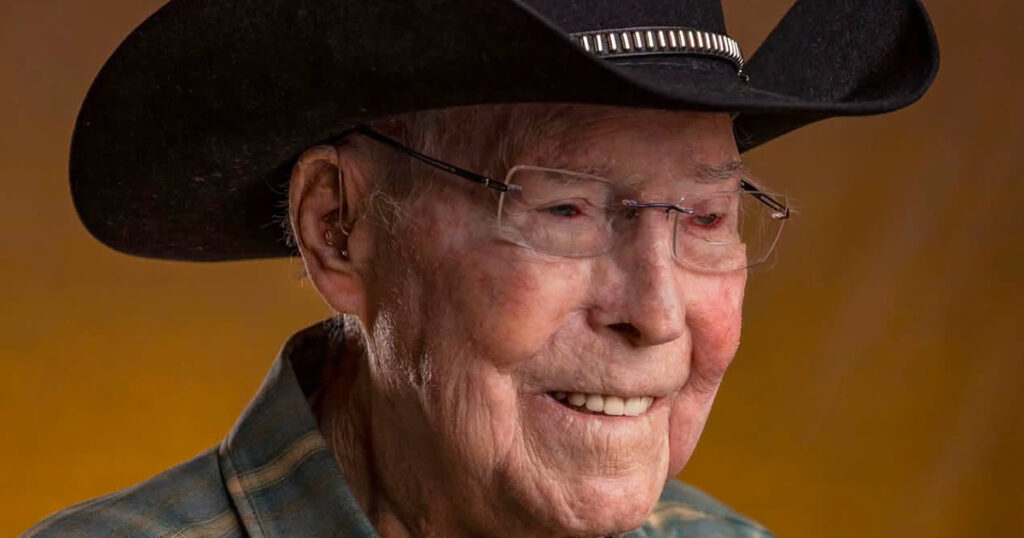
Miller died of natural causes at his home on Saturday, according to Tracy Pitcox, president of Heart of Texas Records.
For longtime country fans, Miller represented something increasingly rare — an artist whose career stretched back to a time when country music was built around simple melodies, vivid storytelling and performers who often lived lives remarkably similar to the people listening to their records.
And remarkably, Miller remained connected to that world almost until the end of his life.
“Frankie had just completed work and released his biography, ‘The Blackland Farmer: Life Among Country Music Legends,’ written by Greg Wilson,” Pitcox said.
Even after reaching his 90s, Miller continued making music and appearing at special events.
“He remained active in the industry and continued to enjoy making music into his 90s,” Pitcox added. “He even was a special guest and performed with his long-time friend Willie Nelson a few years ago at the Luck Reunion.”
It was an extraordinary final chapter for a career that had begun more than seven decades earlier.
Born in Victoria, Texas, on December 17, 1930, Miller discovered his passion for country music while still young.
As a teenager, he formed his first group, The Drifting Texans, and began performing on local radio.
Those appearances helped him develop the direct, unmistakably Texan style that would later become central to his recordings.
But before his professional music career could fully take off, Miller’s life took a dramatic turn.
He entered military service during the Korean War.
Miller served with distinction, eventually reaching the rank of sergeant and earning a Bronze Star.
When his military service ended, however, music was still waiting for him.
He returned home and resumed the career he had started building before the war.
Then, in 1959, Miller recorded the song that would forever be connected with his name.
“Blackland Farmer” was inspired by his uncle and captured the rugged world of agricultural life through the kind of straightforward storytelling that defined traditional country music.
The song became a major success for Starday Records.
It climbed into the Top 5 of the country charts and eventually crossed over to the pop charts as well, introducing Miller’s distinctive voice to listeners far beyond his Texas roots.
For many fans, “Blackland Farmer” became more than simply his biggest hit.
It became his signature.
The success opened doors, and Miller followed it with recordings including “Family Man,” “Baby Rocked Her Dolly” and “A Little South of Memphis.”
His growing reputation was recognized in 1960 when Cashbox magazine named him its Most Promising Country Artist.
By then, Miller was sharing stages and tours with performers whose names would eventually become synonymous with country music history.
The list was remarkable.
Johnny Cash.
George Jones.
Patsy Cline.
Ernest Tubb.
Buck Owens.
Lefty Frizzell.
Willie Nelson.
Miller had been there during an extraordinary period when many of the artists now considered legends were still traveling from town to town, building their audiences one performance at a time.
His influence wasn’t limited to his own records.
Songs associated with Miller were recorded by other performers, including Webb Pierce, Jessi Colter, Pat Boone, Faron Young and Dwight Yoakam.
Still, like many musicians whose commercial peak arrived during country music’s rapidly changing mid-century years, Miller eventually stepped away from full-time performing.
For a period, he worked as a car salesman in Arlington, Texas.
For some performers, that might have been where the story ended.
For Miller, it wasn’t.
During the 1990s, he found his way back onto the road.
He resumed touring and discovered that audiences still wanted to hear the music that had made him famous decades earlier.
His performances took him throughout Texas and eventually overseas.
Even age seemed to have little effect on his desire to perform.
In 2015, at approximately 85 years old, Miller traveled to Sweden to perform.
He continued remaining active well into his later years, becoming something of a living connection between modern audiences and the formative decades of postwar country music.
In 2020, Miller released A Friend Remembered: My Tribute to George Jones, honoring one of the legendary performers with whom his own career had long been connected.
Those relationships were not merely professional.
Country Music Hall of Fame songwriter and performer Bill Anderson once reflected on meeting Miller when both men were young musicians attempting to establish themselves.
“The first major tour I worked following my move to Nashville in 1959 was across western Canada with several other new country artists… among them Frankie Miller,” Anderson recalled.
At the time, Miller was enjoying success with “Blackland Farmer,” while Anderson had released “Ninety-Nine Years.”
Neither could have known what the following decades would bring.
“Most of the fans had no idea who either of us was,” Anderson remembered.
But something more lasting than chart success began during that tour.
“We formed a friendship back then that has lasted to this day,” he said. “He’s been one of my favorite artists and favorite people for a long, long time.”
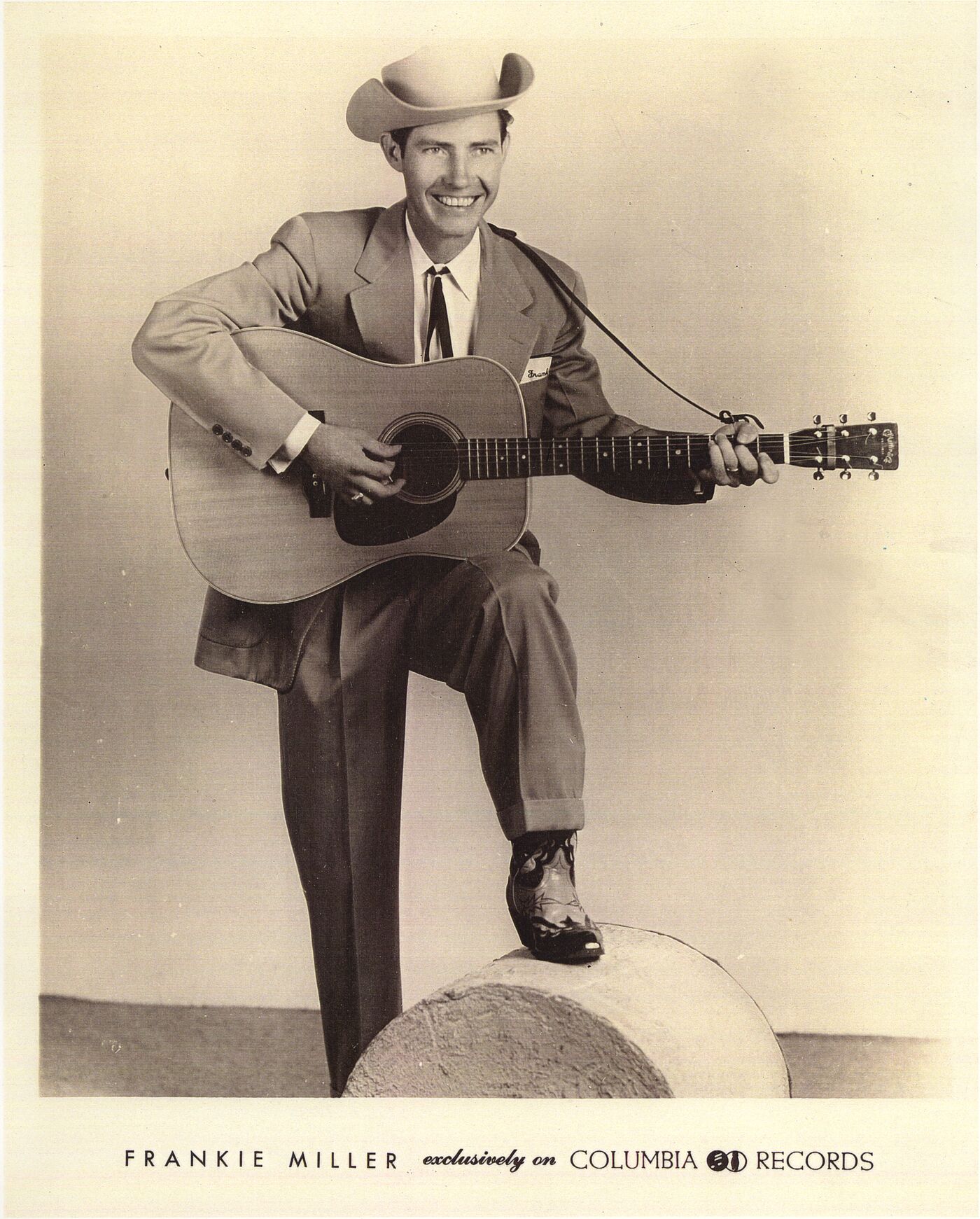
That friendship represented something important about Miller’s place in country music history.
He wasn’t simply someone who had once recorded a hit record.
He was part of the community that helped build the genre during one of its most important periods.
He knew the people who shaped it.
He traveled with them.
He performed beside them.
And decades later, he was still telling those stories.
That connection to the past became especially meaningful as Miller entered his 90s.
While many of the people he had once shared stages with were long gone, Miller continued appearing before audiences and talking about the music they had created together.
His biography, The Blackland Farmer: Life Among Country Music Legends, offered him another opportunity to preserve those memories.
Its completion shortly before his death now feels particularly significant.
Miller had spent much of his life singing stories.
In the end, he made sure his own story was preserved as well.
He leaves behind his daughters, Sandi Wilson and Lori Chaney, their husbands, six grandchildren and two great-grandchildren.
But his extended family also includes generations of traditional country listeners who discovered something authentic in his music.
For them, hearing the opening notes of “Blackland Farmer” will continue to bring back a particular sound and a particular era.
Miller’s career began when country stars traveled relentlessly, radio could turn a regional performer into a national name, and a simple song about a farmer could find its way onto both country and pop charts.
He lived long enough to watch country music transform almost beyond recognition.
Yet he never completely left it behind.
Even in his 90s, Frankie Miller was still making appearances, still sharing stories and still standing beside the musicians and songs that had shaped his life.
He had once been named one of country’s most promising young artists.
More than six decades later, he had become something even rarer — one of the last living links to an unforgettable generation of country music.
{"post":111460,"page":2,"next":[{"id":111457,"title":"My DIL Made Me Sleep in a Tent in Her Backyard While My Son Was Away on a Business Trip \u2013 But She Didn\u0027t Expect Him to Come Home Early","url":"https:\/\/new24.info\/111457"},{"id":111455,"title":"Robert Duvall, Master of Subtle Intensity and Academy Award-Winning Actor, Dies at 95","url":"https:\/\/new24.info\/111455"},{"id":111451,"title":"My Son and I Got on My Pilot Husband\u0027s Flight to Surprise Him \u2013 Then He Said Something over the Speakers That Made Us Stop Smiling","url":"https:\/\/new24.info\/111451"},{"id":111449,"title":"The Three Words That Silenced a Backyard Revealed Who My Son Had Become","url":"https:\/\/new24.info\/111449"},{"id":111447,"title":"Miley Cyrus Sparks Rebranding Speculation Following the Passing of Her Godmother Dolly Parton","url":"https:\/\/new24.info\/111447"},{"id":111443,"title":"I Finally Brought My New Boyfriend Home to Meet My Son \u2013 The Moment My Boyfriend Saw Him, He Went Pale and Said, \u0027I Have to Go Right Now\u0027","url":"https:\/\/new24.info\/111443"},{"id":111426,"title":"Dolly Parton\u0027s Niece and Sister Share Heartbreaking Tributes After Her Death","url":"https:\/\/new24.info\/111426"},{"id":111424,"title":"The Silence They Mistook for Ignorance Hid Eight Years She Never Spoke About","url":"https:\/\/new24.info\/111424"},{"id":111414,"title":"Miley Cyrus Makes a Surprising Move After Her Godmother Dolly Parton\u0027s Passing \u2013 Details \u0026 What the Public Is Saying About It Online","url":"https:\/\/new24.info\/111414"},{"id":111409,"title":"Dolly Parton Death Claim Raises Questions Online","url":"https:\/\/new24.info\/111409"},{"id":111404,"title":"A Legendary Hollywood Career Comes to an End\u2014Fans Remember an Icon","url":"https:\/\/new24.info\/111404"},{"id":111400,"title":"Discovering My Husband Faked Our Divorce While I Nursed His Mother","url":"https:\/\/new24.info\/111400"},{"id":111397,"title":"My MIL Met a Stranger at a Hotel\u2014Then a Midnight Call Changed Everything","url":"https:\/\/new24.info\/111397"},{"id":111388,"title":"The Song Dolly Parton Chose for Her Funeral and What It Reveals \u2013 Details \u0026 Photos","url":"https:\/\/new24.info\/111388"},{"id":111383,"title":"Dolly Parton\u0027s Statement Just Four Days Before Her Passing at 80 \u2013 Details","url":"https:\/\/new24.info\/111383"},{"id":111378,"title":"Why Refusing To Pay For Groceries Saved My Golden Retirement Years","url":"https:\/\/new24.info\/111378"},{"id":111374,"title":"Unexpected Funeral Announcement Reveals Secret Trust Designed To Save Our Family","url":"https:\/\/new24.info\/111374"},{"id":111372,"title":"Remembering the Private Devotion of Dolly Parton, the Beloved Matriarch Known to Her Family as Granny","url":"https:\/\/new24.info\/111372"},{"id":111369,"title":"A Morning Discovery on the Shore Leaves a Walker Searching for Answers","url":"https:\/\/new24.info\/111369"},{"id":111366,"title":"The Heavy Inheritance: Uncovering the Silent Relics of a Forgotten Family Home","url":"https:\/\/new24.info\/111366"}]}