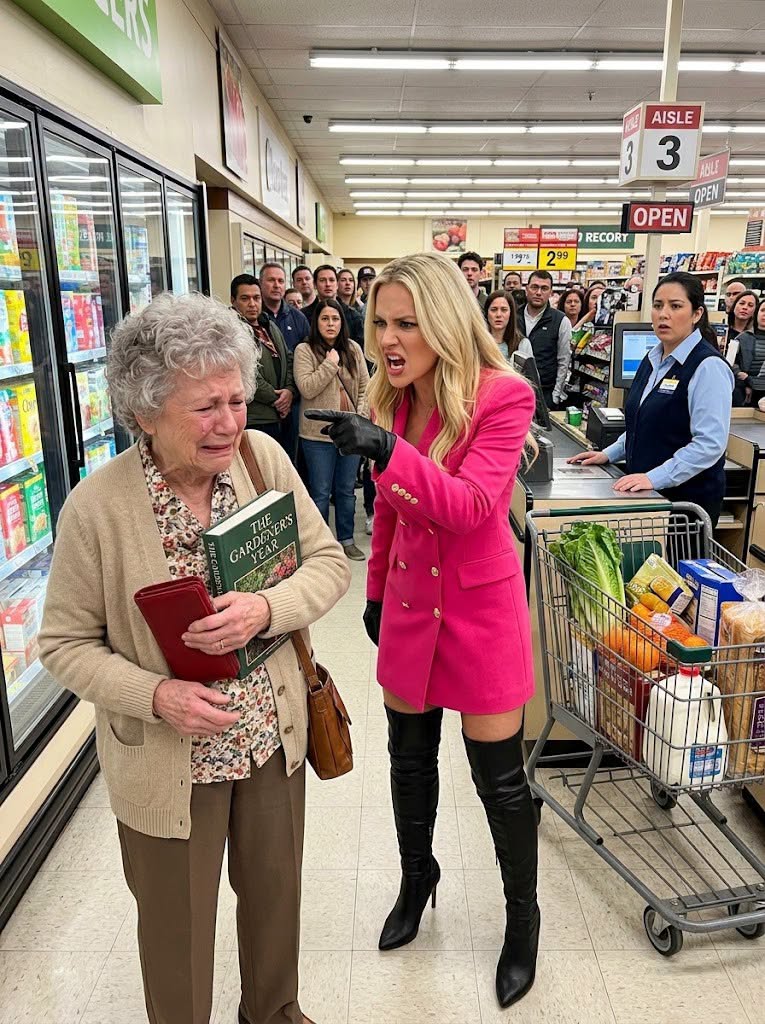
When the cashier announced the total—$980—Stephanie turned toward me.
“You can pay. You live in our house.”
My monthly pension was barely $1,200, and much of it was needed for prescription medications.
Yet what hurt wasn’t simply the money.
Four years earlier, after my husband Donald died, Stephanie had persuaded me to sell the family home where we had spent most of our married life. I gave her and Clinton $250,000 after they promised to build me a comfortable private suite in their house.
That suite never existed.
Instead, my bed ended up in a damp corner of their basement surrounded by storage boxes.
Over time, I also became their unpaid housekeeper. I cooked, cleaned, walked their dog, ironed Clinton’s work shirts, and handled countless daily chores.
Then came the bills.
Electricity.
Internet.
Streaming subscriptions.
Little by little, they began using my pension to support their household.
Standing at that supermarket register, I finally understood what had happened.
I wasn’t living with my daughter because she was caring for me.
I was helping finance her lifestyle while working in her home for free.
I closed my red leather wallet.
“No.”
Stephanie stared at me.
Then she began arguing loudly enough for people nearby to hear.
I didn’t respond.
I left the carts at the register, walked through the sliding doors, and boarded a city bus.
My destination was the home of my longtime friend Clara.
That bus ride became the beginning of my independence.
The following morning, Clara went with me to the bank and utility offices.
I canceled every automatic payment and service contract connected to my name.
It didn’t take long for Stephanie and Clinton to notice.
They arrived at Clara’s gate in their luxury vehicle demanding that I restore everything.
I refused.
During the argument, I finally demanded an explanation for the $250,000 I had given them.
The truth was worse than I expected.
Only a small amount had been spent creating my basement space.
The rest had disappeared into designer furniture, vacations, vehicle payments, and old personal debts.
There was no investment protecting my future.
No savings account.
Almost everything Donald and I had accumulated was gone.
Worse, Stephanie and Clinton had become so accustomed to using my pension that they now depended on it.
I told them I would never return.
I could have spent years fighting over the money, but at seventy-two, I decided that whatever years remained belonged to me.
Without my pension and unpaid labor, their lifestyle began collapsing quickly.
Brenda, a former housekeeper I knew, later told me they were struggling with overdue bills, household expenses, and an enormous mortgage.
Eventually, the house went up for sale.
Several weeks later, Stephanie asked to meet at a public park so I could see my grandson Mason.
I agreed.
Mason and I spent the afternoon playing together, and I returned the little yellow dinosaur he had once given me.
Before leaving, Stephanie handed me a small envelope containing money.
It wasn’t much.
But it was the first repayment she had ever made.
She also told me she had started working as a dental assistant.
For the first time, my daughter was learning to support herself instead of expecting me to absorb every financial problem.
Our relationship wasn’t magically repaired.
Some wounds don’t disappear simply because someone finally says sorry.
But it was a beginning.
Not long afterward, I rented a bright little studio behind the home of a kind widow named Mrs. Higgins.
It had a kitchenette, enough room for everything I needed, and a large window overlooking her flower garden.
My pension covered the rent comfortably.
Without the constant stress, my health improved. My blood pressure stabilized.
I started knitting again.
One rainy afternoon, I sat beside the window wearing a red sweater I had made myself and drinking a cup of chamomile tea.
My old leather wallet rested on the windowsill.
I remembered something Donald once told me.
Give your children strong wings.
But don’t hand them the entire nest.
It had taken me seventy-two years to fully understand what he meant.
Loving your children does not require financing every mistake they make.
Being a mother does not mean surrendering your dignity.
And sometimes the most loving word you can finally learn to say is simply:
No.
{"post":111378,"page":2,"next":[{"id":111374,"title":"Unexpected Funeral Announcement Reveals Secret Trust Designed To Save Our Family","url":"https:\/\/new24.info\/111374"},{"id":111372,"title":"Remembering the Private Devotion of Dolly Parton, the Beloved Matriarch Known to Her Family as Granny","url":"https:\/\/new24.info\/111372"},{"id":111369,"title":"A Morning Discovery on the Shore Leaves a Walker Searching for Answers","url":"https:\/\/new24.info\/111369"},{"id":111366,"title":"The Heavy Inheritance: Uncovering the Silent Relics of a Forgotten Family Home","url":"https:\/\/new24.info\/111366"},{"id":111363,"title":"Public Reaction Divides Over Allie Colleen\u2019s Personal Tribute Featuring Her Father","url":"https:\/\/new24.info\/111363"},{"id":111360,"title":"Uncovering the Mystery of Everyday Objects Found Tucked Away in Your Home","url":"https:\/\/new24.info\/111360"},{"id":111357,"title":"The Unstoppable Grace of Cyd Charisse: From Polio Survivor to Hollywood Legend","url":"https:\/\/new24.info\/111357"},{"id":111354,"title":"Ten Years of Building a Life Together Ended When I Finally Asked for the Truth","url":"https:\/\/new24.info\/111354"},{"id":111348,"title":"Hidden Phone Notes Exposed My Mothers Cruel Treatment Of My Pregnant Wife","url":"https:\/\/new24.info\/111348"},{"id":111345,"title":"My 16-Year-Old Daughter Saved $4,000 All Summer for Her First Car \u2013 Then She Told Me Who She\u2019d Given It All To, and I Couldn\u2019t Say a Word","url":"https:\/\/new24.info\/111345"},{"id":111342,"title":"I Married the Man of My Dreams \u2013 But the Morning After Our Wedding, I Found Something in His Tuxedo Pocket That Made Me Scream","url":"https:\/\/new24.info\/111342"},{"id":111340,"title":"Miley Cyrus Updates Official Website Branding Amidst Speculation of a New Musical Era","url":"https:\/\/new24.info\/111340"},{"id":111333,"title":"My Daughter Was the Only Kid Not Invited to Her Best Friend\u0027s Sweet 16 \u2013 When I Called to Ask Why, She Whispered, \u0027You\u0027d Better Ask Your Husband\u0027","url":"https:\/\/new24.info\/111333"},{"id":111331,"title":"A Mother\u2019s Quiet Reclamation: Why I Locked the Gates to My Life and My Legacy","url":"https:\/\/new24.info\/111331"},{"id":111328,"title":"Understanding Connective Tissue in Ground Beef to Avoid Unnecessary Kitchen Anxiety and Food Waste","url":"https:\/\/new24.info\/111328"},{"id":111325,"title":"The Unseen Architect: Discovering a Hidden Life Form Within the Quiet Confines of a Shared Home","url":"https:\/\/new24.info\/111325"},{"id":111321,"title":"My Daughter Asked Me to Organize Her Gender Reveal for 50 Guests \u2013 10 Minutes Before It Started, the Bakery Told Me Not to Serve the Cake","url":"https:\/\/new24.info\/111321"},{"id":111318,"title":"Miley Cyrus debuts new name following a difficult week","url":"https:\/\/new24.info\/111318"},{"id":111315,"title":"Cruel Valentine Dinner Test Reveals Why A Seven Year Romance Failed","url":"https:\/\/new24.info\/111315"},{"id":111312,"title":"My Neighbor Begged to Borrow My Late Dad\u2019s Canoe \u2014 Days Later, I Found It Cracked Behind His Shed, and His Excuse Left Me Speechless","url":"https:\/\/new24.info\/111312"}]}