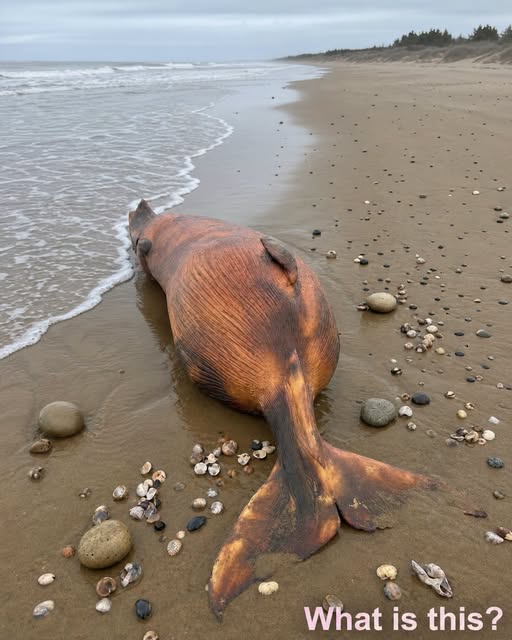
that sat motionless against the dark, churned-up sand. My heart hammered against my ribs, a frantic bird trapped in a cage of bone. I slowed my pace, my boots sinking deeper into the soft sediment with every hesitant step. The object was massive, its surface a ghostly, translucent white that seemed to absorb the weak morning light rather than reflect it. It possessed an unnaturally curved tail that swept back toward the dunes, twisted into a sharp, impossible arc that suggested a violent end or a biological mutation. I stood frozen, my breath hitching in my throat as I scanned the shoreline for any signs of movement or distress, but the beach remained hauntingly empty. The silence was absolute, save for the low, mournful groan of the ocean, which suddenly felt less like a natural phenomenon and more like a warning. My mind began to spiral, conjuring images of prehistoric relics or deep-sea horrors cast up from the abyss by the recent storms. I felt a cold, sharp spike of terror, the kind that renders one immobile, caught between the primal urge to flee and a morbid, desperate curiosity that kept my feet rooted to the spot.
I took a few more steps, my hands trembling so violently that the air felt thin and freezing. I needed to see it clearly, to confirm the nightmare I was witnessing, even as every instinct screamed at me to turn back and run until the horizon swallowed me whole. The texture of the thing was smooth, almost oily, lacking the rough, weathered appearance of driftwood or the decaying rot of a stranded carcass. It looked too deliberate, too engineered in its grotesque form, yet the sheer scale of it made my head swim with confusion. I reached for my phone, my fingers fumbling against the glass screen, and began to document the scene, capturing every angle of the pale, curved monstrosity. I took photos of the tail, the strange, seamless joints, and the way the sand seemed to cling to its base as if it were anchored there by some unseen force. Each flash of the camera felt like a transgression, a violation of a scene that was never meant for human eyes. My thoughts were a chaotic jumble of dread and analytical inquiry. Could this be some rare, undocumented species of marine life? Had the ocean finally surrendered one of its darkest secrets to the morning light? I felt a profound sense of isolation, as if the world had shrunk down to this single, terrifying point on the map where reality had fractured.
I retreated a few dozen yards, keeping my eyes locked on the object, fearful that if I looked away, it might shift or vanish into the surf. Once I reached the safety of the higher dunes, I sat down, my legs finally giving way, and began the frantic process of uploading the images to a local wildlife identification group. I typed out a brief, panicked description, my fingers flying over the keys, desperate for someone, anyone, to tell me that this was normal, that this was something that belonged in the natural order of the world. Minutes stretched into an eternity. I watched the tide creep closer to the object, the foam licking at its pale, curved tail, yet it did not budge. It sat there, a silent sentinel of the unknown, mocking my fear with its absolute stillness. I felt small, insignificant, and utterly unprepared for the possibility that the ocean held mysteries far beyond my understanding. The weight of the moment pressed down on me, turning the simple act of a morning walk into a confrontation with the unknown. I wondered if the creature had suffered, if it had been struggling against the currents for days, or if it had been deposited here by a sudden, violent surge of the deep.
Finally, a notification pinged on my screen. A moderator from the group had replied, their tone clinical and devoid of the alarm I felt. They identified the object not as a creature of the deep, but as an experimental, hyper-realistic movie prop, likely lost during a recent film production further up the coast. The explanation hit me with the force of a physical blow, a sudden deflation of the terror that had been building in my chest for hours. I looked back at the beach, the object now appearing less like a monster and more like a discarded piece of art, a hollow shell of plastic and resin. The mystery evaporated, replaced by a strange, hollow anticlimax that felt almost as unsettling as the fear itself. I walked back toward the object, my steps now heavy with the weight of my own foolishness. Up close, the illusion was still impressive, the craftsmanship evident in the subtle shading and the texture of the material, but the magic was gone. It was just a prop, a forgotten remnant of someone else’s imagination, left to be reclaimed by the tide. I stood there for a long time, watching the waves wash over the fake, curved tail, feeling a profound sense of relief tempered by a lingering, quiet melancholy. The world had not been invaded by a creature from the abyss; it was merely cluttered with the debris of human artifice. I turned away, leaving the prop to its fate, and walked back toward the life I had left behind, the morning light finally beginning to warm the cold, grey sand beneath my feet.