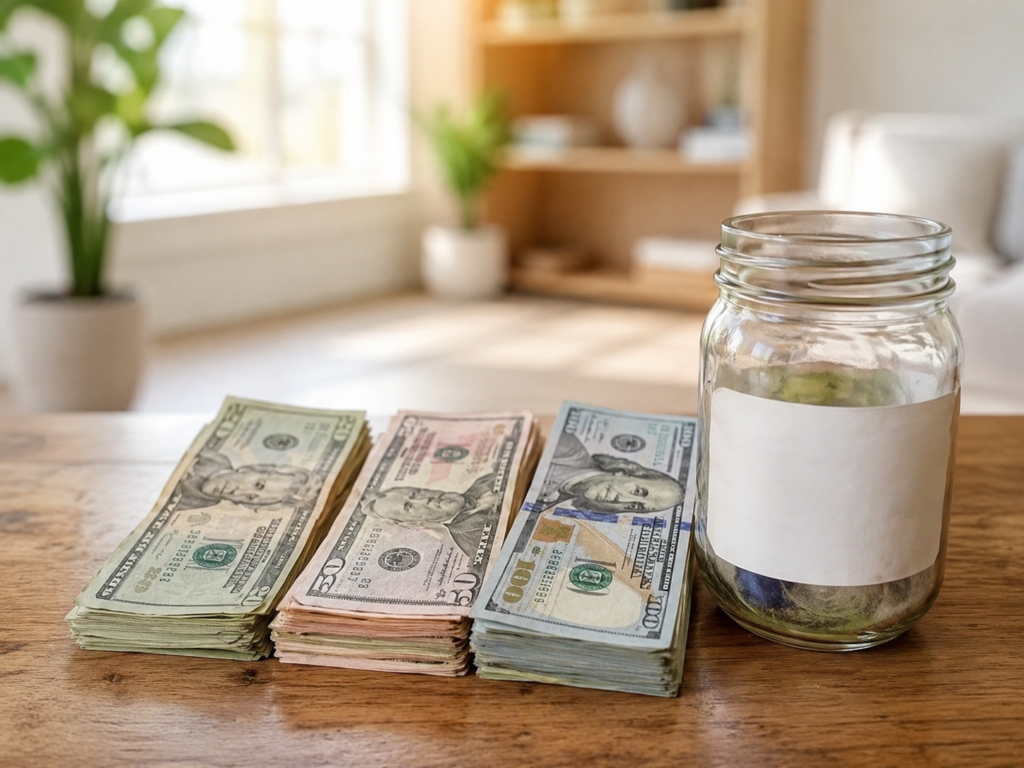
Four thousand eighty-six dollars.
Three months of double shifts, sore feet, missed weekends, and counted tips.
Gone.
And when she finally told me where the money had gone, I didn’t know whether to be furious, terrified, or proud.
That Saturday morning, I had woken before Lily.
I made coffee, printed the used-car listing one more time, and pulled an old metal keychain from the kitchen junk drawer.
It had belonged to Michael.
My husband.
Lily’s father.
He had been gone for four years.
For most of that time, the keychain had been buried beneath dead batteries, takeout menus, mystery screws, expired coupons, and pens that no longer worked.
I had found it the night before while looking for tape.
Attached to the ring was a rectangular metal tag.
One word was stamped across it.
HOME.
Michael carried it everywhere.
I remembered hearing it jingle when he walked through the front door after work.
That morning, I cleaned it carefully with a dish towel.
The ring was empty.
But if everything went according to plan, it wouldn’t be empty for much longer.
Lily had been saving all summer for a car.
Not a nice car.
Not a new car.
We were talking about the kind of car where “the air conditioner sometimes works” was considered a selling point.
She had found one listed for $6,800.
I had promised to contribute $3,000.
She would cover the rest.
Lily had saved $4,086.
Enough.
The seller had agreed to meet us at eleven.
I placed Michael’s keychain beside the listing and smiled.
Then I heard Lily’s bedroom door upstairs.
“Ready?” I called.
Nothing.
I jingled the keychain.
“Lily, if you make us late, somebody else is going to buy your car.”
Still nothing.
Then:
“Mom?”
Something about her voice made me stop smiling.
She appeared in the hallway.
Jeans.
Her old café T-shirt.
Hair unbrushed.
No purse.
No shoes.
She didn’t even glance at the listing.
She walked into the kitchen and sat across from me.
“What’s wrong?”
Lily rubbed her thumb along the edge of the table.
“We can’t go.”
I immediately assumed the seller had canceled.
“What happened?”
She swallowed.
“I don’t have the money anymore.”
I stared at her.
“What money?”
She finally looked at me.
“My car money.”
I laughed once.
Not because it was funny.
Because the sentence made no sense.
“You have four thousand eighty-six dollars.”
Lily’s eyes dropped.
“Had.”
One word.
That was all it took.
“Lily.”
“I’m sorry.”
“Where is it?”
She didn’t answer.
I pulled out the chair beside her and sat.
“Did someone get into your account?”
“No.”
“Did you buy something?”
“No.”
“Did someone online convince you to send them money?”
“No, Mom.”
My heart was starting to pound.
“Then where did four thousand dollars go?”
Her eyes filled.
“I gave it away.”
I leaned back.
“You what?”
“I gave it away.”
“All of it?”
She nodded.
“Four thousand dollars?”
Another nod.
For three months, I had watched my daughter earn that money.
While her friends spent Saturdays at the lake, Lily carried plates through a crowded café.
She cleaned tables.
Refilled coffee.
Swept floors.
Took orders from people who somehow believed snapping their fingers was an acceptable way to summon a sixteen-year-old waitress.
She came home smelling like coffee, fryer oil, syrup, and pancake batter.
Every night, she counted her tips at our kitchen table.
Twenty-dollar bills.
Fives.
Ones.
Coins.
She tracked every dollar.
She skipped movies because she had early shifts.
Turned down trips because she wanted extra hours.
One Saturday, after working eleven hours, she collapsed onto the couch and announced:
“If I ever own a restaurant, chairs will be illegal.”
I laughed.
“What would people sit on?”
“Nothing. They’ll eat standing up and leave faster.”
She wanted that car badly.
Not because it was cool.
It wasn’t.
The thing had a dent over the rear wheel and a radio that apparently only played through one speaker.
But to Lily, a car meant independence.
She could drive herself to school.
Drive herself to work.
Stop borrowing mine.
Stop asking friends for rides.
And although neither of us said it often, driving was one of those milestones that reminded us Michael wasn’t there.
When Lily was nine, he had once let her sit behind the wheel of his parked truck.
I walked outside carrying groceries and nearly dropped them.
“What are you doing?”
Michael looked innocent.
“Teaching her early.”
“You absolutely are not.”
Lily grinned from behind the wheel.
“Dad said yes.”
Michael immediately raised both hands.
“Dad has reconsidered.”
She still told that story.
Michael should have been the one teaching her to drive.
He should have been inspecting her first car.
He should have been telling the seller that a mysterious noise from the engine was “definitely not normal.”
Instead, I was doing it alone.
And now the money Lily had spent all summer earning had disappeared.
I forced myself to stay calm.
“Who did you give it to?”
She wiped one eye.
“Mom, I need you to understand something first.”
“No.”
I shook my head.
“I need a name first.”
She hesitated.
“It’s not one name.”
“What does that mean?”
She took a breath.
“Seventeen.”
I stared at her.
“Seventeen what?”
“People.”
I thought I had misunderstood.
“You gave four thousand dollars to seventeen people?”
“Yes.”
“What people?”
Lily stood.
“Come with me.”
“Where?”
“The café.”
“Lily, I’m not going anywhere until you explain what happened.”
She grabbed her hoodie.
“Please, Mom.”
I looked at Michael’s empty keychain beside my coffee.
Then at my daughter.
Twenty minutes later, we were walking toward the café where Lily had worked all summer.
Neither of us said much.
My mind kept inventing worse explanations.
Had adults at work discovered she had savings?
Had coworkers pressured her?
Had someone manipulated her?
Was there some social-media scheme involved?
Lily was sixteen.
Sixteen-year-olds could have enormous hearts and terrible judgment at exactly the same time.
When we reached the café, Mrs. Patel was unlocking the front door.
She had owned the place for almost twenty years.
She had hired Lily in June.
When she saw us, her smile disappeared.
She looked at Lily.
“You told her?”
Lily nodded.
I stopped.
“You knew?”
Mrs. Patel opened the door.
“Come inside, Rachel.”
“That is not the answer I was hoping for.”
“I know.”
The café wasn’t open yet.
The chairs were still upside down on the tables.
The pastry case was empty.
The coffee machines hadn’t been turned on.
Mrs. Patel led us behind the counter and into the cramped office where Lily counted her tips after shifts.
She opened a metal cabinet.
“Before you get angry with me, I didn’t realize how far she had taken this until recently.”
I stared at her.
“That sentence is somehow worse.”
“I know.”
She reached behind a box of receipt paper.
Then pulled out an old index card.
That was it.
A cheap card.
Bent corners.
Coffee stain along one edge.
Sixteen first names had been written across it in blue and black ink.
Each had a date beside it.
Next to several names was the same word.
FRIDAY.
I took the card.
My hands went cold.
I recognized the handwriting.
“Where did you get this?”
Mrs. Patel didn’t answer.
I looked at Lily.
“Where?”
“In July.”
I stared at the card.
The handwriting belonged to Michael.
My husband had been dead for four years.
“What is this?”
Mrs. Patel pulled out a chair.
“Sit down.”
“I’m fine.”
“Rachel.”
“I said I’m fine.”
She gave me a look.
And suddenly I could almost hear Michael.
Didn’t ask that.
I sat.
Mrs. Patel smiled sadly.
“Your husband used to come here a lot.”
“I know.”
Michael loved diner coffee.
Not good coffee.
Diner coffee.
He claimed it tasted better from thick white ceramic mugs.
I called that ridiculous.
He called me uncultured.
I knew Mrs. Patel recognized him.
I had no idea she actually knew him.
“Do you remember George?” she asked.
“No.”
She pointed to the first name on the card.
GEORGE.
“Seven years ago, Michael came in early one morning.”
She paused.
“There was a man washing his face in the restroom.”
“Why?”
“Because George had been sleeping in his car.”
Lily sat silently beside me.
Mrs. Patel continued.
“George had a job interview that morning. Michael saw him trying to straighten his shirt.”
I could already imagine the conversation.
“Michael asked whether he had an interview.”
Mrs. Patel smiled.
“George said, ‘I’m fine.’”
I closed my eyes.
“What did Michael say?”
Her smile widened.
“‘Didn’t ask that.’”
I laughed despite myself.
That was Michael.
If he asked whether your head hurt and you answered, “I’m okay,” he would become irritated.
He wanted the answer to the question he had actually asked.
“What happened?”
“Michael bought George breakfast.”
Mrs. Patel tapped the card.
“Then he took him to a discount store and bought him a clean shirt.”
I looked at the date.
“He gave him bus fare too.”
“For the interview?”
“Yes.”
“Did George get the job?”
“He did.”
I looked at the card.
“So that’s what this list is?”
“Not exactly.”
Mrs. Patel folded her arms.
“Three days later, George almost lost the job.”
“Why?”
“His first paycheck wasn’t coming until Friday.”
I looked at the word written beside his name.
FRIDAY.
“He couldn’t afford bus fare?”
Mrs. Patel nodded.
“Michael found out.”
She sat across from me.
“He didn’t pay George’s rent.”
“He didn’t fix every problem.”
“He just gave him enough money for bus fare, laundry, and a few lunches.”
Enough to keep him showing up.
Enough to get him to payday.
Enough to get him to Friday.
Mrs. Patel pointed toward the other names.
“After that, your husband started noticing people getting stuck in the same kind of gap.”
“What kind?”
“The gap between getting an opportunity and being able to afford to take it.”
A woman had been hired in a restaurant kitchen but couldn’t afford the required nonslip shoes before her first shift.
Michael bought the shoes.
A young father found a warehouse job but needed childcare for several days before his first paycheck arrived.
Michael covered it.
Someone else needed twenty dollars of phone service because an employer was trying to reach him.
Another person needed a bus pass.
Another needed a clean shirt.
Another needed lunch money.
Small things.
Nothing that sounded heroic.
But without those small things, opportunities disappeared.
“What did Michael call it?” Lily asked.
Mrs. Patel looked at her.
Lily clearly already knew.
Mrs. Patel smiled.
“Getting somebody to Friday.”
That was when I finally understood the word on the card.
I stared at the sixteen names.
I had been married to Michael for fourteen years.
I knew how he took his coffee.
I knew he couldn’t sleep wearing socks.
I knew he sang the wrong lyrics to nearly every song and refused to accept correction.
I knew the exact face he made when he was worried.
I knew which jokes he used when he didn’t know what else to say.
But I had never known this.
“Sixteen?”
Mrs. Patel nodded.
“That’s how many I knew about.”
“Why keep a list?”
She laughed.
“Because your husband was ridiculous.”
That sounded more familiar.
“Every few months, he would come in and ask me, ‘How many Fridays are we at?’”
I smiled through tears.
“He turned helping people into a scoreboard?”
“He wasn’t competing with anyone.”
“No.”
I wiped my eyes.
“He was competing with himself.”
“Exactly.”
I looked down again.
Sixteen names.
Sixteen dates.
Sixteen Fridays.
Then I turned the card over.
There were numbers written on the back.
One through seventeen.
Different handwriting.
Newer ink.
I knew that handwriting too.
I looked at Lily.
“You wrote these.”
She nodded.
“Seventeen?”
“Yes.”
“This summer?”
“Yes.”
My throat tightened.
She hadn’t added names to her father’s list.
She had started her own.
Mrs. Patel looked toward the front door.
“She’s at work.”
I frowned.
“Who?”
Lily shoved her hands into her hoodie pockets.
“Mom, there’s something else.”
“What?”
“The seventeen people aren’t all the same.”
“I don’t understand.”
“One needed a lot more than everyone else.”
Mrs. Patel picked up her keys.
“Come with us.”
She drove us across town.
We stopped outside a small auto-repair shop.
The person Lily wanted me to meet was nineteen.
Her name was Tara.
She was halfway through her first week as an apprentice mechanic.
When Lily walked inside, Tara smiled.
“Car day?”
Lily stopped.
“Not anymore.”
Tara’s smile vanished.
She looked at me.
Then at Lily.
“No.”
Lily said nothing.
Tara stepped closer.
“Tell me you didn’t use your car money.”
Silence.
Tara’s eyes immediately filled.
“Oh, Lily.”
That was when I learned where more than a quarter of my daughter’s savings had gone.
Tara had been accepted into an apprenticeship.
A real one.
Paid.
Training included.
It could lead to a career.
There was one problem.
Her shift started at six in the morning.
The bus from the temporary room where she was staying didn’t run early enough.
She had no car.
No family who could drive her.
If she missed enough shifts before her first paycheck, she would lose the opportunity.
Lily had paid for required work boots.
Then she found Tara a used bicycle.
Then she helped pay for a short-term room close enough to the shop that Tara could get to work.
A little more than $1,100.
Tara wiped her face.
“I told you I’d pay you back.”
Lily shook her head.
“No.”
“Lily.”
“You don’t owe me.”
“Yes, I do.”
“No.”
Tara looked at her.
“Then what am I supposed to do?”
Lily glanced at me.
Then said:
“Help somebody else get to Friday.”
I turned away.
I didn’t want either of them to see me cry.
The remaining money had gone to sixteen other people.
Much smaller amounts.
A bus pass.
A pair of work pants.
Groceries for a mother starting a new job.
Phone service.
Childcare.
Shoes.
Gas.
Lunch.
Not random gifts.
Not internet strangers.
Every dollar had been used to remove some small obstacle standing between somebody and an opportunity.
That didn’t mean Lily had handled it responsibly.
She was still sixteen.
She had still given away more than four thousand dollars without telling me.
But the story I had imagined that morning was gone.
Nobody had stolen from my daughter.
Nobody had scammed her.
She had found an old index card.
And somehow, four years after Michael died, it had taught her something about him I had never known myself.
On the drive home, I finally asked:
“Why didn’t you tell me?”
Lily stared out the window.
“Because you would have helped.”
“Of course I would have.”
“I know.”
“Then why is that a problem?”
She looked at me.
“Because I needed to know whether I could do it.”
“Do what?”
“What Dad did.”
My hands tightened around the steering wheel.
She looked down.
“Dad can’t help anybody anymore.”
I said nothing.
“I just wanted to know if I could do one thing he would recognize.”
That broke me.
I pulled into a parking lot.
Put the car in park.
Then sat there.
Lily immediately looked worried.
“Mom?”
“I’m okay.”
She almost smiled.
“Dad would say you didn’t answer the question.”
I laughed through tears.
“Yes.”
“He would.”
I reached for her hand.
Then stopped.
There was something important I still needed to say.
“Lily.”
“Yeah?”
“What you did was beautiful.”
Her eyes filled.
“But it was also reckless.”
She nodded.
“You gave away four thousand dollars.”
“I know.”
“Money you worked for.”
“I know.”
“And you hid it from me until the morning we were supposed to buy your car.”
“I know.”
“I’m not going to punish you for helping people.”
She looked at me.
“But I’m also not going to pretend that generosity means consequences disappear.”
“Okay.”
“The three thousand dollars I promised toward your car is staying exactly where it is.”
She nodded.
“But I’m not replacing the money you gave away.”
“I didn’t expect you to.”
“When you save your portion again, we’ll start shopping.”
“Okay.”
“And next time you decide somebody needs eleven hundred dollars in work boots, housing, and transportation…”
A tiny smile appeared.
“…you tell your mother.”
She laughed.
“Deal.”
I squeezed her hand.
“Your father apparently helped people quietly.”
Lily nodded.
“So maybe you inherited that.”
Her smile faded into something softer.
“Maybe.”
“But he was also forty-two.”
“I know.”
“You’re sixteen.”
“I know.”
“There’s a difference.”
“Big difference?”
“Enormous.”
She laughed again.
That evening, I found Lily at the kitchen table.
Exactly where she had spent all summer counting tips.
Her laptop was open.
Used-car listings covered the screen.
Michael’s old HOME keychain rested beside her phone.
Still empty.
I leaned against the doorway.
“Starting over?”
“Yep.”
“How much do you have?”
She checked.
“Eighty-six dollars.”
I raised my eyebrows.
“Look at you. Practically wealthy.”
She laughed.
Then I noticed the photograph on her phone.
Mrs. Patel’s index card.
Michael’s sixteen names on the front.
Lily’s seventeen on the back.
“Any regrets?” I asked.
She thought about it.
A long time.
Then she said, “I regret that cars cost four thousand dollars.”
I laughed.
She looked at the photograph again.
“But I don’t regret the seventeen.”
I walked over.
Michael’s keychain was lying between us.
I slid it toward her.
Lily picked it up.
She turned the little metal tag between her fingers.
HOME.
“Dad would have been proud of you,” I said.
She looked at me.
For a second, I wondered if I had gone too far.
If saying it would hurt more than help.
Then she smiled.
“You think?”
“I know.”
She looked at the empty ring.
“Even though I gave away my car?”
“Oh, he would’ve given you a lecture.”
Lily laughed.
“A long one?”
“Painfully long.”
“Then what?”
I pictured Michael sitting at this table.
The coffee.
The wrong song lyrics.
The ridiculous grin.
The man who had apparently spent years quietly getting strangers to Friday.
“Then he would’ve asked how many people you helped.”
Lily looked at the picture.
“Seventeen.”
“And he would have been furious that you beat his record.”
She laughed so hard she covered her face.
I laughed too.
And for a moment, Michael didn’t feel quite so far away.
The key ring remained empty.
No first-car key.
Not yet.
But I realized something as I watched Lily return to the listings.
That morning, I had thought the keychain was going to mark the day my daughter became more independent.
I had imagined handing it to her beside some battered little car and thinking about how proud Michael would have been.
Instead, she had already shown me something much bigger.
She had worked for something she wanted.
Then she had looked around and realized seventeen other people needed a bridge more than she needed a car.
I still wanted her to learn to save.
To think before making enormous decisions.
To understand that kindness without boundaries can eventually hurt the person giving it.
Those lessons mattered too.
But I wasn’t going to teach responsibility by making her ashamed of compassion.
So the keychain stayed empty.
For now.
Lily went back to work the following weekend.
She started counting tips again.
The eighty-six dollars became one hundred forty.
Then two hundred.
Then more.
And Michael’s HOME keychain remained beside her savings jar, waiting for the day she finally earned enough to put a car key on it.
But now there was something else beside it.
A photocopy of that old index card.
Sixteen names in her father’s handwriting.
Seventeen in Lily’s.
Thirty-three people who had needed just enough help to reach the next paycheck, the next shift, the next opportunity.
Thirty-three Fridays.
And whenever Lily complained about how slowly her car fund was growing, I would point at the card.
She would roll her eyes.
Then she would smile.
Because the car could wait.
Those seventeen people couldn’t.
And when the day finally comes that Lily places her first car key on her father’s old keychain, I know exactly what I’ll be thinking.
Michael never got to teach his daughter how to drive.
But somehow, four years after he died, he still managed to teach her which direction was worth going.
{"post":111345,"page":2,"next":[{"id":111342,"title":"I Married the Man of My Dreams \u2013 But the Morning After Our Wedding, I Found Something in His Tuxedo Pocket That Made Me Scream","url":"https:\/\/new24.info\/111342"},{"id":111340,"title":"Miley Cyrus Updates Official Website Branding Amidst Speculation of a New Musical Era","url":"https:\/\/new24.info\/111340"},{"id":111333,"title":"My Daughter Was the Only Kid Not Invited to Her Best Friend\u0027s Sweet 16 \u2013 When I Called to Ask Why, She Whispered, \u0027You\u0027d Better Ask Your Husband\u0027","url":"https:\/\/new24.info\/111333"},{"id":111331,"title":"A Mother\u2019s Quiet Reclamation: Why I Locked the Gates to My Life and My Legacy","url":"https:\/\/new24.info\/111331"},{"id":111328,"title":"Understanding Connective Tissue in Ground Beef to Avoid Unnecessary Kitchen Anxiety and Food Waste","url":"https:\/\/new24.info\/111328"},{"id":111325,"title":"The Unseen Architect: Discovering a Hidden Life Form Within the Quiet Confines of a Shared Home","url":"https:\/\/new24.info\/111325"},{"id":111321,"title":"My Daughter Asked Me to Organize Her Gender Reveal for 50 Guests \u2013 10 Minutes Before It Started, the Bakery Told Me Not to Serve the Cake","url":"https:\/\/new24.info\/111321"},{"id":111318,"title":"Miley Cyrus debuts new name following a difficult week","url":"https:\/\/new24.info\/111318"},{"id":111315,"title":"Cruel Valentine Dinner Test Reveals Why A Seven Year Romance Failed","url":"https:\/\/new24.info\/111315"},{"id":111312,"title":"My Neighbor Begged to Borrow My Late Dad\u2019s Canoe \u2014 Days Later, I Found It Cracked Behind His Shed, and His Excuse Left Me Speechless","url":"https:\/\/new24.info\/111312"},{"id":111308,"title":"My Neighbor Begged to Borrow My Late Grandma\u2019s Sewing Machine \u2014 Three Days Later, I Found It Outside in the Rain with a Note Taped to It","url":"https:\/\/new24.info\/111308"},{"id":111304,"title":"Relatives Mocked Her Retail Job Before Discovering She Owned Everything Around","url":"https:\/\/new24.info\/111304"},{"id":111300,"title":"Walking Off A Train Exposed My Fiance And Saved My Career","url":"https:\/\/new24.info\/111300"},{"id":111291,"title":"From sickly to stunning: The polio survivor who became a Hollywood icon","url":"https:\/\/new24.info\/111291"},{"id":111289,"title":"Addressing Recent Misinformation Regarding the Health and Personal Life of Dolly Parton","url":"https:\/\/new24.info\/111289"},{"id":111286,"title":"A Denim Dress and a Public Reckoning: How We Escaped Our Stepmother\u0027s Control","url":"https:\/\/new24.info\/111286"},{"id":111283,"title":"The Legal and Ethical Conflict Surrounding an Eighty-Six Year Sentence for a Teenage Offender","url":"https:\/\/new24.info\/111283"},{"id":111279,"title":"My Neighbor Constantly Borrowed My Appliances \u2013 When She Returned My Mixer Dirty and Broken, I Taught Her a Lesson","url":"https:\/\/new24.info\/111279"},{"id":111276,"title":"I Turned Down a Millionaire to Marry My Broke Best Friend\u2014Then He Showed Me the Letter My Parents Had Hidden for Years","url":"https:\/\/new24.info\/111276"},{"id":111271,"title":"This iconic actor went from $150 a month to running a farm with his famous wife","url":"https:\/\/new24.info\/111271"}]}