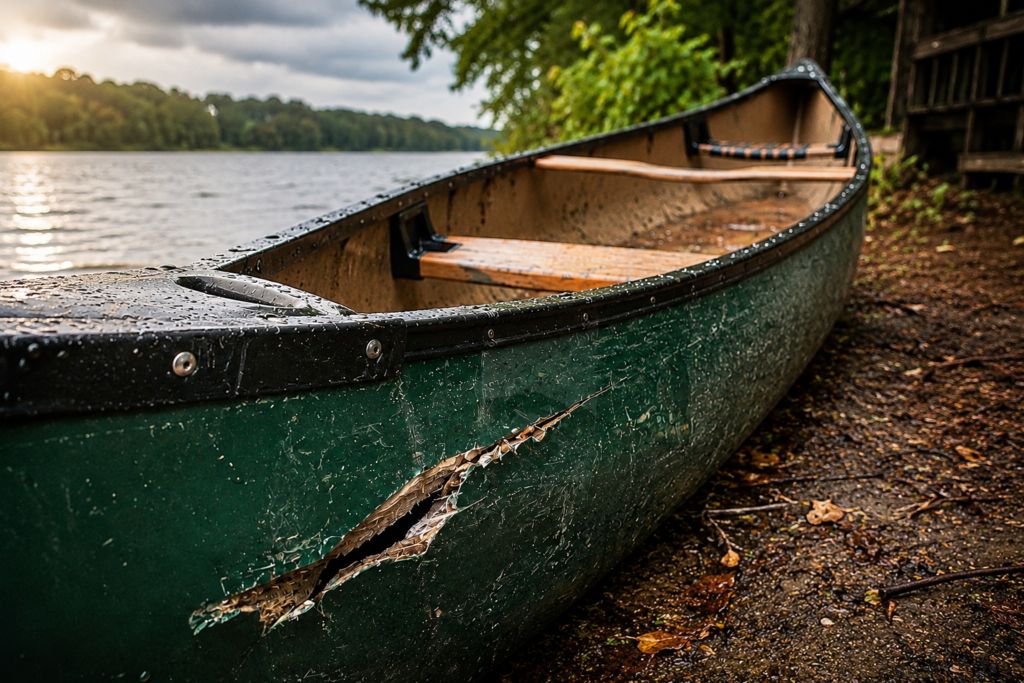
The shrugging.
And especially the way Jason decided that because something looked old, he had the right to decide it no longer mattered.
I called a marine restoration shop that afternoon.
The owner, a man named Walter, asked me to send photographs.
Twenty minutes later, he called.
“The hull can probably be repaired,” he said. “But I’d want to see it in person.”
“What about the seat?”
“That’s easier.”
Then I explained why the canoe mattered.
Walter became quiet.
“Bring it in.”
That evening, my brother helped me retrieve it from behind Jason’s shed.
Jason watched us from his kitchen window.
He never came outside.
Walter inspected the damage the following morning.
The good news was that the canoe wasn’t destroyed.
The bad news was that repairing the cracked hull, replacing structural material, restoring the wooden seat, and refinishing the damaged section would cost a little over $900.
Then Walter noticed the metal lodged underneath.
“That didn’t happen from hitting a rock,” he said.
I leaned closer.
“What is it?”
He pulled it free.
It looked like part of a steel bracket.
Walter frowned.
“You said they were on Miller Lake?”
“Yes.”
“There aren’t many places something like this would be sitting underwater near shore.”
That bothered me.
So I called the lake office.
I explained that my neighbor had borrowed my canoe and damaged it Saturday.
The manager asked where Jason had launched.
I didn’t know.
But I knew Jason had posted photographs online.
His public profile showed exactly where they had been.
And that was when the story changed.
Jason hadn’t been quietly fishing with his son.
He had taken the canoe into a restricted section near an old maintenance dock where boats were prohibited because damaged metal pilings remained beneath the water.
Large signs marked the area.
Apparently, Jason had ignored them.
The lake manager remembered him.
Not because of the canoe.
Because a staff member had confronted him.
Jason had argued with the employee after being told to leave the restricted area.
Suddenly, his “we hit something near the shore” explanation made a lot more sense.
But there was another problem.
When the canoe struck the submerged metal, Jason abandoned it temporarily near the maintenance dock.
Staff later moved it onto shore.
According to the manager, Jason returned nearly two hours later to collect it.
Meaning he knew how badly it was damaged long before bringing it home.
He hadn’t panicked.
He hadn’t discovered the crack afterward.
He knew.
And he still hid it behind his shed.
I asked the manager if he could put what happened in writing.
He did.
Then I sent Jason two things.
The restoration estimate.
And the statement from the lake.
I kept the message simple.
The repair estimate is $927. You can pay the shop directly.
Ten minutes later, my phone rang.
I ignored it.
Then again.
And again.
By evening, Jason was at my door.
“What the hell is this?”
He was holding the estimate.
“That’s the cost to repair the canoe.”
“Nine hundred dollars? You’re insane.”
“I didn’t choose the price.”
“You could buy another canoe for that!”
“I don’t want another canoe.”
Jason threw one hand into the air.
“This is exactly what I mean. You’re acting like this thing is some priceless antique.”
“No. I’m acting like it belongs to me.”
That stopped him.
I continued.
“And you borrowed it after I repeatedly told you I didn’t want to lend it out.”
“It was an accident.”
“Hitting the metal was an accident.”
I held up the lake manager’s email.
“Taking it into a clearly marked restricted area wasn’t.”
His face changed immediately.
That was the first time I knew he understood exactly how much I knew.
“You called the lake?”
“Yes.”
“Seriously?”
“You hid my damaged canoe behind your shed.”
Jason lowered his voice.
“My kid was with me.”
“I know.”
“I was just trying to give him a good day.”
“And if you had come home and told me exactly what happened, we probably wouldn’t be having this conversation.”
He looked away.
That was the truth.
I wasn’t furious because the canoe had been damaged.
I was furious because Jason had decided avoiding an uncomfortable conversation was more important than respecting me.
Finally he said, “I don’t have nine hundred dollars lying around.”
“I didn’t say you needed to pay it tonight.”
“What do you want me to do?”
“Call Walter. Arrange payment with him. Take responsibility.”
Jason stood there for several seconds.
Then he asked something I didn’t expect.
“Why does that canoe matter so much?”
So I told him.
I told him about Dad.
About Miller Lake.
About sitting in the front of that canoe at eleven years old, terrified every time it rocked.
About Dad teaching me to stop fighting the movement of the water.
I told him about the little black phone number Dad had written underneath the wooden seat.
Jason’s expression slowly changed.
He looked embarrassed.
“I didn’t know.”
“I told you it belonged to my father.”
“Yeah, but…”
He stopped himself.
“But you didn’t think that was enough.”
He nodded.
“No.”
Then he looked down at the repair estimate.
“I’m sorry, Claire.”
It didn’t magically fix everything.
But it was the first honest thing he had said since Saturday.
Jason called Walter the following morning.
They arranged three payments.
Two weeks later, the canoe came home.
Walter had repaired the hull beautifully.
But when he offered to replace the scratched finish and make the entire thing look new, I told him not to.
I wanted the old marks.
Dad had made some of them.
I had made others.
Even Jason’s repaired crack would now become part of its history.
Walter also saved the original wooden seat.
He reinforced it instead of replacing it.
And underneath, slightly faded but still readable, was Dad’s handwriting.
Our old home phone number.
I stood there running my finger across those numbers for a long time.
A month later, Jason knocked on my door.
His son was standing beside him.
The boy looked nervous.
Jason was holding something.
A new wooden canoe paddle.
“I know it doesn’t replace the one we lost,” he said. “But Ethan wanted to pick this out.”
The boy looked up at me.
“I’m sorry about your dad’s canoe.”
That almost broke me.
I accepted the paddle.
Then I surprised both of them.
“Do you still want to learn how to canoe?”
Ethan’s face lit up.
Jason looked confused.
“You’d let us use it again?”
“No.”
I smiled.
“But you can come with me.”
The following Saturday, the three of us went to Miller Lake.
I sat in the back.
Ethan sat in front.
Jason stayed on shore.
And when the canoe started rocking, Ethan immediately grabbed the sides.
I heard my father’s voice in my head.
So I repeated the same words he had once said to me.
“Don’t fight the water. Feel where it wants to move.”
A few minutes later, Ethan stopped being afraid.
And as we moved slowly across the lake, I realized the canoe had survived something more important than a crack in its hull.
It had survived someone treating it as worthless.
Sometimes an object isn’t valuable because of what someone would pay for it.
Sometimes its value comes from the person whose hands touched it before yours.
{"post":111312,"page":2,"next":[{"id":111308,"title":"My Neighbor Begged to Borrow My Late Grandma\u2019s Sewing Machine \u2014 Three Days Later, I Found It Outside in the Rain with a Note Taped to It","url":"https:\/\/new24.info\/111308"},{"id":111304,"title":"Relatives Mocked Her Retail Job Before Discovering She Owned Everything Around","url":"https:\/\/new24.info\/111304"},{"id":111300,"title":"Walking Off A Train Exposed My Fiance And Saved My Career","url":"https:\/\/new24.info\/111300"},{"id":111291,"title":"From sickly to stunning: The polio survivor who became a Hollywood icon","url":"https:\/\/new24.info\/111291"},{"id":111289,"title":"Addressing Recent Misinformation Regarding the Health and Personal Life of Dolly Parton","url":"https:\/\/new24.info\/111289"},{"id":111286,"title":"A Denim Dress and a Public Reckoning: How We Escaped Our Stepmother\u0027s Control","url":"https:\/\/new24.info\/111286"},{"id":111283,"title":"The Legal and Ethical Conflict Surrounding an Eighty-Six Year Sentence for a Teenage Offender","url":"https:\/\/new24.info\/111283"},{"id":111279,"title":"My Neighbor Constantly Borrowed My Appliances \u2013 When She Returned My Mixer Dirty and Broken, I Taught Her a Lesson","url":"https:\/\/new24.info\/111279"},{"id":111276,"title":"I Turned Down a Millionaire to Marry My Broke Best Friend\u2014Then He Showed Me the Letter My Parents Had Hidden for Years","url":"https:\/\/new24.info\/111276"},{"id":111271,"title":"This iconic actor went from $150 a month to running a farm with his famous wife","url":"https:\/\/new24.info\/111271"},{"id":111264,"title":"Leaving My Husband After A Delivery Room Betrayal Brought Me Total Peace","url":"https:\/\/new24.info\/111264"},{"id":111260,"title":"Uncovering Hidden Truths About My Daughter Brought Ultimate Justice And Healing","url":"https:\/\/new24.info\/111260"},{"id":111256,"title":"I Went to Pick up My 19-Year-Old Daughter After Her Summer Job \u2013 She Walked Out Carrying a Newborn and Said, \u0027Mom... She\u0027s Mine Now\u0027","url":"https:\/\/new24.info\/111256"},{"id":111253,"title":"My Son Rolled His Eyes and Giggled at Our Waiter with Down Syndrome \u2013 So I Taught Him a Lesson He\u0027ll Never Forget","url":"https:\/\/new24.info\/111253"},{"id":111249,"title":"The Quiet Charm of Homemade Jam","url":"https:\/\/new24.info\/111249"},{"id":111247,"title":"The Answer I Gave My Daughter at the Farmers Market Ended Years of Being Her Doormat","url":"https:\/\/new24.info\/111247"},{"id":111243,"title":"Why A Simple Wooden Recipe Box From Grandmother Vivienne Changed Everything","url":"https:\/\/new24.info\/111243"},{"id":111239,"title":"Hidden Phone Video Exposes A Husbands Betrayal After A Family Accident","url":"https:\/\/new24.info\/111239"},{"id":111231,"title":"Dolly Parton\u0027s Little-Seen Detail Comes Into Focus in These Photos","url":"https:\/\/new24.info\/111231"},{"id":111225,"title":"Dolly Parton\u0027s Statement Just Four Days Before Her Passing at 80 \u2013 Details","url":"https:\/\/new24.info\/111225"}]}