At first, everything was returned normally.
Then objects started coming back late.
My folding table came home with a deep scratch across the top.
A cake carrier disappeared for almost three weeks.
Two of my dining chairs came back with stains on the cushions.
Whenever I mentioned something, Carla always had an explanation.
The kids did it.
Her husband forgot.
She had been busy.
The damage was already there.
Eventually, I stopped complaining.
That turned out to be my biggest mistake.
Because every time I accepted her excuses, Carla learned that she could treat my belongings however she wanted.
Still, my grandmother’s sewing machine was different.
Grandma Evelyn had owned it for decades.
Some of my clearest childhood memories involved sitting beside her while that machine rattled across fabric.
She taught me how to guide material underneath the needle without pulling it.
When I became impatient, she would gently move my hands away.
“Slow hands make straight stitches,” she always told me.
After Grandma died, I inherited very little.
Some photographs.
A recipe box.
Her wedding ring, which eventually went to my daughter.
And the sewing machine.
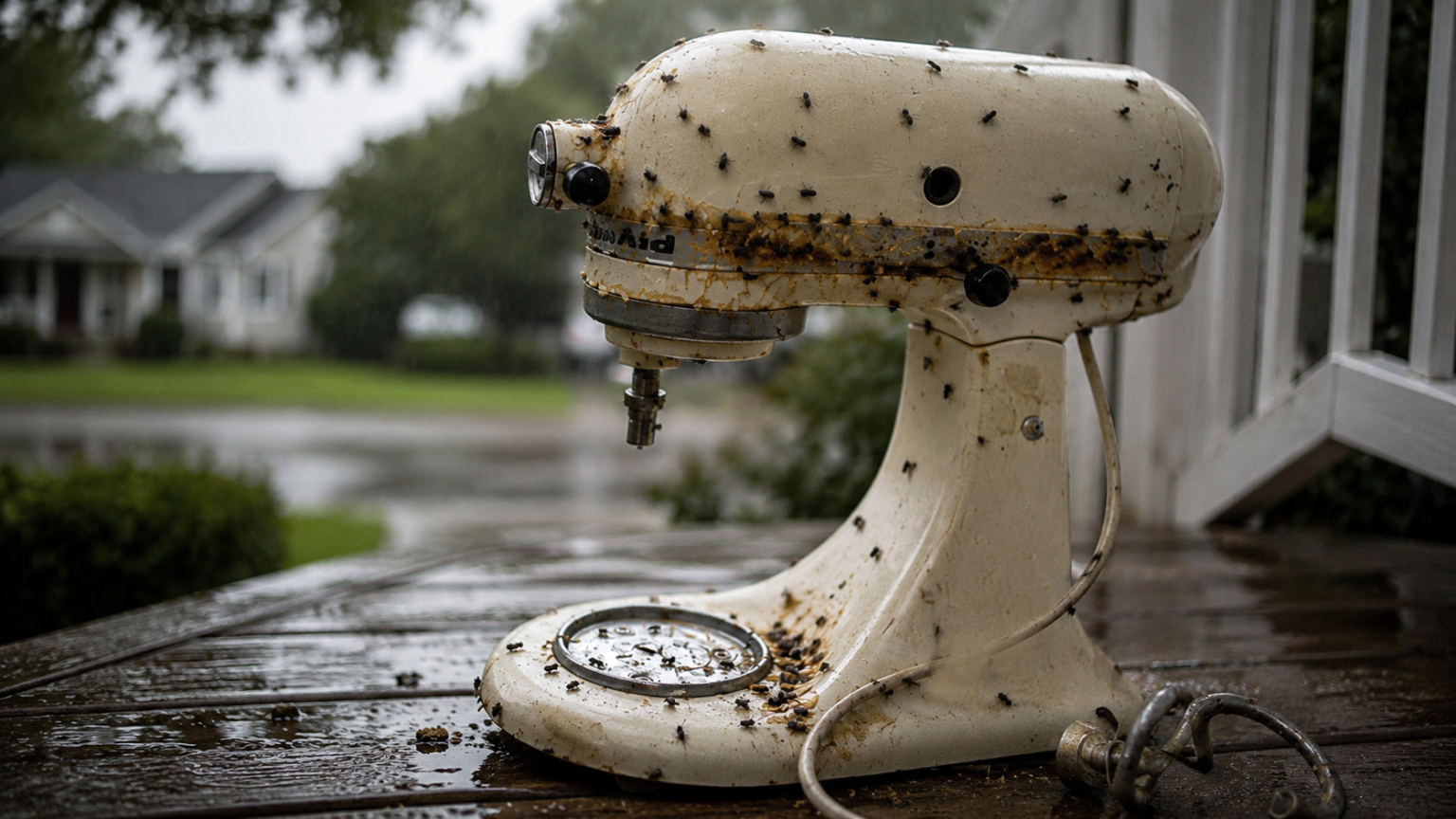
That was why seeing it soaked with rainwater felt like something far worse than losing an appliance.
Carla had treated a piece of my family history like garbage.
But I still refused to retaliate by damaging her property.
Instead, I remembered the large carpet cleaner sitting in my garage.
Carla had bought it several months earlier for almost $600.
Her garage was being renovated, so she asked if she could keep it in mine temporarily.
“Maybe two weeks,” she had said.
Two months later, it was still there.
That Friday, Carla texted me.
Need the carpet cleaner tomorrow. Having family over Sunday.
Normally, I would have responded immediately.
Instead, I waited.
Saturday morning, another message appeared.
Can you put it outside?
I replied:
I’d rather you come get it when I’m home. I don’t leave expensive things sitting outside unattended.
She responded almost instantly.
Seriously? Just leave it on the porch.
I stared at the message.
Then typed:
I thought leaving valuable things outside was normal.
There was silence for about thirty seconds.
Then my phone rang.
I didn’t answer.
Ten minutes later, Carla was pounding on my front door.
When I opened it, she looked furious.
“I need my machine.”
“It’s safe in my garage.”
“Then give it to me.”
“I will.”
I crossed my arms.
“But first, we’re going to talk about mine.”
Her expression changed.
Suddenly she understood.
“I told you, your sewing machine just stopped.”
“That isn’t the issue anymore. You left it outside during a storm.”
She started making excuses again.
This time, I didn’t let her finish.
“I took it to a repair shop yesterday.”
That part was true.
The technician said water had entered the motor and electrical components. He believed it could possibly be restored, but the repair would cost $420.
I handed Carla the estimate.
She looked at it.
Then looked at me.
“You expect me to pay this?”
“Yes.”
“That machine isn’t even worth $420.”
I shook my head.
“You still don’t understand.”
“It doesn’t matter what you think it’s worth. You borrowed something that belonged to me, damaged it, and left it outside.”
For once, Carla had nothing to say.
Finally she muttered, “I can’t pay $420 right now.”
“I’m not asking for it right now. But I am asking you to take responsibility.”
There was a long silence.
Then something surprising happened.
Her shoulders dropped.
“I’m sorry.”
It was probably the first sincere apology I had heard from her in years.
She admitted that the sewing machine had jammed while she was rushing to finish the curtains. Instead of stopping, she had forced the wheel.
Something inside snapped.
She panicked.
Then, embarrassed, she returned it while I was asleep because she didn’t want to face me.
Leaving it outside had been careless, she admitted.
The rain made everything worse.
Carla eventually agreed to pay the repair bill in two installments.
I opened the garage and gave her the carpet cleaner.
Before she left, she looked at me.
“You could have held onto this until I paid you.”
“I could have.”
“Why didn’t you?”
“Because then I’d be treating your property the way you treated mine.”
She became quiet.
Three weeks later, Grandma’s Singer came home from the repair shop.
When I flipped the switch, the motor hummed again.
My daughter smiled.
I almost cried.
Carla paid every dollar of the repair bill.
And something else changed afterward.
She stopped borrowing things.
Not just from me.
Apparently from everyone on our street.
A few weeks later she knocked on my door holding a brand-new cake carrier.
“I think this belongs to you,” she said.
It wasn’t mine.
Mine had been scratched and cloudy from years of use.
She smiled awkwardly.
“I know. I ruined yours last year.”
Then she handed it to me.
It took nearly destroying something irreplaceable for Carla to finally understand something my grandmother had taught me long before either of us lived on that street:
When someone trusts you with something they value, the real responsibility isn’t protecting the object.
It’s protecting the trust that came with it.
{"post":111308,"page":2,"next":[{"id":111304,"title":"Relatives Mocked Her Retail Job Before Discovering She Owned Everything Around","url":"https:\/\/new24.info\/111304"},{"id":111300,"title":"Walking Off A Train Exposed My Fiance And Saved My Career","url":"https:\/\/new24.info\/111300"},{"id":111291,"title":"From sickly to stunning: The polio survivor who became a Hollywood icon","url":"https:\/\/new24.info\/111291"},{"id":111289,"title":"Addressing Recent Misinformation Regarding the Health and Personal Life of Dolly Parton","url":"https:\/\/new24.info\/111289"},{"id":111286,"title":"A Denim Dress and a Public Reckoning: How We Escaped Our Stepmother\u0027s Control","url":"https:\/\/new24.info\/111286"},{"id":111283,"title":"The Legal and Ethical Conflict Surrounding an Eighty-Six Year Sentence for a Teenage Offender","url":"https:\/\/new24.info\/111283"},{"id":111279,"title":"My Neighbor Constantly Borrowed My Appliances \u2013 When She Returned My Mixer Dirty and Broken, I Taught Her a Lesson","url":"https:\/\/new24.info\/111279"},{"id":111276,"title":"I Turned Down a Millionaire to Marry My Broke Best Friend\u2014Then He Showed Me the Letter My Parents Had Hidden for Years","url":"https:\/\/new24.info\/111276"},{"id":111271,"title":"This iconic actor went from $150 a month to running a farm with his famous wife","url":"https:\/\/new24.info\/111271"},{"id":111264,"title":"Leaving My Husband After A Delivery Room Betrayal Brought Me Total Peace","url":"https:\/\/new24.info\/111264"},{"id":111260,"title":"Uncovering Hidden Truths About My Daughter Brought Ultimate Justice And Healing","url":"https:\/\/new24.info\/111260"},{"id":111256,"title":"I Went to Pick up My 19-Year-Old Daughter After Her Summer Job \u2013 She Walked Out Carrying a Newborn and Said, \u0027Mom... She\u0027s Mine Now\u0027","url":"https:\/\/new24.info\/111256"},{"id":111253,"title":"My Son Rolled His Eyes and Giggled at Our Waiter with Down Syndrome \u2013 So I Taught Him a Lesson He\u0027ll Never Forget","url":"https:\/\/new24.info\/111253"},{"id":111249,"title":"The Quiet Charm of Homemade Jam","url":"https:\/\/new24.info\/111249"},{"id":111247,"title":"The Answer I Gave My Daughter at the Farmers Market Ended Years of Being Her Doormat","url":"https:\/\/new24.info\/111247"},{"id":111243,"title":"Why A Simple Wooden Recipe Box From Grandmother Vivienne Changed Everything","url":"https:\/\/new24.info\/111243"},{"id":111239,"title":"Hidden Phone Video Exposes A Husbands Betrayal After A Family Accident","url":"https:\/\/new24.info\/111239"},{"id":111231,"title":"Dolly Parton\u0027s Little-Seen Detail Comes Into Focus in These Photos","url":"https:\/\/new24.info\/111231"},{"id":111225,"title":"Dolly Parton\u0027s Statement Just Four Days Before Her Passing at 80 \u2013 Details","url":"https:\/\/new24.info\/111225"},{"id":111205,"title":"This insecure and \u0027odd\u0027 baby with severe asthma grew up to become one of the most iconic artists in the world","url":"https:\/\/new24.info\/111205"}]}