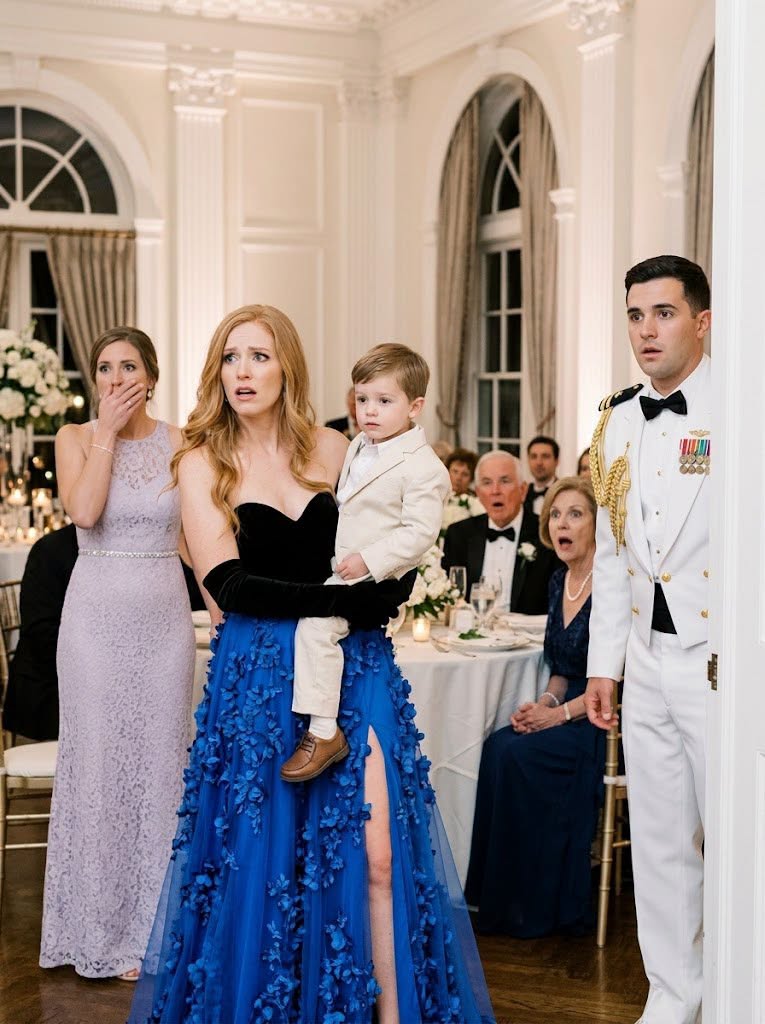
Someone near me pointed toward the entrance.
I turned.
Christopher Alistair was standing there in the ceremonial uniform of a veterans association.
Time had changed him. His hair was gray and his face looked worn, almost older than it should have.
But he wasn’t looking at me.
He was staring at Leo.
And suddenly I wasn’t standing in a Saint Paul restaurant anymore.
I was back in the worst chapter of my life.
Back when my daughter Daisy was six years old.
At the time, I was serving as an Army medical captain and had been sent away from our base for field exercises. Daisy remained behind under the supervision of Christopher and Jacqueline Miller.
Then I received the call that changed everything.
They had placed Daisy in a dangerously unsafe situation as punishment.
Even from hundreds of miles away, I understood how serious it could become. I begged them over the phone to stop.
They didn’t listen.
I tried desperately to get back to the base, but by the time I secured a flight home, my daughter was dead.
Daisy was six.
There are moments after a loss like that when the world continues functioning around you and you cannot understand how.
People walk.
Phones ring.
Cars move through intersections.
And somehow you’re expected to keep breathing.
I wanted one thing: the truth.
I went directly to retired regional commander Thomas Alistair, Christopher’s grandfather, and told him I was divorcing Christopher.
Then I began filing reports.
I contacted every military authority I believed could help me and demanded a formal investigation.
I still believed institutions worked the way they were supposed to.
I believed that if something terrible happened, you documented it, presented the evidence and eventually someone with authority would do the right thing.
I learned otherwise.
The more questions I asked, the more resistance I encountered.
Witnesses suddenly became unavailable.
My legal support disappeared.
People who had initially promised to speak with investigators stopped answering calls.
Then the intimidation became much more serious.
I was unlawfully detained and taken to a dangerous industrial location in what I understood as an attempt to frighten me into abandoning my complaints.
The next thing I clearly remember was waking inside a military hospital in Baltimore.
The message surrounding me was unmistakable.
Stop asking questions.
Stay quiet.
Move on.
Then Jacqueline walked into my hospital room carrying a brass urn.
She placed it where I could see it and implied that whatever remained of Daisy had already been disposed of.
I don’t think she understood what that moment did to me.
She expected it to destroy my determination.
Instead, it eliminated whatever fear I had left.
If they were willing to go that far to silence me, then there was something they desperately didn’t want uncovered.
The breakthrough came when Major Zachary Vance entered my hospital room accompanied by federal investigators.
Jacqueline was arrested for evidence tampering and abuse of authority.
Then Zachary showed me what his forensic team had recovered.
Security footage.
Not fragments.
Not someone’s recollection.
Actual recordings.
They showed Daisy pleading for help.
They showed Jacqueline ordering that the punishment continue.
And they showed Christopher authorizing it before leaving.
For months, I had been told that what happened was an unfortunate disciplinary situation that somehow went wrong.
The recordings told a very different story.
An officer named Captain Ronald Hayes had secretly preserved backup copies of the files before disappearing because he feared retaliation.
There was something else.
Zachary told me that Daisy’s actual remains had been secured before Jacqueline could interfere with them.
For the first time since my daughter’s death, someone inside the system wasn’t asking me to forget her.
Someone was protecting the truth.
Weeks later, investigators located Ronald.
His testimony made the situation even worse.
According to him, Daisy was still alive when someone finally checked on her.
Immediate medical intervention might have saved her.
That revelation haunted me more than almost anything else.
I was a medical officer.
I understood exactly what minutes could mean.
And Daisy had lost precious minutes because adults with authority had cared more about protecting themselves than protecting a six-year-old child.
Months later, the case finally reached court.
Ronald testified that a retired general associated with the Alistair family had delayed the medical response for eighteen minutes because he did not want civilian paramedics arriving on the base and discovering an injured child before senior officials could control the situation.
Then a nurse named Brenda Scott produced audio recordings supporting the allegation that the ambulance had deliberately been told to wait.
That was when the last protective wall around the people responsible began to collapse.
Christopher and Jacqueline were convicted and received lengthy prison sentences. Their military status and associated privileges were stripped away.
Before Christopher began serving his sentence, he asked to see me.
We sat opposite each other with glass between us.
He asked for forgiveness.
I didn’t give him the reconciliation he wanted.
I told him to serve his sentence, stop hiding behind the Alistair name and never contact me again.
Then I walked away.
Justice did not bring Daisy back.
Nothing could.
But at least the truth could no longer be rewritten as an innocent mistake or a punishment that had accidentally gone too far.
I eventually left that world behind and moved to Denver.
I studied trauma psychology and began working with families affected by institutional abuse and failures of authority.
Zachary remained in my life.
At first, he was simply someone I trusted.
Then he became a friend.
Eventually, he became much more.
We married years later in Aspen.
I carried Daisy with me that day in a small golden locket containing her photograph.
When our son was born, we named him Leo Zachary.
We never raised Leo as though Daisy’s existence were some painful family secret.
He grew up knowing he had an older sister.
He knew her name.
He knew her photographs.
And he understood why our family believed so strongly that vulnerable people must be protected when they cannot protect themselves.
That was why seeing Christopher again at the reunion in Saint Paul affected me differently than I once imagined it would.
Years earlier, merely hearing his name could send my mind back into everything I had lost.
Now he was simply an aging man standing in a doorway, looking at a child whose life he had no place in.
I adjusted Leo against my shoulder and continued walking.
Christopher didn’t follow.
And I didn’t look back.
Years passed.
Leo eventually became an air-rescue flight surgeon.
Perhaps some part of Daisy’s story shaped that choice. He grew up understanding something our family had learned at an unbearable cost:
When someone’s life is slipping away, minutes matter.
Every one of them.
Thomas Alistair’s final will later established a foundation intended to support vulnerable families facing institutional mistreatment and abuse of authority.
It carried Daisy’s name.
I wish none of it had ever been necessary.
I would trade every conviction, every courtroom victory, every foundation and every lesson learned simply to have my six-year-old daughter back.
But that was never the choice I was given.
The only choice left to me was what I would do with the life that remained.
For years, I thought surviving meant defeating the people who tried to bury the truth.
Eventually, I understood something else.
Surviving also meant reaching the day when they no longer controlled my thoughts, my family or the direction of my life.
That afternoon in Saint Paul, with Leo sleeping safely against my shoulder and Christopher disappearing behind me, I realized I had finally reached it.