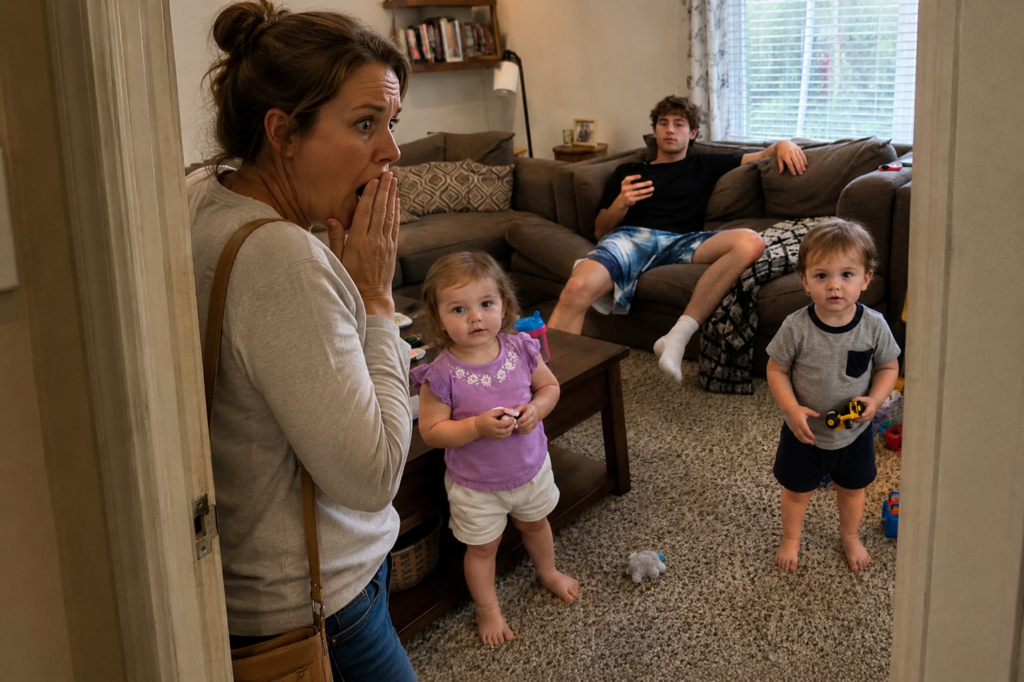
I was reaching for my phone to call 911 when an unknown number appeared on the screen.
What I learned over the next few hours changed not only the way I saw Tyler, but the way our entire family had been treating him for years.
My husband Roy’s family had always treated his younger brother like the golden child.
Tyler could do almost anything, and somehow there was always an explanation for why it wasn’t really his fault.
If he skipped class, his mother blamed boring teachers.
If he forgot an assignment, his father complained that schools gave teenagers too much work.
If Tyler lost money, someone replaced it.
If he needed a ride at midnight, someone got out of bed.
And if something truly went wrong, there was Roy.
Roy was twelve years older than Tyler.
Technically, he was his brother.
In reality, he had been acting like a third parent for most of Tyler’s life.
Roy taught him how to ride a bicycle.
Helped with homework.
Attended school meetings when their parents were unavailable.
Drove him to football practice.
Picked him up when he quit halfway through the season.
Whenever Tyler fell, Roy caught him before he hit the ground.
It came from love.
But by the time Tyler turned eighteen, he had learned two dangerous lessons.
His parents would provide whatever he needed.
And Roy would fix whatever he ruined.
So when Tyler got suspended from school for shoving another student during an argument, my in-laws handled it exactly as I expected.
They brought him to our house.
On a Friday evening, they arrived carrying one suitcase and a grocery bag full of Tyler’s favorite snacks.
My mother-in-law smiled apologetically.
“We already paid for the resort.”
I stared at her.
They were leaving the following morning for a two-week tropical vacation.
Tyler’s suspension lasted only five school days, but apparently they didn’t trust him alone in their house.
Instead of changing their plans, they decided he could stay with us.
“We can’t cancel everything now,” she continued.
I looked at Roy.
He already knew what I was thinking.
We had two toddlers.
Emma was two.
Noah had just turned four.
Our house was already one spilled cup, missing shoe, or unexplained tantrum away from total chaos.
I pulled Roy aside.
“We don’t have the energy for this.”
“It’s two weeks.”
“It is never just two weeks with your family.”
He rubbed the back of his neck.
“I know.”
“Do you?”
“I’ll handle him.”
There it was.
The sentence Roy had probably been saying since he was seventeen.
I’ll handle him.
And that was exactly the problem.
For the first three days, Tyler barely moved from our couch.
He slept until noon.
Played games on his phone.
Left plates beside the sink.
Ate snacks I had bought specifically for the children.
When I asked him to rinse a dish, he would say, “I’ll do it later.”
Later never came.
He left wet towels on the bathroom floor.
Played videos after the children went to bed.
Forgot to lock the front door.
Rolled his eyes whenever I reminded him of basic house rules.
Roy tried talking to him.
Tyler responded with the same two words every time.
“Yeah, okay.”
Then nothing changed.
By Tuesday, I had stopped seeing him as an eighteen-year-old temporarily staying with us.
He felt like a third child.
Then came the afternoon that changed everything.
Noah was refusing to wear shoes.
Emma was crying because I had cut her banana into pieces instead of giving it to her whole.
I opened the refrigerator.
No milk.
Almost no vegetables.
Nothing useful for dinner.
I needed groceries.
The supermarket was only a few minutes away.
Normally, I would have taken the children.
That afternoon, the thought of dragging two exhausted toddlers through crowded aisles felt unbearable.
Tyler was lying on the couch watching something on his phone.
I stood there for nearly a minute before asking.
“Tyler?”
He glanced up.
“What?”
“Can you watch Emma and Noah for thirty minutes?”
He looked toward them.
Noah was building a block tower.
Emma was sitting on the rug holding her stuffed bunny.
“Sure.”
I didn’t move.
“Tyler, I need you to actually listen.”
He sighed dramatically and locked his phone.
“I’m listening.”
“Keep them in the living room.”
“Okay.”
“Keep the front door locked.”
“Okay.”
“Emma puts everything in her mouth, so watch her carefully.”
“Got it.”
“Noah might try going upstairs. Keep the baby gate closed.”
“Fine.”
“And do not give either of them snacks without asking me.”
Tyler leaned back.
“They’ll be fine.”
“Tyler.”
He sat upright.
“I’ve got them, Amanda. Go.”
I should have taken them with me.
That thought followed me all the way to the supermarket.
I rushed through the aisles.
Milk.
Pasta.
Chicken.
Tomatoes.
Bread.
Nothing unnecessary.
At checkout, the woman ahead of me had trouble with her card.
I checked the time.
Thirty-four minutes.
I called Tyler.
No answer.
I tried again.
Nothing.
A strange feeling settled into my stomach.
Eventually, the line moved.
I paid, threw the bags into my cart, and hurried outside.
By the time I pulled into our driveway, approximately forty minutes had passed.
Then I saw the front door.
Wide open.
I stopped the car.
For one second, my brain refused to process what I was seeing.
Then I noticed something near the doorway.
Emma’s stuffed bunny.
I left the groceries on the porch.
“Tyler?”
No answer.
The television was playing cartoons.
The living room was empty.
“Noah?”
Nothing.
“Emma?”
I checked behind the couch.
Kitchen.
Bathroom.
Then upstairs.
Both bedrooms were empty.
I ran downstairs and threw open the back door.
Nothing.
No children.
No Tyler.
The yard was silent.
Every terrible possibility arrived in my head at once.
Had Emma wandered outside?
Had Noah followed her?
Had somebody entered the house?
Had Tyler abandoned them?
I grabbed my phone.
My hands were shaking so badly that I nearly dropped it.
I was about to call 911 when an unknown local number appeared.
I answered immediately.
“Hello?”
“Is this Amanda?”
“Yes.”
“This is Hillcrest Emergency Clinic. We have your children here.”
My knees nearly gave out.
“What?”
“You need to come immediately.”
“What happened? Are they hurt?”
“Your daughter experienced a severe allergic reaction. She’s stable, but the doctor needs to speak with you.”
I stopped breathing.
“How did they get there?”
“Your brother-in-law brought them.”
I was already running toward the car.
Hillcrest was only four blocks away.
I don’t remember driving there.
I remember parking crooked.
I remember leaving the door unlocked.
I remember running through the clinic entrance and saying Emma’s name before anyone even asked why I was there.
A nurse led me into a treatment room.
Emma was lying on a bed.
An oxygen tube rested beneath her nose.
Red patches covered her cheeks and neck.
One tiny hand was secured to an IV board.
Noah sat nearby holding crackers.
And Tyler stood against the wall.
His shirt was stained.
His hair was wet with sweat.
One knee was scraped badly enough that blood had dried down his shin.
I ran to Emma.
“What happened?”
A doctor approached.
“I’m Dr. Patel.”
“Is she okay?”
“She experienced anaphylaxis, a severe allergic reaction.”
My stomach dropped.
“She developed hives, facial swelling, vomiting, and difficulty breathing.”
I looked at my daughter’s swollen eyelids.
“Is she going to be okay?”
“She responded well to epinephrine.”
I almost collapsed from relief.
“We’re transferring her to the hospital for observation because symptoms can occasionally return.”
“What caused it?”
“We don’t know for certain yet.”
Then the doctor looked toward Tyler.
“Your brother-in-law said she ate part of a cookie shortly before the reaction began.”
I slowly turned.
“A cookie?”
Tyler looked sick.
“It was mine.”
I stared at him.
“It was in my bag. I forgot it had nuts.”
My anger exploded instantly.
“I told you not to give them snacks.”
“I know.”
“I specifically told you.”
“I know.”
“Tyler!”
“I didn’t know she was allergic!”
“Neither did I!”
My voice cracked.
“That’s why I told you not to give her anything!”
Dr. Patel gently interrupted.
“Food allergies can sometimes appear without a previously diagnosed reaction.”
I looked at her.
“The important thing right now is that your brother-in-law recognized that something was seriously wrong and responded very quickly.”
I turned back to Tyler.
“What happened?”
His voice shook.
“She started scratching her neck.”
He swallowed.
“At first, I thought she was just tired.”
Then red spots appeared.
Her lips started swelling.
Emma began vomiting.
And then Tyler heard her breathing change.
“She made this sound.”
His face crumpled slightly.
“Like she couldn’t pull air in.”
Noah stared down at his crackers.
Tyler continued.
“I’ve seen someone have an allergic reaction at school before.”
He looked at me.
“I knew it was bad.”
“What did you do?”
“I panicked.”
The doctor glanced at him.
“But you acted.”
Tyler nodded.
“I grabbed Emma.”
“And Noah?”
“I put him in the stroller.”
Suddenly, everything made sense.
The open door.
Emma’s bunny on the floor.
Tyler’s sweaty clothes.
The scraped knee.
“You ran here?”
He nodded.
“With Emma in your arms?”
“Yes.”
“Four blocks?”
“I didn’t know how long an ambulance would take.”
Dr. Patel stepped closer.
“He arrived carrying your daughter while pushing your son in the stroller.”
I covered my mouth.
“Her airway was beginning to narrow. Another few minutes without treatment could have been dangerous.”
I looked at Tyler.
For almost a week, I had seen nothing but laziness.
Carelessness.
Entitlement.
And yes, he had been careless.
Terribly careless.
He had given my daughter something after I specifically told him not to.
But when the consequences appeared in front of him, something unexpected happened.
For once, Tyler didn’t call Roy.
He didn’t wait for someone else to solve the problem.
He acted.
Fast.
The ambulance arrived shortly afterward.
I rode with Emma.
Tyler followed with Noah.
At the hospital, doctors monitored Emma for several hours.
Roy arrived straight from work.
He rushed into the room and kissed Emma’s forehead.
Then he looked at me.
“What happened?”
I told him everything.
The cookie.
The reaction.
The open door.
The clinic.
When I explained that Tyler had carried Emma four blocks while pushing Noah, Roy slowly turned toward his brother.
“You ran there?”
Tyler shrugged.
But his eyes were wet.
“She couldn’t breathe.”
Roy crossed the room.
Then he hugged him.
“You saved her life.”
Tyler stood stiffly.
“I gave her the cookie that almost killed her.”
Roy pulled back.
“You made a serious mistake.”
Tyler looked at him.
“And then you recognized what was happening and got her help.”
That sentence stayed with me.
Because Roy wasn’t rescuing him.
He wasn’t pretending the cookie didn’t matter.
He wasn’t saying Tyler had done nothing wrong.
For perhaps the first time in their relationship, Roy was treating his brother like an adult capable of being responsible for both parts of what happened.
The mistake.
And the response.
Emma came home that evening with two epinephrine auto-injectors and a referral to an allergy specialist.
Nobody wanted dinner.
We sat around the kitchen table after the children went to sleep.
Tyler kept staring at his hands.
Finally, he whispered, “I thought she was going to die.”
Roy leaned forward.
“But she didn’t.”
“I’ve never been that scared.”
“You acted anyway.”
Tyler looked at him.
Then something unexpected happened.
“You always fix everything for me.”
Roy went still.
“What?”
“If I get in trouble, you come.”
Tyler stared at the table.
“If I fail something, Mom blames the teacher.”
Neither Roy nor I spoke.
“If I need money, Dad gives it to me.”
He rubbed his palms together.
“Nobody actually expects me to handle anything.”
Roy looked hurt.
“I was trying to help you.”
“I know.”
“You’re my little brother.”
“I know.”
Tyler finally looked up.
“You raised me more than they did.”
Roy’s face changed.
“But you also never let me find out whether I could handle anything myself.”
The kitchen went quiet.
Roy looked toward the stairs where Emma was sleeping.
“You handled today.”
Tyler shook his head.
“After nearly causing it.”
“Yes.”
I spoke for the first time.
“And you’re going to remember that mistake for the rest of your life.”
He looked at me.
“You will never give another child food without checking with the parent.”
“No.”
“Ever.”
“Never.”
I believed him.
I was still angry.
I was angry at Tyler.
Angry at myself for leaving the children.
Angry at the entire situation.
But I could no longer look at him and see only the lazy teenager occupying my couch.
“Thank you,” I said.
He blinked.
“For what?”
“For getting her help.”
His eyes filled again.
“I panicked.”
“I know.”
“I was terrified.”
“You acted while you were terrified.”
Something about that seemed to reach him.
Later that evening, Tyler finally told us why he had been suspended.
The student he shoved had been mocking him about failing two classes.
“He said everyone knows my parents will get me out of it again.”
Roy frowned.
“So you hit him?”
“I shoved him.”
“That doesn’t make it okay.”
“I know.”
Tyler looked down.
“That’s why it made me so angry.”
“What?”
“Because he was right.”
Roy sat back.
Tyler had spent years laughing whenever anyone mentioned his future.
College?
“Maybe.”
Work?
“I’ll figure it out.”
Graduation?
“Relax.”
That night, there were no jokes.
“I don’t know what I’m doing after school.”
“You’ll figure it out,” Roy said automatically.
Tyler immediately shook his head.
“No.”
Roy frowned.
“No what?”
“Don’t do that.”
“Do what?”
“Tell me everything is going to work out before I’ve done anything to make it work out.”
Roy fell silent.
Tyler looked toward the hallway.
“When we got to the clinic, I watched them give Emma the injection.”
He paused.
“She was getting worse so fast.”
His voice softened.
“Then they gave her the medicine.”
He snapped his fingers.
“And everything started changing.”
I watched him carefully.
“I want to learn how to do that.”
“Do what?” I asked.
“Help people when something happens.”
He thought for a moment.
“Before they get to the hospital.”
Roy looked at him.
“Like an EMT?”
Tyler nodded.
“Maybe.”
It was the first time I had ever heard him talk about his future as though he expected himself to participate in creating it.
Roy nodded slowly.
“Then the first thing you need to do is graduate.”
Tyler looked at him.
This time Roy didn’t say, “You can do it.”
He didn’t promise everything would work out.
He simply waited.
Tyler finally said, “Okay.”
When my in-laws returned from vacation, they came to collect Tyler.
They expected complaints.
Instead, Tyler asked them to sit down.
His mother smiled when she heard Emma was okay.
Then Roy explained what Tyler had done.
Their reaction was immediate.
“Oh, sweetheart!”
My mother-in-law grabbed him.
“We knew you would know what to do.”
His father slapped his shoulder.
“That’s my boy.”
Tyler pulled away.
“No.”
His father frowned.
“What?”
“You don’t get to do that.”
“Do what?”
“Act like you taught me how to handle something.”
The room went silent.
His mother looked hurt.
“Tyler, we have always supported you.”
“You gave me things.”
“We gave you everything you needed.”
“You left Roy to raise me.”
His father’s face hardened.
“That is incredibly disrespectful.”
“It’s true.”
Roy started to speak.
Then stopped himself.
For once, he let Tyler handle it.
“When I got suspended, what did you do?”
His mother stared at him.
“You dropped me here and went on vacation.”
“We had already paid—”
“I know.”
Tyler nodded.
“That’s always the answer.”
His father crossed his arms.
“What exactly do you want from us?”
“I want you to stop fixing everything.”
His mother looked confused.
“We’re your parents.”
“Then be my parents.”
That landed.
“Ask why I got suspended.”
Silence.
“Ask whether I’m passing my classes.”
Nothing.
“Make me deal with what I do instead of calling somebody and making it disappear.”
His mother’s eyes filled.
“You always seemed so independent.”
Tyler gave a sad laugh.
“No. I seemed independent because Roy was doing everything you weren’t watching.”
Then Tyler said something that made Roy look away.
“He’s more of my parent than you two are.”
Nobody spoke.
Finally, Tyler’s father looked at Roy.
“Is that how you feel?”
Roy laughed once, but there was no humor in it.
“I was seventeen the first time you asked me to miss football practice because somebody needed to stay home with Tyler.”
His mother lowered her eyes.
“I’ve felt that way for a long time.”
There were apologies.
There were excuses too.
Families rarely repair eighteen years of dysfunction during one kitchen conversation.
But something changed.
Tyler agreed to go home under one condition.
His parents had to let consequences belong to him.
If he failed an assignment, they would not blame the teacher.
If he missed a deadline, they would not call the school.
If he needed to complete an application, Roy would not do it for him.
Roy made his own promise.
“I’ll help when you need advice.”
Tyler nodded.
“But I won’t rescue you from things you need to handle yourself.”
“Good.”
Tyler didn’t transform overnight.
That would have been too easy.
He still procrastinated.
Still complained.
Still occasionally forgot things.
But after his suspension, he attended every class.
He apologized to the student he had shoved.
Not because his parents forced him.
Because he decided he owed him one.
He started studying.
His grades improved slowly.
Sometimes he failed a test.
And nobody called the teacher.
Sometimes he forgot an assignment.
And nobody invented an excuse.
For the first time, Tyler was allowed to experience something his family had spent years protecting him from.
Consequences.
And with consequences came something else.
Confidence.
A few months later, we attended his high school graduation.
My in-laws sat behind us.
Roy sat beside me.
Emma was on my lap, perfectly healthy, while Noah bounced impatiently in his seat.
Then Tyler’s name was announced.
Roy stood first.
I stood beside him.
Noah threw both hands into the air.
Tyler walked across the stage.
He looked toward us.
And smiled.
It wasn’t his usual careless grin.
This smile was different.
Nervous.
Proud.
Earned.
After the ceremony, his parents handed him a card with money inside.
Then his mother took his hand.
“We’re sorry.”
Tyler looked at her.
No explanation followed.
No “but.”
No reminder of how hard they had worked.
Just an apology.
He hugged her.
It didn’t erase the past.
It didn’t need to.
That fall, Tyler planned to begin EMT training.
And whenever I thought back to that afternoon, I remembered the terror of seeing my front door standing open.
For several horrible minutes, I thought Tyler had proven every bad thing I believed about him.
Instead, I learned something far more complicated.
Tyler wasn’t incapable.
Everyone around him had spent years making sure he never needed to become capable.
His parents neglected responsibility by calling it support.
Roy compensated by rescuing him and called it love.
And Tyler accepted both because avoiding adulthood was easier than discovering whether he could handle it.
Then a two-year-old girl stopped breathing in his arms.
Nobody was there to tell him what to do.
Nobody could make the decision for him.
For once, Tyler had to become the person everyone else had prevented him from needing to be.
He made a terrible mistake that afternoon.
We never pretended otherwise.
But responsibility isn’t never making mistakes.
Sometimes it is recognizing the damage, acting when every part of you is terrified, accepting the consequences afterward, and making sure you never repeat the same mistake.
I thought the phone call from Hillcrest Emergency Clinic would be the moment our family finally gave up on Tyler.
Instead, it became the moment we stopped giving up on him in a completely different way.
We stopped rescuing him.
We stopped excusing him.
We stopped assuming he couldn’t handle difficult things.
Tyler didn’t suddenly become a different person during those four blocks to the clinic.
I think that responsible young man had been inside him all along.
He just needed everyone else to finally get out of his way.
{"post":111202,"page":2,"next":[{"id":111199,"title":"My 6-Year-Old Son\u0027s Friends Started Laughing at Him When They Saw Him Pushing a Toy Baby in a Stroller \u2013 But His Response Left Me Speechless","url":"https:\/\/new24.info\/111199"},{"id":111196,"title":"I Turned Down a Millionaire to Marry My Broke Best Friend \u2013 But on Our Wedding Day, While We Were Eating Burgers, My Husband Pulled Something Out of His Pocket and Said, \u0027Dear, There\u0027s Something You Don\u0027t Know About Me\u0027","url":"https:\/\/new24.info\/111196"},{"id":111194,"title":"A Practical Guide to Identifying and Managing Household Insects for a Healthier Home Environment","url":"https:\/\/new24.info\/111194"},{"id":111191,"title":"Clarifying the Legacy and Estate Planning of Dolly Parton Amidst Persistent Misinformation Regarding Her Personal Life","url":"https:\/\/new24.info\/111191"},{"id":111185,"title":"What to Know About the Dolly Parton Health Claims","url":"https:\/\/new24.info\/111185"},{"id":111181,"title":"There\u2019s a Hidden Face in This Snowy Forest Scene","url":"https:\/\/new24.info\/111181"},{"id":111177,"title":"Hidden Garage Routine Leads Husband To Uncover Astonishing Decades Old Secret","url":"https:\/\/new24.info\/111177"},{"id":111173,"title":"Hidden Hospital Footage Revealed My Paralyzed Husband Was Faking His Severe Injuries","url":"https:\/\/new24.info\/111173"},{"id":111152,"title":"Hidden Brown Folder Reveals A Shocking Family Betrayal During Birthday","url":"https:\/\/new24.info\/111152"},{"id":111167,"title":"The Enduring Grace of Dolly Parton: Reflecting on a Career Defined by Resilience and Lasting Community Service","url":"https:\/\/new24.info\/111167"},{"id":111164,"title":"The Sunflower Secret: Unraveling Forty Years of Silence Following My Twin Sister\u2019s Disappearance","url":"https:\/\/new24.info\/111164"},{"id":111161,"title":"Charming Production Glitches and Behind-the-Scenes Secrets of Television\u2019s Most Famous Stranded Castaways","url":"https:\/\/new24.info\/111161"},{"id":111157,"title":"My MIL Met a Stranger at the Hotel Bar and Decided to Stay with Him \u2013 Then She Called Me at Midnight and Said, \u0027Please Help Me. Don\u0027t Tell My Son\u0027","url":"https:\/\/new24.info\/111157"},{"id":111153,"title":"The Officer Who Walked Into That Restaurant And Ended My Marriage At The Window Table","url":"https:\/\/new24.info\/111153"},{"id":111148,"title":"Widow Discovers Her Missing Husband Traveling Under Fake Name During Flight","url":"https:\/\/new24.info\/111148"},{"id":111144,"title":"If you see window grills with a curve at the bottom here\u2019s what it means","url":"https:\/\/new24.info\/111144"},{"id":111141,"title":"Dolly Parton, 80, private final days revealed as family insider shares why she stepped away from the spotlight","url":"https:\/\/new24.info\/111141"},{"id":111133,"title":"I Spent Two Weeks in the Hospital, and My Husband Never Visited Me Once \u2013 When I Finally Came Home and Opened the Front Door, I Stood There Staring in Disbelief","url":"https:\/\/new24.info\/111133"},{"id":111134,"title":"Military Mother Discovers Shocking Conspiracy Behind Her Mistreated Daughter And Fights Back","url":"https:\/\/new24.info\/111134"},{"id":111130,"title":"My MIL Said I \u0027Ate Too Much for the Beach\u0027 and Laughed When Everyone Agreed \u2013 By Sunset, She Was Screaming, \u0027How Could You Do This to Me?!\u0027","url":"https:\/\/new24.info\/111130"}]}