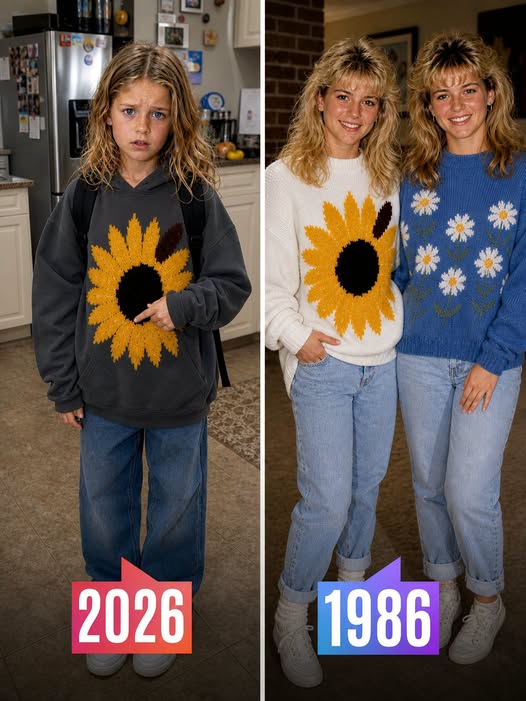
The ghost was not Laura herself, but the physical manifestation of the night she ceased to exist. I reached out, my trembling hands hovering over the coarse knit of the sweater until I touched the familiar, faded red initials near the collar: L.M. The room spun. I had spent forty years mourning a girl who had simply stepped into the night, a girl whose absence had carved a hollow space in the center of our family. My father had been the architect of that silence, a man who had folded his grief into a fortress of stone and refused to let anyone—not even his own wife—enter. I knelt before Sophie, my eyes burning, and followed her small, pointing finger to a tiny, concealed seam beneath the sunflower’s golden head. I pried it open, my heart hammering against my ribs like a trapped bird, and pulled out a small, hand-carved wooden rose. I recognized the grain immediately. It was the token my father had been whittling on the back porch the very night Laura vanished, his knife rhythmic and steady, his face a mask of impenetrable calm while the world outside searched for his missing child.
The days that followed were a blur of frantic, jagged movement. I drove to the care home, the wooden rose burning a hole in my pocket. My father sat by the window, his gaze fixed on a horizon he had spent four decades trying to erase. When I placed the wooden rose on his tray, he did not cry. He did not gasp. He simply looked at it, then at me, his eyes clouded with the terrible, weary clarity of a man who has held a secret for too long. I demanded the truth, my voice cracking under the pressure of forty years of unanswered questions. He spoke then, his voice a dry, rasping whisper that seemed to come from a great distance. He told me that Laura had not run away to escape us; she had run away to find a life that felt like her own, but the world had proven colder than she anticipated. She had returned to our doorstep three days after her sixteenth birthday, shivering and desperate, only to find him waiting in the shadows of the porch.
He told me, with a chilling detachment that made my blood run cold, that he had turned her away. He had convinced himself that her return would be a scandal, a stain on the family name, or perhaps he simply feared the vulnerability of a daughter who had dared to reject his control. He had given her a small amount of cash and told her never to come back, watching her walk down the driveway until she was nothing more than a silhouette against the twilight. He had kept the sweater she left behind, a trophy of his own cruelty, and eventually, through a series of strange, disconnected events involving the school’s new custodian—a woman who had once been a friend of Laura’s—the garment had found its way back to my home. The revelation was not a sharp blade, but a slow, agonizing poison that seeped into every memory I held of my childhood. The man I had defended, the man I had pitied for his supposed heartbreak, was the very person who had severed the final thread of hope.
I left the care home without saying goodbye. The drive back was silent, the landscape blurred by tears that felt like they were decades overdue. When I returned home, I found Sophie in the living room, sketching sunflowers on a piece of paper. She looked up and smiled, her innocence a stark, beautiful contrast to the darkness I had just unearthed. I sat beside her, the weight of the truth pressing down on my chest, and realized that the mystery was finally solved, but the resolution brought no comfort, only a profound, hollow exhaustion. I had spent my life waiting for a sign, a clue, a reason for the disappearance, and now that I had it, I understood that some secrets are not meant to be uncovered. They are meant to be buried, along with the people we once were.
In the weeks that followed, I found a strange, quiet peace in the wreckage. I did not go back to see my father; there was nothing left to say to a man who had built his life on such a profound betrayal. Instead, I focused on the living. I taught Sophie how to knit, though I could never bring myself to pick up the yellow yarn again. I watched her grow, seeing flickers of Laura in the way she tilted her head or the sudden, infectious bursts of laughter that echoed through the house. I kept the sweater in a cedar chest, a relic of a girl who had been brave enough to try to come home, and a reminder of the man who had denied her that mercy. I realized that my grief had been a cage, and while the truth was a harsh key, it was a key nonetheless. I stopped looking for Laura in every passing car or every ringing phone. I let her go, not because I had forgotten her, but because I finally understood that she had been trying to find her own way, and my father’s interference was a tragedy that belonged to him, not to her or to me.
The finality of the discovery allowed me to breathe again. I stopped jumping at shadows. I stopped waiting for the impossible. I found that I could hold the memory of my sister and the reality of my granddaughter in the same space without the two colliding. The sunflower sweater remained in the drawer, a silent witness to a past that was now firmly behind me. I realized that the story of my life was not defined by the disappearance, but by what I chose to do with the time that remained. I moved forward, carrying the weight of the truth, but no longer defined by it. I had survived the silence, and in the end, that was the only victory that mattered. The mystery was resolved, the betrayal acknowledged, and for the first time in forty years, I was finally, truly, moving toward a future that belonged entirely to me.