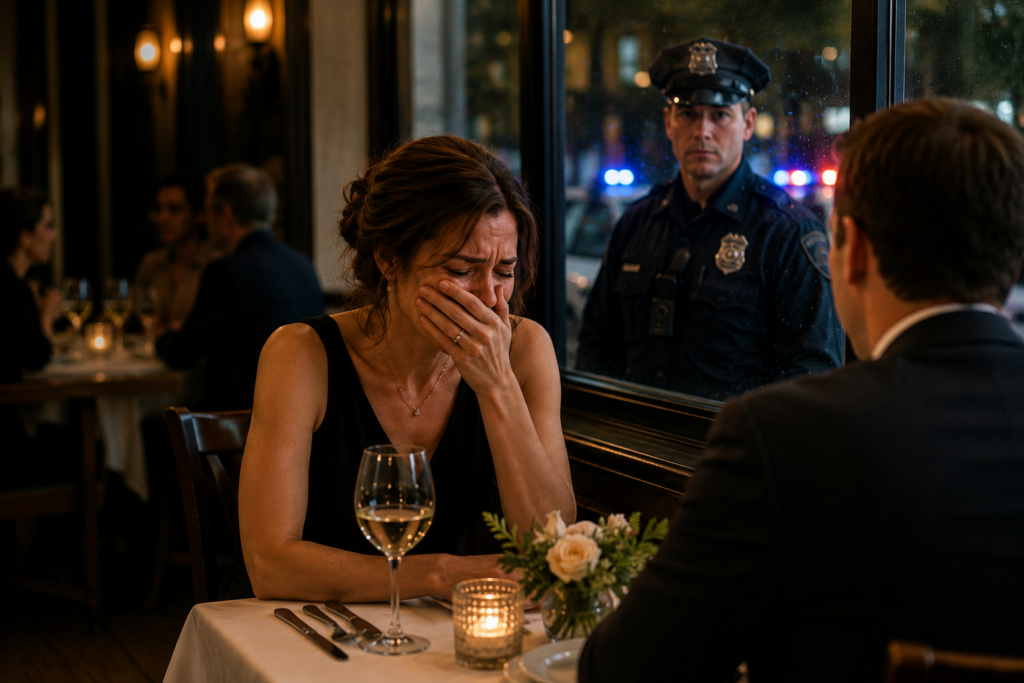
There was only a revelation.
And I wanted that revelation delivered in a way he could not minimize, rewrite, or explain away later.
Janet walked into the restaurant, crossed the room, and stopped beside the window table where Grant was sitting with Vivian.
Then she said, calmly and clearly, “Mr. Wilson, your wife was in a serious car accident this evening. She is at Lakeshore General with a dislocated shoulder and a concussion. She has been trying to reach you for three hours.”
Janet told me later that the entire restaurant went silent.
Forks paused halfway to mouths.
Conversations stopped.
Even the servers seemed to freeze.
Vivian’s hand slipped away from Grant’s sleeve.
Grant just stared at Janet.
For ten years, he had been able to keep his choices private.
A missed call could be explained.
A delayed text could be softened.
A lie could be reshaped into something more convenient.
But this was different.
His decision had just been spoken aloud in front of strangers.
His wife had been pulled from a wrecked car.
She had spent hours trying to reach him.
And he had stayed at lunch.
Grant stood so quickly he nearly knocked over his chair.
“I’m going now,” he stammered.
Janet looked at him.
“I think that’s between you and her now.”
Then she turned and walked out.
But according to Janet, it was what happened after she left that destroyed the life Grant had spent months carefully balancing.
Vivian turned toward him.
Her face had completely changed.
“You told me you two were basically separated.”
Grant tried to answer.
She didn’t let him.
“You said she didn’t care what you did.”
“Vivian—”
“You let me sit here every Thursday believing I wasn’t the other woman.”
The nearby tables were still silent.
Grant lowered his voice.
“Can we not do this here?”
Vivian stared at him.
“Apparently you’ve been doing all of it here.”
Then she grabbed her coat.
Grant reached for her arm.
She pulled away.
“Don’t.”
And she walked out.
Grant was left alone at the window table he had chosen over his injured wife.
For six months, he had been maintaining two separate stories.
One for me.
One for Vivian.
To me, he was simply busy.
Distracted.
Working late.
Having lunch with colleagues.
Going through a difficult period.
To Vivian, apparently, he was a man trapped in a dead marriage, waiting for the right moment to leave.
Neither story was true.
And in less than five minutes, both collapsed.
For the first time, there was nowhere left for him to hide.
No convenient half-truth.
No carefully worded text.
No promise that tomorrow would somehow be different.
About forty minutes later, Grant appeared at the hospital.
He came through the doorway breathless.
His face was pale.
His shirt was wrinkled.
And before he even reached the bed, he started explaining.
“Vivian was having a crisis.”
I said nothing.
“I didn’t realize how serious the accident was.”
Still nothing.
“The text came across differently than I meant it.”
I watched him.
For years, that had been our pattern.
Grant explained.
I listened.
Grant softened what happened.
I adjusted my feelings to make room for his version.
He would say he hadn’t meant something that way.
That I had misunderstood.
That he had been under pressure.
That I was turning a small issue into something bigger.
And eventually, I would wonder whether I really was overreacting.
That night, lying in a hospital bed with my shoulder immobilized and a headache pounding behind my eyes, I finally let him talk until he ran out of words.
Then I said, “When they pulled me out of that car, the first person I asked for was you.”
Grant stopped.
I looked directly at him.
“It was raining.”
My voice remained calm.
“There was broken glass everywhere. I couldn’t move my arm. I didn’t even know if I had internal injuries yet.”
He looked down.
“And the first name I called was yours.”
“Beverly—”
“No.”
I had listened long enough.
“I texted you because I was scared.”
He swallowed.
“I know.”
“No. You know now.”
I could feel the anger sitting somewhere deep inside me.
But it no longer felt wild.
It felt clear.
“Your answer was lunch.”
His eyes filled.
“I didn’t mean it like that.”
“It doesn’t matter how you meant it.”
He looked at me.
“That was your answer.”
He sat down slowly.
“I made a mistake.”
I shook my head.
“A mistake is forgetting milk.”
His face tightened.
“A mistake is being late.”
I held his gaze.
“This was a choice.”
He looked like he wanted to argue.
Then stopped.
“You knew I had been in an accident.”
“Yes.”
“You knew I was at the hospital.”
“Yes.”
“You knew I was asking you to come.”
He covered his face.
“Yes.”
“And you stayed.”
Silence.
There it was.
No interpretation.
No misunderstanding.
Just a fact.
For years, I had wondered where I ranked in my own marriage.
That evening, I finally received the answer.
I wasn’t going to scream.
I wasn’t going to throw anything.
I had already done my crying.
I had cried alone under fluorescent hospital lights while staring at the cracked screen of my phone.
I had cried with dried blood still tangled in my hair.
I had cried because the one person I believed would always show up had chosen not to.
By the time Grant reached the hospital, there was almost nothing left except certainty.
“I want a divorce.”
His hands dropped from his face.
“What?”
“I want a divorce.”
“Don’t say that right now.”
“I’ve never been more certain about anything.”
“You’re hurt. You’re angry.”
“Yes.”
“You’ve had medication.”
I almost laughed.
There he was again.
Trying to find some explanation that made my decision less real.
“This isn’t the medication.”
“Then wait until tomorrow.”
“No.”
“Beverly.”
“No more tomorrow.”
He stared at me.
I had said some version of that word countless times during our marriage.
Tomorrow we’ll talk.
Tomorrow things will be better.
Tomorrow Grant will understand.
Tomorrow I’ll finally explain why this hurts.
Tomorrow he’ll choose me.
I was done waiting for tomorrow.
“You didn’t end our marriage tonight,” I said quietly.
He flinched.
“You just made me finally understand what it had already become.”
Grant began crying.
Once, that would have changed me.
I would have softened.
Comforted him.
Started questioning whether I was being too harsh.
That night, I simply watched him.
“I love you,” he said.
“I believe you think you do.”
“That’s not fair.”
“Neither was lying to two women for six months.”
His face changed.
So Janet had been right.
Vivian had told him exactly what she knew before leaving.
“You talked to her?”
“I didn’t need to.”
I looked toward the door.
“She found out the same way I did.”
Grant said nothing.
“She found out you were lying when somebody finally said the truth out loud.”
My sister arrived shortly afterward.
She didn’t ask me for details.
That mattered more than I can explain.
She walked into the room carrying my coat, a thermos of soup, and a phone charger.
“I brought the gray one,” she said.
I blinked.
“What?”
“Your coat. The gray one is warmer.”
That was it.
No interrogation.
No dramatic speech.
No demand that I explain why Grant was sitting silently in the corner.
She simply showed up.
When the nurse helped me into a wheelchair, my sister pushed me toward the elevator.
Grant followed us into the hallway.
“Can we talk tomorrow?”
I looked back at him.
“No.”
His face fell.
“Then when?”
“When I’m ready.”
That answer felt strange in my mouth.
Strong.
For years, Grant’s urgency had determined the timing of every conversation.
That night, mine did.
My sister drove me home.
She heated soup.
Found extra pillows for my shoulder.
Set water on the nightstand.
Then she sat beside me without asking anything.
At some point, I said, “He didn’t come.”
She looked at me.
“I know.”
“I was in a wreck and he didn’t come.”
Her eyes filled.
“I know.”
And suddenly, I understood something I should have understood years earlier.
Showing up was not complicated.
It didn’t require perfect words.
It didn’t require fixing everything.
Sometimes it was soup.
A coat.
A ride home.
A chair beside the bed.
Somewhere during ten years of marriage, I had forgotten that I deserved that.
The divorce turned out to be far cleaner than I expected.
Perhaps Grant understood that fighting me would only expose more than he wanted exposed.
Perhaps Vivian walking away had finally forced him to confront what he had done.
Maybe he was simply tired.
Whatever the reason, he didn’t contest much.
I kept the house.
He moved into an apartment across town.
Vivian never went back to him.
She sent me one message several weeks later.
It said only, “I’m sorry. I truly didn’t know.”
I believed her.
Grant had lied to both of us.
I didn’t need to turn another deceived woman into my enemy simply because he had placed us on opposite sides of his story.
A month after the accident, I returned to work.
My shoulder was still in a brace.
My head still occasionally ached.
And my five-year service dinner at the pharmacy had been rescheduled.
For a moment, I considered skipping it.
Then I remembered the old version of myself.
The woman who would have stayed home because she didn’t want anyone asking questions.
The woman who worried more about other people’s comfort than her own.
So I went.
I wore a simple blue dress that fit over the brace.
My sister came.
So did Janet.
When my name was called, I walked carefully toward the stage.
The room applauded.
I accepted the plaque.
Five years.
It wasn’t some enormous achievement.
But standing there beneath the lights, I realized how much of my own life I had allowed to become background noise.
My work.
My friendships.
My needs.
My dignity.
Grant’s problems had always seemed more urgent.
Grant’s moods had always taken up more space.
Grant had always assumed the marriage would wait.
That I would wait.
That no matter how many times he failed to show up, I would still be there when he finally decided to return.
My sister started clapping louder.
Janet joined her.
I laughed.
Then the rest of the room applauded harder too.
For the first time in weeks, I felt light.
Grant lost the marriage he believed would always be available to him.
But that wasn’t really the ending.
The ending was me understanding that his absence did not have to become mine.
I had spent years waiting for someone else to choose me.
It took a car accident, a hospital bed, and one brutally simple text to realize I could do it myself.
Leaving Grant wasn’t the moment my life fell apart.
It was the moment I finally began showing up for it.
{"post":111153,"page":2,"next":[{"id":111148,"title":"Widow Discovers Her Missing Husband Traveling Under Fake Name During Flight","url":"https:\/\/new24.info\/111148"},{"id":111144,"title":"If you see window grills with a curve at the bottom here\u2019s what it means","url":"https:\/\/new24.info\/111144"},{"id":111141,"title":"Dolly Parton, 80, private final days revealed as family insider shares why she stepped away from the spotlight","url":"https:\/\/new24.info\/111141"},{"id":111133,"title":"I Spent Two Weeks in the Hospital, and My Husband Never Visited Me Once \u2013 When I Finally Came Home and Opened the Front Door, I Stood There Staring in Disbelief","url":"https:\/\/new24.info\/111133"},{"id":111134,"title":"Military Mother Discovers Shocking Conspiracy Behind Her Mistreated Daughter And Fights Back","url":"https:\/\/new24.info\/111134"},{"id":111130,"title":"My MIL Said I \u0027Ate Too Much for the Beach\u0027 and Laughed When Everyone Agreed \u2013 By Sunset, She Was Screaming, \u0027How Could You Do This to Me?!\u0027","url":"https:\/\/new24.info\/111130"},{"id":111127,"title":"My Twin Sister Vanished on Our Birthday\u2014Years Later, Her Sweater Revealed a Family Mystery","url":"https:\/\/new24.info\/111127"},{"id":111120,"title":"Brigitte Bardot blamed her son for not giving her the maternal instinct \u2013 cut all contact for decades","url":"https:\/\/new24.info\/111120"},{"id":111117,"title":"The Hidden Costs of Deception: Why Supermarket Meat Labels Are Failing to Tell the Truth","url":"https:\/\/new24.info\/111117"},{"id":111114,"title":"Test Your Sharp Eyes With This Cozy Bedroom Hidden Object Challenge","url":"https:\/\/new24.info\/111114"},{"id":111111,"title":"Clarifying the Truth Regarding Dolly Parton and Her Recent Public Appearances","url":"https:\/\/new24.info\/111111"},{"id":111107,"title":"After Four Months Without Work, My Husband Finally Got a Job \u2013 Just Hours Into His First Day, He Came Home Pale and Refused to Tell Me What Happened","url":"https:\/\/new24.info\/111107"},{"id":111104,"title":"My 16-Year-Old Daughter Saved $4,000 All Summer for Her First Car \u2013 Then She Told Me Who She\u0027d Given It All To, and I Couldn\u0027t Say a Word","url":"https:\/\/new24.info\/111104"},{"id":111101,"title":"My Neighbor Covered My Car in Concrete for \u0027Blocking Her Lake View\u0027 \u2013 Then My 8-Year-Old Daughter Wiped the Smile off Her Face","url":"https:\/\/new24.info\/111101"},{"id":111098,"title":"Which Shoes Match This Dress Best? \u2013 Wake Up Your Mind","url":"https:\/\/new24.info\/111098"},{"id":111096,"title":"The Cream Envelope In My Purse That Revealed Which Daughter Had Been Erasing The Other","url":"https:\/\/new24.info\/111096"},{"id":111090,"title":"Before her death, Dolly Parton revealed the name she had chosen for her unborn daughter","url":"https:\/\/new24.info\/111090"},{"id":111086,"title":"Dolly Parton fans blown away by her real hair after years of seeing her in wigs","url":"https:\/\/new24.info\/111086"},{"id":111084,"title":"What Your Choice of Footwear Reveals About Your Inner Personality and Personal Style","url":"https:\/\/new24.info\/111084"},{"id":111081,"title":"Building Bridges: How to Foster Open Communication and Prevent Your Child from Facing Hidden Digital Pressures","url":"https:\/\/new24.info\/111081"}]}