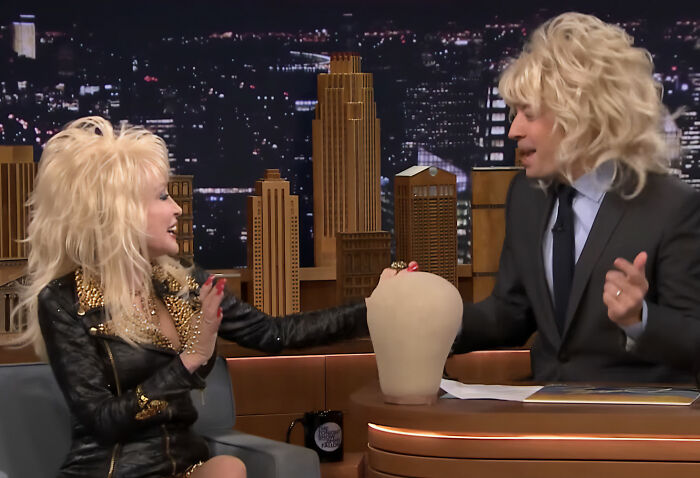
Big hair.
Rhinestones.
High heels.
Bright makeup.
And a confidence that made every part of the look feel unmistakably Dolly.
Following her death at 80 on August 25, fans began revisiting photographs and interviews from throughout her extraordinary life, including one rare image that showed what Parton looked like before her enormous wigs became part of the legend.
The difference immediately caught people’s attention.
Parton never tried to convince anyone that the huge blonde hairstyles she wore throughout her career were entirely natural.
In fact, she spoke openly about wigs for years and often turned the subject into a joke.
During a 2016 appearance on Hallmark Channel’s Home & Family, Parton explained that she originally tried to create the same dramatic volume using her own hair.
The combination of constant teasing and bleaching eventually became too damaging.
“I used to try to keep my own hair teased as big as I like it, and having the bleach and all of that, it just broke off,” she explained.
Eventually, Parton realized there was a much easier solution.
Wigs.
“I thought, ‘Why am I going through all that? Why don’t I just wear wigs?’” she recalled.
The decision solved several problems at once.
Her natural hair could stay protected, she could achieve the exaggerated volume she loved, and she no longer had to worry about whether her hair would cooperate before a performance.
Parton summed it up perfectly:
“That way, I never have a bad hair day! I have a big hair day, but not a bad hair day.”
It became one of countless examples of Parton’s ability to laugh at the very things that helped create her famous image.
But underneath the jokes was something more deliberate.
Parton’s appearance was never accidental.
She knew exactly how she wanted Dolly Parton to look.
In her memoir Dolly Parton, Songteller, she explained that she embraced wigs because she wanted her appearance to match the version of herself she had imagined.
She wanted to “look like the dream I carried in my head.”
That dream eventually became one of the most recognizable images in entertainment history.
The blonde hair grew higher.
The clothes became brighter.
The rhinestones multiplied.
And Dolly became Dolly.
Yet the wigs also served another purpose.
They offered consistency and, in a sense, protection.
Parton once described them as her “armor.”
“My wigs are my armor,” she said.
Beneath them, she continued taking care of her natural hair.
Parton revealed that she sometimes allowed it to grow long enough to braid, although she rarely appeared publicly that way and never intended to replace her stage wigs with her natural hair.
The elaborate hairstyles belonged to the performer.
The woman underneath them could remain largely private.
That distinction became especially amusing inside Parton’s marriage.
Carl Dean, her famously private husband of nearly six decades, apparently had no hesitation about teasing his wife over her enormous blonde hair.
Parton once revealed that Dean compared her appearance to a Q-Tip.
Because Dolly was so petite and her wigs could be so enormous, Dean thought the proportions were hilarious.
“When I wear this big hair, because I’m so tiny, my husband always says I look like a Q-Tip,” Parton recalled.
Then, laughing at herself, she added:
“It’s nothing but a big white wad on my head!”
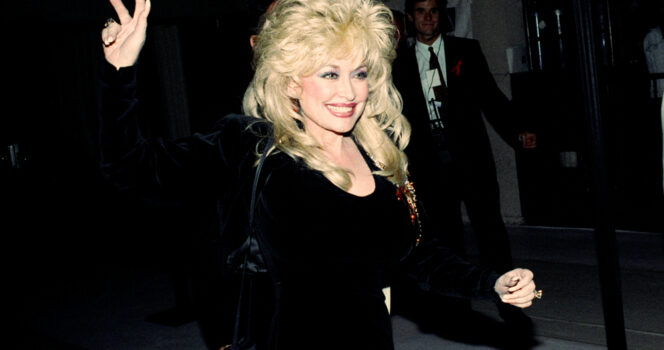
It was exactly the kind of private joke that seemed to define their relationship.
While the world treated Dolly Parton as an icon, Dean could still look at her extravagant stage appearance and make fun of her hair.
Their marriage began in 1966, long before Parton became an international superstar, and Dean spent almost the entirety of their relationship avoiding the celebrity spotlight.
He rarely appeared at major events and preferred an ordinary life away from cameras.
Parton often said that arrangement helped their marriage survive.
Dean died in March 2025 after nearly 60 years with Dolly.
Following his death, Parton spoke publicly about the depth of their relationship.
“Words can’t do justice to the love we shared,” she said.
She later thanked fans for sending messages, flowers and cards while she grieved.
“He is in God’s arms now and I am okay with that,” she wrote, before ending with words that had become inseparable from her career and her life:
“I will always love you.”
The loss gave some of Parton’s stories about Dean — including his Q-Tip joke — a more emotional meaning.
But decades before he was teasing her about towering wigs, there was simply a young Dolly Parton trying to build a career.
One photograph in particular has fascinated fans.
Parton previously shared a black-and-white image believed to date from around 1965, when she was still at the beginning of her journey in Nashville.
The photograph shows a young Parton inside a recording booth wearing a simple white sweater.
There are no towering curls.
No enormous stage wig.
No elaborate rhinestones.
Her natural blonde hair is swept away from her face and falls softly around her shoulders.
Parton captioned the photograph:
“Making music was my very first true love!”
For fans accustomed to seeing decades of enormous blonde hairstyles, the picture offered a rare look at the woman before the familiar Dolly Parton image had fully formed.
And people loved it.
“Wow Dolly! I absolutely love your natural hair! You are beyond gorgeous!” one person wrote.
Another fan commented that Parton looked beautiful regardless of whether she was wearing one of her trademark wigs.
“Dolly Parton looks very pretty even without a big wig,” the person wrote, adding that the huge blonde hairstyles had understandably become her trademark over the years.
“She is very pretty with or without her big hair.”
Others saw something deeper in the photograph.
For them, Parton’s appeal had never depended on wigs or rhinestones in the first place.
One admirer praised her grace and suggested that younger generations could learn from the way she carried herself throughout her life.
That may be why the rare photograph remains so striking.
It doesn’t reveal a completely different Dolly Parton.
It reveals an earlier version of the same person.
Before the wigs became enormous.
Before the rhinestones covered nearly everything.
Before Dollywood, Hollywood movies and global superstardom.
There was a young woman in a recording studio whose greatest obsession was already music.
The extravagant image would come later.
Parton eventually learned how to turn appearance into part of the performance without ever taking herself too seriously.
She openly admitted that her hair wasn’t real.
She joked about plastic surgery.
She laughed when her husband compared her to a Q-Tip.
And she understood that the exaggerated version of Dolly Parton people saw in public was something she had consciously created.
But she never seemed embarrassed by that.
Quite the opposite.
The wigs allowed her to become the person she had once imagined.
They were glamorous, funny, practical and protective all at once.
They became her “armor.”
Yet the rare photographs underneath that armor serve as a reminder that the hairstyle was never the reason people stayed.
The hair may have caught their attention.
The rhinestones may have made her unforgettable.
But it was Parton’s music, humor, generosity and warmth that ultimately made millions of people feel connected to her.
The young woman with natural blonde hair standing inside that recording booth could not yet have known exactly how enormous her life would become.
She could not have known that one day people would identify her silhouette from across a room.
She could not have known that the wigs she chose partly for convenience would become one of the most recognizable trademarks in entertainment.
But she already knew what mattered most.
“Making music was my very first true love.”
Everything else — including that legendary mountain of blonde hair — became part of the extraordinary character she built around it.
{"post":111086,"page":2,"next":[{"id":111084,"title":"What Your Choice of Footwear Reveals About Your Inner Personality and Personal Style","url":"https:\/\/new24.info\/111084"},{"id":111081,"title":"Building Bridges: How to Foster Open Communication and Prevent Your Child from Facing Hidden Digital Pressures","url":"https:\/\/new24.info\/111081"},{"id":111078,"title":"The Secret Contract That Redefined My Sister\u2019s Life and My Family\u2019s Future","url":"https:\/\/new24.info\/111078"},{"id":111068,"title":"Dolly Parton\u0027s Tribute Responses Leave Fans Divided \u2014 One Touched Hearts, Another Sparked Outrage","url":"https:\/\/new24.info\/111068"},{"id":111066,"title":"Reflecting on the Final Public Appearances and Enduring Legacy of the Beloved Icon Dolly Parton","url":"https:\/\/new24.info\/111066"},{"id":111061,"title":"My 8-Year-Old Son Gave Up His Lunch Money to Buy a Little Girl with Down Syndrome a Red Birthday Dress \u2013 The Next Morning, Our Lawn Was Covered with Lunchboxes, but What Was Inside the Biggest One Made Him Go Pale","url":"https:\/\/new24.info\/111061"},{"id":111058,"title":"Every Graduate\u0027s Sibling Had to Make Them a Gift for Prom \u2013 I Worried About My Brother with Down Syndrome Until I Saw What He\u0027d Made Me","url":"https:\/\/new24.info\/111058"},{"id":111053,"title":"Remembering Peter Cullen: The Iconic Voice Behind Optimus Prime and Eeyore","url":"https:\/\/new24.info\/111053"},{"id":111050,"title":"A little girl called 911 crying: \u201cDaddy\u2019s snake is so big it hurts!\u201d\u2026","url":"https:\/\/new24.info\/111050"},{"id":111037,"title":"Dolly Parton Once Revealed the Life-Changing Discovery That Came After Her Surgery \u2014 and Why She Never Regretted It","url":"https:\/\/new24.info\/111037"},{"id":111035,"title":"Why Persistent Household Odors Demand Immediate Investigation Before Structural Damage Occurs Behind Your Drywall Surfaces","url":"https:\/\/new24.info\/111035"},{"id":111029,"title":"With heavy hearts, we announce the passing of this legendary man who became such a big part of our childhood.","url":"https:\/\/new24.info\/111029"},{"id":111027,"title":"The Quiet Strategy: Reclaiming My Life After My Children Left Me on a Remote Road","url":"https:\/\/new24.info\/111027"},{"id":111024,"title":"The Symbolic Significance of Placing Elephant Statues at Your Home Entrance","url":"https:\/\/new24.info\/111024"},{"id":111018,"title":"The Surprising Changes Men May Notice as They Get Older-","url":"https:\/\/new24.info\/111018"},{"id":111014,"title":"Mother-in-law Susan makes these 3 ingredient lifesavers for every school bake sale. I finally got her secret and the whole pan vanishes instantly.","url":"https:\/\/new24.info\/111014"},{"id":111010,"title":"24 Celeb Couples with Shocking Age Gaps Who Have Defied the Odds","url":"https:\/\/new24.info\/111010"},{"id":111006,"title":"Claims About Dolly Parton Are Circulating\u2014Here\u2019s What We Know","url":"https:\/\/new24.info\/111006"},{"id":111002,"title":"Slow Cooker Rice Pudding","url":"https:\/\/new24.info\/111002"},{"id":110998,"title":"Grandmothers Unexpected Warning Revealed Deep Family Secrets Moments Before The Wedding Vows","url":"https:\/\/new24.info\/110998"}]}