I looked at my eight-year-old son.
“Needs?”
He thought about it.
“Okay. Wants.”
I laughed.
“She hasn’t even seen it.”
Noah gave me that patient look children use when adults are clearly struggling with something obvious.
“She’d like it.”
“How do you know?”
“Because she’d look like a princess.”
Lucy lived next door with her mother, Hannah.
She was almost two, had Down syndrome, and had adored Noah practically from the moment she was old enough to recognize him.
Whenever he came through the gate, her entire face changed.
Noah brought her dandelions from our yard.
He drew terrible pictures of dogs for her.
He made ridiculous noises purely because they made her laugh.
If Lucy dropped a toy, Noah picked it up.
If she wanted to follow him around the patio, he slowed down so she could keep up.
To him, none of it was extraordinary.
Lucy was simply Lucy.
Hannah had been raising her alone since infancy, and money was often tight.
A few weeks before Lucy’s second birthday, Hannah and I were sitting on her patio drinking coffee while Lucy stacked plastic cups beside us.
“I’m not really doing a party this year,” Hannah admitted.
“Nothing?”
“Just cake here. Maybe a few balloons.”
She gave me a tired smile.
“We’ve had extra appointments lately. Therapy, travel, little expenses. Somehow everything costs something.”
I understood.
Later that evening, Noah asked why Lucy wasn’t having a “real birthday.”
I kept my explanation simple.
“Hannah has other things she needs to pay for right now.”
He glanced toward the neighboring house.
“Like helping Lucy learn stuff?”
“Exactly.”
Noah nodded.
I thought that was the end of it.
It wasn’t.
Over the next three weeks, my son became suspiciously economical.
The first warning sign came when I offered him five dollars for a snack after school.
“I’m good.”
I stared at him.
Noah had never been “good” when French fries were available.
“You don’t want anything?”
“Nope.”
“Want an extra dollar for later?”
He hesitated.
Then smiled.
“Sure.”
I should have known.
A few days later, he asked my husband, Cyril, how much he would pay him to rake the yard.
Cyril stared at him.
“You live here.”
“I know.”
“That’s generally why you rake our leaves.”
Noah remained serious.
“How much?”
Cyril looked at me.
“I respect the confidence.”
Soon, Noah was knocking on Mrs. Reynolds’s door asking whether she needed leaves collected too.
Then another neighbor.
And another.
He started storing crumpled bills inside an old pencil case beneath his bed.
I assumed he was saving for a toy.
Then one afternoon, I found lunch money sitting on his dresser.
Beside it was an old cafeteria receipt.
That evening, I waited until Noah was halfway through his homework.
“What did you eat for lunch today?”
He kept his eyes on the worksheet.
“School food.”
“What school food?”
Silence.
“Noah.”
He glanced toward the hallway.
Then he stood and disappeared into his bedroom.
I followed.
He dropped to his knees, reached underneath his bed, and pulled out the pencil case.
Thirty-eight dollars.
Before I could speak, he opened his closet.
Hanging from the door handle was a clear garment bag.
Inside was the red dress.
For several seconds, I just stared at it.
“You bought it?”
Noah smiled proudly.
“I got the last one.”
I looked from the dress to him.
“Buddy, have you been skipping lunch to save money for this?”
“Not every day.”
My heart sank.
“That is not helping your case.”
“But Lucy’s birthday is tomorrow.”
I sat beside him.
“Listen to me.”
His smile faded.
“Wanting to buy Lucy something beautiful is incredibly kind.”
He brightened slightly.
“But going hungry and hiding it from us is not okay.”
“I needed the money.”
“Then you ask us.”
“You might’ve said no.”
“Then you ask if you can earn it.”
“I did.”
“I know.”
He frowned.
“Mrs. Reynolds pays terrible.”
I laughed despite myself.
Then I pulled him against me.
“You never skip meals to prove you care about someone. Do you understand?”
He sighed against my shoulder.
“Okay.”
That evening, my mother-in-law stopped by.
Unfortunately, she happened to be standing in our kitchen when Noah came downstairs carrying the dress.
“Grandma, look.”
He proudly held it up.
“I bought this for Lucy.”
My mother-in-law smiled at first.
Then I explained how he’d managed to save enough money.
Her face changed immediately.
“You skipped lunches for that?”
Noah nodded.
She looked at the dress.
Then she laughed.
Not kindly.
“Oh, sweetheart. That’s such a waste of money.”
Noah’s smile disappeared.
I turned toward her.
“Excuse me?”
“She’s two.”
My mother-in-law shrugged.
“And with everything going on with her, she probably doesn’t even understand what a birthday is.”
The room became very still.
Noah stared at her.
“If you’re going to save money that hard,” she continued, “you should buy yourself something. Lucy won’t know the difference.”
Noah lowered the dress.
Then he said, very quietly, “She understands when somebody’s nice to her, Grandma.”
My mother-in-law opened her mouth.
Nothing came out.
Cyril had just walked in from the garage.
He’d heard enough.
“Mom.”
She raised both hands.
“Oh, don’t start. I’m being practical.”
Cyril walked over to Noah and crouched beside him.
He touched the garment bag.
“Good color, buddy.”
Noah looked at him.
“Yeah?”
“Absolutely. Lucy’s going to spin in that thing until she falls over.”
Noah smiled again.
My mother-in-law sighed.
“You people hear what you want.”
I pointed toward the front door.
“I think we’re finished for tonight.”
She stared at me.
“You’re asking me to leave over a dress?”
“No.”
I held her gaze.
“I’m asking you to leave because an eight-year-old showed more kindness than you did tonight.”
That ended the discussion.
The next afternoon, Hannah hosted perhaps the smallest birthday party I had ever attended.
Seven people.
Six balloons.
A grocery-store cake.
Paper plates that didn’t match the napkins.
Noah arrived carrying the red dress carefully in both hands.
“This is for Lucy.”
Hannah blinked.
“For her?”
“Open it.”
She unzipped the garment bag.
Then she looked at me.
“Adele, this is too much.”
“Noah bought it.”
My son corrected me immediately.
“I earned most of it.”
I raised an eyebrow.
He added, “And I’m not skipping lunch anymore.”
Cyril coughed into his fist to hide a laugh.
Hannah knelt in front of Noah.
“You bought this for Lucy?”
He nodded.
Her eyes began to shine.
“I think she’s going to love it.”
Twenty minutes later, Hannah brought Lucy outside wearing the dress.
Noah had been completely right.
The second Lucy realized the skirt moved, she grabbed both sides and spun.
The first attempt lasted approximately two seconds.
She stumbled sideways into Hannah’s legs.
Then immediately demanded another try.
Noah laughed so hard he had to sit down.
Lucy spun again.
Red fabric flew around her legs.
She squealed.
Everyone laughed.
Hannah wiped tears from her face.
That was when I noticed someone standing near the fence.
My mother-in-law.
She had come after all.
She watched Lucy spinning in the dress she had called a waste of money.
For once, she said absolutely nothing.
That night, after the party, Cyril found me standing in Noah’s bedroom doorway watching him sleep.
“Proud?” he asked.
“Very.”
I crossed my arms.
“Still furious about the lunch thing.”
“Same.”
We went to bed.
At 6:30 the next morning, Noah came charging into our bedroom.
“Mom! Dad!”
I sat upright.
“What happened?”
“You have to come outside!”
Something in his voice made Cyril’s feet hit the floor immediately.
We followed Noah through the hallway and out onto the porch.
Then all three of us stopped.
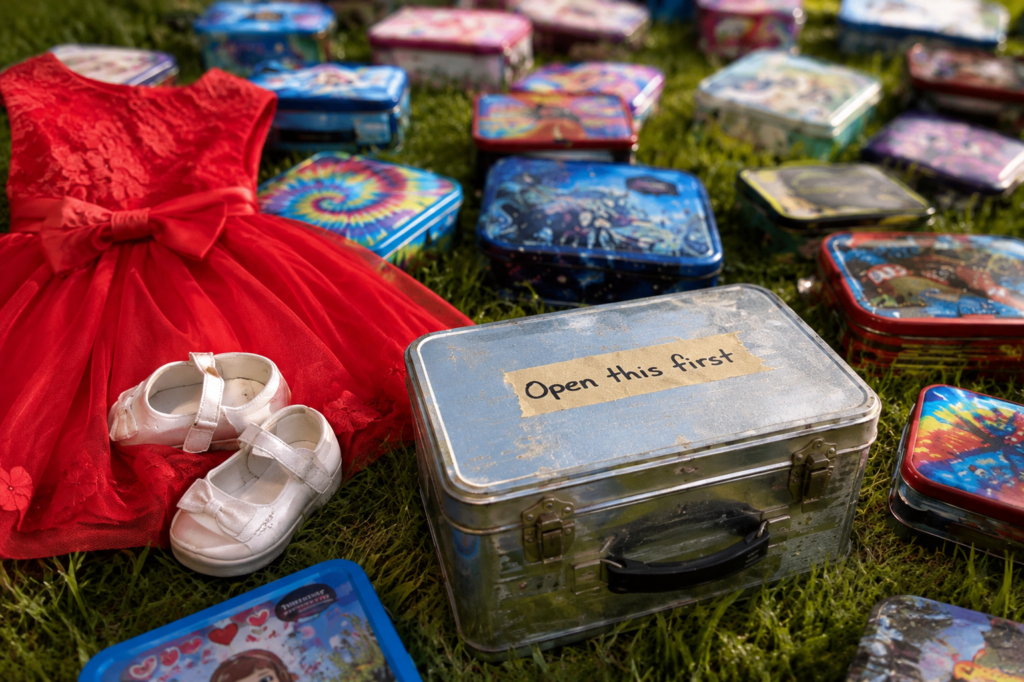
Our entire front lawn was covered in lunchboxes.
Dozens of them.
Maybe fifty.
Maybe more.
Dinosaurs.
Superheroes.
Princesses.
Plain metal boxes.
Bright insulated bags.
Old ones with scratched paint.
New ones with tags still attached.
They stretched from the porch almost all the way to the sidewalk.
Noah turned slowly.
“Are these all mine?”
“I sincerely hope not.”
Cyril stepped outside.
“What in the world…”
Then Noah spotted one lunchbox sitting by itself in the middle of the yard.
It was huge.
An old battered metal box that looked more like a toolbox than something meant to carry sandwiches.
A white card had been taped across the lid.
OPEN THIS FIRST.
“Noah, wait.”
Too late.
He ran toward it and dropped to his knees.
The metal clasp popped open.
He lifted the lid.
And froze.
“Noah?”
He didn’t answer.
Then he scrambled backward so quickly that he nearly tripped over another lunchbox.
His face had gone pale.
“Mom.”
I hurried over.
Inside were several thick bundles of cash.
A work identification badge belonging to a woman I didn’t recognize.
A key with a bright plastic tag.
And a wedding photograph.
For one horrifying second, my brain went somewhere very dark.
Noah pointed at the money.
“Mom, somebody left all their stuff here.”
Then he looked up at me.
“Call the police.”
“Please don’t!”
The voice came from the sidewalk.
I spun around.
A woman was hurrying toward us, waving both hands.
She looked to be in her thirties.
And I noticed immediately that she had Down syndrome.
Behind her stood several adults.
Hannah was among them.
Lucy was in her arms.
Still wearing the red dress.
Noah pointed accusingly at the giant lunchbox.
“Why is your money in my yard?”
The woman stopped.
She looked inside.
Then back at Noah.
“Because apparently I did a terrible job making this look less like a crime scene.”
Cyril covered his mouth.
Noah did not look amused.
The woman pointed toward the identification badge.
“That’s me.”
She smiled.
“I’m Tessa.”
Noah narrowed his eyes.
“You put all that money there?”
“With supervision.”
She glanced at me.
“Apparently eight-year-olds are very suspicious accountants.”
Now Cyril laughed.
Hannah stepped forward.
“The lunchboxes came from families connected to the community center.”
I stared at her.
“What community center?”
“The one Lucy goes to sometimes.”
She shifted Lucy on her hip.
“I posted a picture of Lucy in the dress last night.”
Noah looked betrayed.
“You told everybody I skipped lunch?”
“I told them what you did.”
Hannah smiled.
“Including the part where your mother said you were never allowed to do that again.”
“Good.”
Tessa crouched beside the giant metal lunchbox.
“This one belongs to me.”
She tapped the money.
“And that isn’t for you.”
Noah visibly relaxed.
“Okay.”
“It’s for a weekend program we’ve been trying to start.”
She looked toward the other families.
“We’ve been raising money for months. We were close, but we hadn’t reached enough.”
Noah stared across the lawn.
“What are all the lunchboxes for?”
Tessa smiled.
“Because you gave up yours.”
He frowned.
Hannah explained.
“When people heard what you did for Lucy, somebody said that if one kid could give up his lunches because he wanted another kid to feel special, maybe everyone else could help finish something that would make a lot of kids feel special.”
Tessa spread her arms toward the lawn.
“So they did.”
Twenty minutes later, we were inside the neighborhood community center.
That was when everything finally made sense.
The weekend program would bring children with Down syndrome together with siblings and friends for activities that had nothing to do with appointments, evaluations, milestones, or what anyone thought they should be learning.
Art.
Music.
Cooking.
Gardening.
Dancing.
Games.
Just things children might enjoy.
The lunchboxes on our lawn had been borrowed from people connected to the center.
Each represented someone’s ordinary life.
One contained dance shoes.
Another held gardening gloves.
Another had an old library card and several pens.
Tessa opened her battered lunchbox again.
First, she picked up the employee badge.
“I’ve worked at the same bakery for seven years.”
Then she lifted the key.
“My apartment.”
Finally, she picked up the wedding photograph.
“And my husband.”
Noah studied it.
“You’re married?”
“Yep.”
She sighed dramatically.
“He snores.”
Noah nodded with complete seriousness.
“So does Dad.”
Cyril looked offended.
“Betrayal.”
Noah studied the objects again.
“So all those are yours?”
“All mine.”
Tessa ran one finger across the badge, key, and photograph.
“I brought them because when I was little, people had a lot of ideas about what I might never do.”
Noah listened carefully.
“Have a job.”
She touched the badge.
“Live by myself.”
She touched the key.
“Get married.”
She picked up the photograph.
Then she smiled.
“Turns out people don’t always know as much about somebody else’s future as they think they do.”
Just then, Lucy toddled toward Noah.
She grabbed both sides of her red skirt.
And spun.
Noah laughed.
My mother-in-law had entered the room quietly behind us.
She stood near the doorway watching Lucy.
Noah noticed her.
“See?”
She looked at him.
“See what?”
“She understood.”
For half a second, I almost corrected him.
Because of course a two-year-old didn’t understand the meaning of birthdays, sacrifice, money, or everything Noah had done.
Then I realized that wasn’t what he meant.
Lucy understood joy.
She understood that people she loved were smiling at her.
She understood the dress made everyone laugh when she spun.
She understood kindness in exactly the way Noah had said she would.
My mother-in-law looked at Lucy.
Then at Noah.
Finally, she nodded.
“She did.”
Hannah was standing beside me twisting a tissue between her fingers.
“The money really was tight,” she said quietly.
I looked at her.
“But?”
She watched her daughter.
“That wasn’t the only reason I kept the birthday small.”
Her eyes filled.
“I spend so much time thinking about what Lucy needs.”
She swallowed.
“What should we practice? What appointment is next? What therapy might help? What will make things easier for her later?”
Lucy spun again.
Hannah smiled through her tears.
“I forgot to ask what might just make her happy now.”
Across the room, Tessa handed Noah a brand-new lunchbox.
He opened it.
Inside was a sandwich.
Fruit.
Juice.
And a cookie.
He frowned.
“It’s just lunch.”
Tessa smiled.
“Exactly.”
Cyril crouched beside him.
“Buddy, next time you decide to save the world, tell your parents before you stop eating.”
Noah rolled his eyes.
“I wasn’t saving the world.”
Cyril glanced around the room.
“Apparently nobody told these people.”
Later, someone brought cake over for Lucy.
My mother-in-law opened her mouth.
“She probably doesn’t…”
Then she stopped herself.
She looked at Hannah instead.
“Can she have some?”
Hannah smiled.
“Absolutely.”
It wasn’t a dramatic apology.
It wasn’t a speech.
But somehow that tiny question meant more.
She had stopped deciding what Lucy could understand.
What Lucy could enjoy.
What Lucy needed.
She had simply asked.
By evening, our lawn was empty again.
The borrowed lunchboxes had returned to their owners.
There were no reporters.
No cameras.
No giant ceremony.
Just our porch.
A warm breeze.
And Noah sitting beside Lucy with his new lunchbox open on his lap.
Lucy reached for his sandwich.
He pulled it away.
“Lucy. Mine.”
She reached again.
Noah sighed like a seventy-year-old man who had been inconvenienced for the last time.
Then he tore off a small piece and handed it to her.
I raised an eyebrow.
He immediately took a huge bite from the remaining sandwich.
With his mouth completely full, he said, “I’m eating too, Mom.”
I laughed.
Lucy took her piece of sandwich and somehow managed to smear jelly across the front of her beautiful red dress.
My hand moved automatically toward the stain.
Then I stopped.
Lucy was laughing.
Noah was laughing.
The red skirt was wrinkled from spinning.
There was frosting near the bow.
Now jelly too.
The dress was no longer perfect.
And suddenly I understood that it was never supposed to stay perfect.
Noah hadn’t spent weeks earning money because he wanted Lucy to own a beautiful dress.
He wanted her to feel beautiful in it.
He wanted her to spin.
To laugh.
To make a mess.
To be celebrated without anyone asking what she understood or what she might someday be capable of.
So I left the jelly exactly where it was.
The dress was doing precisely what my eight-year-old had bought it to do.
{"post":111061,"page":2,"next":[{"id":111058,"title":"Every Graduate\u0027s Sibling Had to Make Them a Gift for Prom \u2013 I Worried About My Brother with Down Syndrome Until I Saw What He\u0027d Made Me","url":"https:\/\/new24.info\/111058"},{"id":111053,"title":"Remembering Peter Cullen: The Iconic Voice Behind Optimus Prime and Eeyore","url":"https:\/\/new24.info\/111053"},{"id":111050,"title":"A little girl called 911 crying: \u201cDaddy\u2019s snake is so big it hurts!\u201d\u2026","url":"https:\/\/new24.info\/111050"},{"id":111037,"title":"Dolly Parton Once Revealed the Life-Changing Discovery That Came After Her Surgery \u2014 and Why She Never Regretted It","url":"https:\/\/new24.info\/111037"},{"id":111035,"title":"Why Persistent Household Odors Demand Immediate Investigation Before Structural Damage Occurs Behind Your Drywall Surfaces","url":"https:\/\/new24.info\/111035"},{"id":111029,"title":"With heavy hearts, we announce the passing of this legendary man who became such a big part of our childhood.","url":"https:\/\/new24.info\/111029"},{"id":111027,"title":"The Quiet Strategy: Reclaiming My Life After My Children Left Me on a Remote Road","url":"https:\/\/new24.info\/111027"},{"id":111024,"title":"The Symbolic Significance of Placing Elephant Statues at Your Home Entrance","url":"https:\/\/new24.info\/111024"},{"id":111018,"title":"The Surprising Changes Men May Notice as They Get Older-","url":"https:\/\/new24.info\/111018"},{"id":111014,"title":"Mother-in-law Susan makes these 3 ingredient lifesavers for every school bake sale. I finally got her secret and the whole pan vanishes instantly.","url":"https:\/\/new24.info\/111014"},{"id":111010,"title":"24 Celeb Couples with Shocking Age Gaps Who Have Defied the Odds","url":"https:\/\/new24.info\/111010"},{"id":111006,"title":"Claims About Dolly Parton Are Circulating\u2014Here\u2019s What We Know","url":"https:\/\/new24.info\/111006"},{"id":111002,"title":"Slow Cooker Rice Pudding","url":"https:\/\/new24.info\/111002"},{"id":110998,"title":"Grandmothers Unexpected Warning Revealed Deep Family Secrets Moments Before The Wedding Vows","url":"https:\/\/new24.info\/110998"},{"id":110994,"title":"Hidden Route In My Late Husbands Truck Revealed Decades Of Family Secrets","url":"https:\/\/new24.info\/110994"},{"id":110988,"title":"Her sister reveals, Dolly Parton made one final selfless offer to her doctors","url":"https:\/\/new24.info\/110988"},{"id":110982,"title":"Miley Cyrus Reveals She Knows Exactly What Dolly Parton Would Want Her to Do Now","url":"https:\/\/new24.info\/110982"},{"id":110979,"title":"Doctors Reveal What Drinking Coffee Every Morning Really Does to Your Body \u2014 From Hormones and Heart Health to Digestion and Sleep","url":"https:\/\/new24.info\/110979"},{"id":110977,"title":"The Enduring Legacy and Global Appeal of the Name Sophia","url":"https:\/\/new24.info\/110977"},{"id":110974,"title":"Miley Cyrus Makes First Public Appearance Following the Passing of Her Godmother Dolly Parton","url":"https:\/\/new24.info\/110974"}]}